[News Culture] The sound of the piri has followed Gyeong-man Choi for most of his life. Now turning 80, the veteran musician is looking back on a career spent not only performing Korean folk music, but recovering repertories that had begun to disappear, organizing scattered melodies and passing what he learned to another generation.
A concert marking Choi’s 80th birthday, “Eight Decades of Resonance — Sansu Yechan,” will be held Sept. 20 at the National Gugak Center’s Yeakdang in Seoul. Fellow master musicians, longtime colleagues and students will join him for a program that doubles as both a birthday celebration and a survey of the folk traditions that have shaped his career.
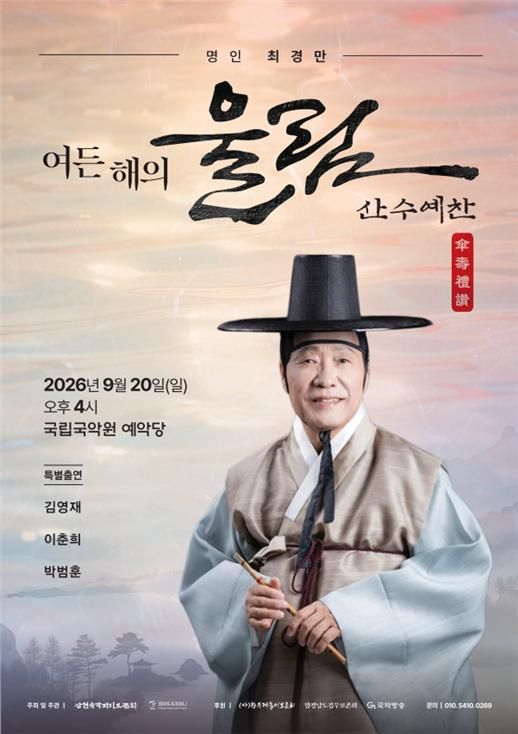
The piri has long occupied a central position in Korean wind ensembles, particularly in the samhyeon yukgak and daepungnyu traditions of Seoul and Gyeonggi Province. The taepyeongso, with its penetrating tone and considerable volume, developed a different but equally distinctive role in processional music, shamanic rites and outdoor performance.
Choi has spent decades working within both traditions. Building on music learned from his teacher Ji Yeong-hui, he studied and organized Seoul and Gyeonggi ensemble repertories including samhyeon yukgak and daepungnyu, as well as folk pieces such as pusal and gut pungnyu. His work also extended to pieces that had fragmented or largely disappeared during the course of transmission.
Performance and research were never separate strands of that career. Korean traditional music has historically depended heavily on direct transmission: musicians learn melodies from teachers, absorb rhythm and phrasing through repeated performance, and eventually pass that knowledge to their own students. Variations in melody, ornamentation and technique inevitably emerge along the way.
Choi worked inside that process while also documenting it.
During his tenure as artistic director of the National Gugak Center’s Folk Music Group, he drew on materials left by Ji to examine and reconstruct repertories from the Seoul and Gyeonggi traditions. Among those efforts was the restoration of Daeyeongsan, a work whose performance lineage had been in danger of disappearing.
Reconstructing such music involves more than recovering notes from an archive. Surviving documentation must be compared with the memories of musicians and the practical demands of performance before a piece can return to the stage. For Choi, restoration has therefore remained inseparable from performance and teaching: music recovered from the past has value as a living tradition only when musicians can play it again.
That philosophy runs throughout a career that has included service as artistic director of the National Gugak Center’s folk ensemble, president of the Samhyeon Yukgak Preservation Society and artistic director of the Chungnam Gugak Orchestra in Buyeo. His work has also ranged beyond the piri and taepyeongso to vocal composition, arrangement and singing.
“Sansu Yechan” reflects that breadth.
Choi opens the program with a taepyeongso solo, placing the instrument’s commanding tone and the performer’s control of breath and melodic phrasing at the center of the stage.
Students then join him for Daechwita and Gwanak Yeongsanhoesang. Daechwita, historically associated with military ceremonies and processions, brings together wind and percussion instruments including taepyeongso, nabal, nagak, buk and janggu. Gwanak Yeongsanhoesang, meanwhile, belongs to the wind-instrument branch of the broader Yeongsanhoesang tradition.
The concert also gives audiences a less familiar side of Choi: his voice.
Accompanied on janggu by his wife, master singer Ji-suk Yoo, he will perform Monggeumpo Taryeong and Yeongbyeonga. His vocalized instrumental syllables, or gueum, will also feature in Yeombul Pungnyu, revealing another dimension of a musician better known for shaping melodies through wind instruments.
A collaboration with master singer Chun-hee Lee, who is the same age as Choi, pairs voice and piri in an “Arirang” medley. The segment draws on the sound worlds of Gyeonggi and Seodo folk song, traditions connected with Seoul, Gyeonggi Province and the northwestern regions of the Korean Peninsula.
Another reunion reaches much further back. Masters Young-jae Kim and Beom-hun Park have known Choi since their school days, when the three began studying traditional music as teenagers. Their appearance together places decades of shared musical history on the same stage.
The program also includes a Hamgyeongnam-do sword dance for which Choi arranged the music. The work reflects the breadth of his engagement with folk performance, extending beyond instrumental repertory to the relationship between music and traditional dance.
Taken as a whole, the concert is less a collection of career highlights than a map of Choi’s musical life. It moves from taepyeongso solo to wind ensemble, from folk song to gueum, and from piri playing to music for dance, tracing the many areas of folk music he has encountered, studied and transmitted.
The title carries its own significance. Sansu, written with the Chinese characters 傘壽, is a traditional term for an 80th birthday, derived from the visual association between the character 傘 and the number 80.
For Choi, the milestone also offers a way of measuring the changes Korean folk music has undergone during his lifetime. As conditions for transmission and performance shifted, he worked in multiple roles — performer, teacher, researcher and artistic director — while continuing to bring older repertories into contemporary performance.
That cycle of learning, recovering, performing and teaching lies at the heart of the concert. Music passed down from a teacher, repertories returned to the stage and melodies entrusted to younger musicians all converge in a single program.
At 80, Choi’s piri is therefore not being presented simply as the sound of a long career. It stands at a point of transmission — carrying music received from an earlier generation toward the musicians who will take it forward.
Reported by News Culture M.J._mj94070777@nc.press
Copyright ⓒ 뉴스컬처 무단 전재 및 재배포 금지


