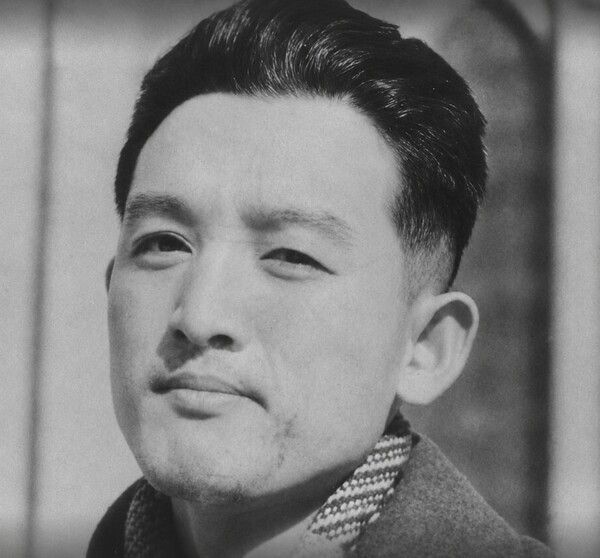
[News Culture] The year 2026 marks both the centenary of poet Park In-hwan’s birth and the 70th anniversary of his death.
For many Koreans, Park remains inseparable from “The Wooden Horse and the Lady” and “As Time Goes By,” works that helped establish his image as one of the defining romantic figures of postwar Korean literature. He is remembered as the stylish young poet who moved through the streets of Myeong-dong, immersed himself in Western literature and cinema, and died before reaching the age of 30.
That familiar portrait, however, captures only one aspect of Park’s life and work.
Over the course of just 29 years and seven months, he worked as a bookstore owner, newspaper reporter, war correspondent, shipping company employee, film critic and translator. His literary career lasted barely a decade, yet unfolded during one of the most turbulent periods in modern Korean history: liberation from Japanese colonial rule, national division, the Korean War and the anxiety of a devastated postwar society.
Park’s writing cannot be understood solely through the language of romance and melancholy.
Mari Seosa: A Literary Salon in Post-Liberation Seoul
Born on Aug. 15, 1926, in Inje, Gangwon Province, Park attended Deoksu Public Elementary School and Gyeonggi Public Middle School before entering Pyongyang Medical College in 1944.
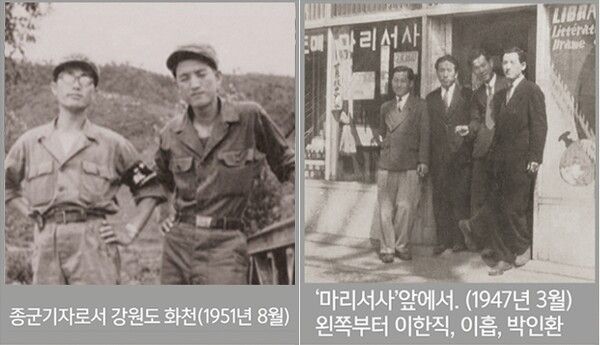
Liberation arrived on his 19th birthday in 1945. Park abandoned his medical studies and moved to Seoul, where he opened Mari Seosa, a bookstore near the entrance to Nagwon-dong in Jongno.
Mari Seosa was far more than a place to buy books. Stocked with Western literature and art publications, it became one of the intellectual centers of post-liberation Seoul. Writers and artists including Kim Ki-rim, Kim Gwang-gyun, Oh Jang-hwan and Kim Soo-young gathered there to discuss literature and emerging artistic movements.
After the bookstore closed in 1948, Park entered journalism, working for the Jayu Shinmun and Kyunghyang Shinmun and developing a career that continually bridged literature and the press.
Despite his reputation as an urban modernist, Park never entirely left Inje behind. His poetry repeatedly returned to the impoverished mountain town and its people. The countryside of his childhood served as a counterpoint to the cosmopolitan streets, foreign books and modern urban imagery that came to define his public persona.
Today, Inje County commemorates that legacy through the Park In-hwan Literary Museum and annual memorial events dedicated to the poet.
Before “Street,” There Was “Fault”: The Emergence of a Modernist
For decades, literary scholarship identified “Street,” published in the Kukje Shinbo in December 1946, as Park’s literary debut.
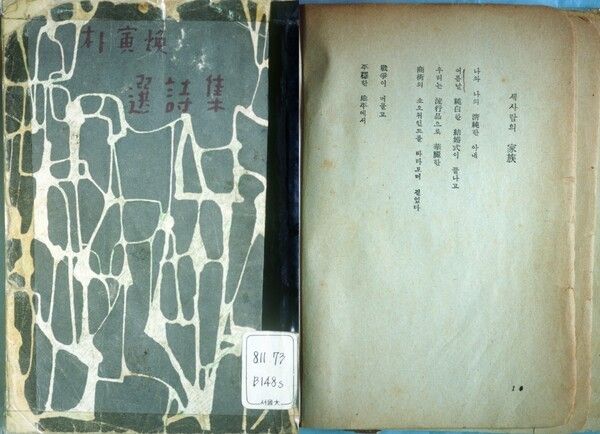
That chronology changed after previously unknown material was discovered in 2013. The findings established that “Fault,” published six months earlier, in June 1946, preceded “Street.” The poem is now regarded as an early version of “Unfortunate Chanson,” which was later included in his 1955 poetry collection.
Park soon emerged as a leading figure among a new generation of Korean modernists. He participated in the publication of the literary journal “New Poetics” in 1948 and, the following year, joined Kim Soo-young and three other poets in publishing the five-poet anthology “A Chorus of New Cities and Citizens.”
His involvement with the Hubangi literary circle later placed him near the center of Korea’s postwar modernist movement.
Reading Park’s early poetry solely as sentimental melancholy overlooks much of its political and historical significance. Works including “South Wind,” “Incheon Port” and “A Poem for the People of Indonesia” engage with the colonial experience, the oppression of weaker nations, the emergence of the modern city and the rapidly changing international order after World War II.
War Turns Modernity Into Ruins
The Korean War, which began in 1950, fundamentally altered Park’s literary world.
After fleeing to Daegu, he covered the front as a correspondent for the Kyunghyang Shinmun. In May 1951, he joined the Army War Writers’ Corps, documenting the conflict both as a journalist and as a literary figure.
Before the war, the wider world had represented new civilization, freedom and possibility in Park’s imagination. After experiencing the conflict, his vocabulary darkened. Death, loss, ruins and anxiety increasingly dominated his work.
Poems such as “If There Is Something Alive,” “The Unburied at Night” and “Returning Home” bear the marks of someone who encountered war not as an abstraction but as lived reality.
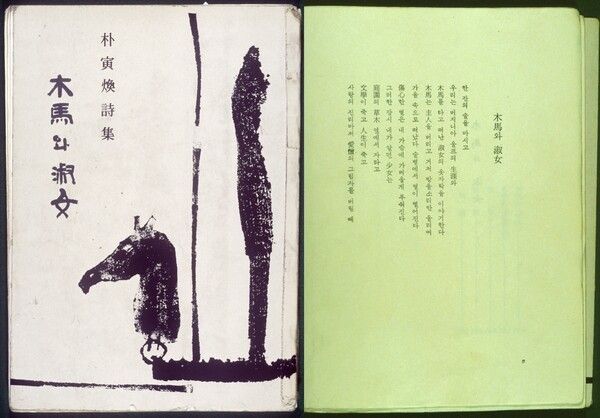
“The Wooden Horse and the Lady,” his best-known poem and one of the signature works in the only individual poetry collection published during his lifetime, also belongs to this postwar landscape.
Its fragmented constellation of Virginia Woolf, a wooden horse, a lady and bottles of alcohol has often been associated with Park’s Westernized sensibility and romantic melancholy. More recent readings, however, emphasize a darker dimension: a postwar generation confronting the collapse of the civilization and values it had once believed in.
From that perspective, the poem reads less like a private lament than a modernist apocalypse written from the ruins of war.
Beyond Poetry: Film, Translation and the Wider World
Park’s intellectual interests extended well beyond poetry.
During the 1950s, he became active in the Korean Film Critics Association and wrote extensively about cinema. Essays including “The Present and Future of Korean Cinema” and “Cinema’s Social Consciousness and Resistance” went beyond reviewing individual films to examine production conditions, industry structures, policy limitations and the social function of mass media.
Translation provided another avenue into the international culture that fascinated him. In 1952, he published a Korean translation of John Steinbeck’s “A Russian Journal” and participated in translating Tennessee Williams’ “A Streetcar Named Desire.” He also helped introduce Western modernist writers, including T.S. Eliot and Jean-Paul Sartre, to Korean readers. His translation of a Willa Cather novel was published posthumously in 1959.
In 1955, while working for the Korea Shipping Corporation, Park boarded the cargo vessel Namhae as a purser and traveled to the United States.
After visiting cities in the Pacific Northwest for approximately a month, he serialized the travelogue “19 Days in America” in the Chosun Ilbo and wrote several poems inspired by the journey, including “On the Pacific.”
The trip did not turn Park into an uncritical admirer of the United States. His writing reveals a more complex perspective: that of an intellectual from a small, war-damaged country encountering the spectacle of American capitalism while remaining attentive to the contradictions beneath modern prosperity.
For a writer who had previously encountered much of the outside world through books and cinema, physically crossing the Pacific expanded the scale of his literary imagination.
A Life Stopped at 29, a Literary Legacy Still Expanding
One of the most enduring stories surrounding Park concerns “As Time Goes By.”
According to the widely repeated account, Park improvised the lyrics in a Myeong-dong bar, and composer Lee Jin-seop immediately set them to music. Although the historical accuracy of every detail remains uncertain, the song unquestionably came to embody the romance, melancholy and existential emptiness of postwar Myeong-dong.
Park died suddenly of a heart attack at his home on March 20, 1956. He was 29. He was buried at Manguri Cemetery.
His death ended a literary career of barely 10 years, but it did not fix his reputation in place. In 1976, the 20th anniversary of his death, his eldest son, Park Se-hyeong, compiled and published his previously unpublished work. Biographies, collections of film criticism and volumes of translations followed, gradually revealing a writer far more multidimensional than the popular image of the doomed young romantic.
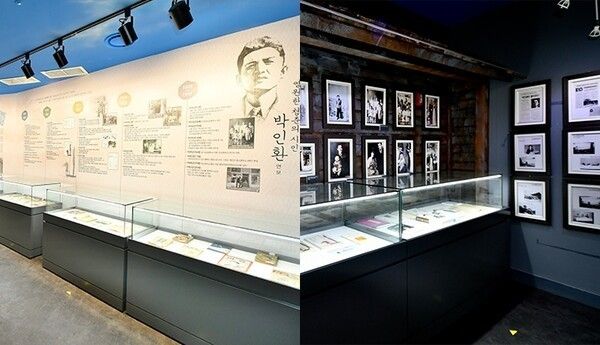
Park lived for only 29 years and seven months.
Yet those years coincided with liberation, division, war and reconstruction — some of the most violent transformations in modern Korean history. He absorbed them as a poet, journalist, critic and translator, leaving behind poetry, prose, reportage, criticism and translated literature.
That is why Park In-hwan cannot be remembered solely through the melancholy melody of “As Time Goes By.”
The romantic poet of Myeong-dong was real. So was the war correspondent who watched a country collapse, the critic who examined modern mass culture, the translator who opened windows onto foreign literature and the young intellectual who crossed the Pacific to explore the world beyond Korea.
A century after his birth, those two worlds finally belong in the same portrait.
Reported by News Culture M.J._mj94070777@nc.press
Copyright ⓒ 뉴스컬처 무단 전재 및 재배포 금지


