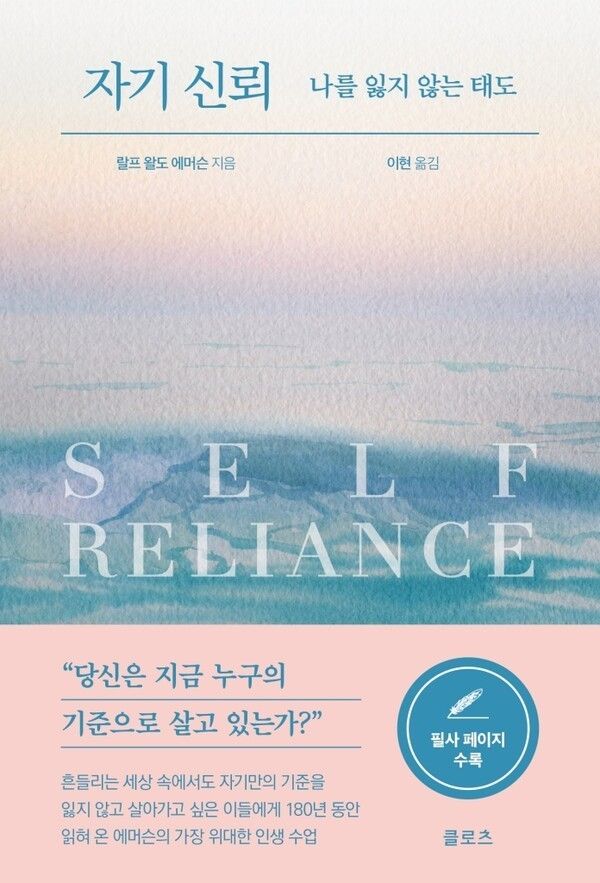
[News Culture] Modern life offers no shortage of voices telling people who to be. Approval is measured in likes, success is mapped out by someone else, and personal choices are often bent to fit the expectations of family, peers and society. A new Korean edition of Ralph Waldo Emerson’s Self-Reliance returns to his landmark 1841 essay with a message that feels sharply attuned to the present: a meaningful life begins when the judgment of the crowd gives way to the authority of one’s own conscience.
Emerson’s idea of self-reliance has little to do with empty confidence or motivational optimism. It demands intellectual independence—the willingness to claim ownership of one’s beliefs, make choices without waiting for permission and accept the consequences that follow. In his view, recovering the self means refusing to let convention determine the boundaries of one’s life.
Genius, Emerson argues, emerges when private conviction is given an honest voice. That requires freedom not only from public approval but also from the pressure to remain perfectly consistent with one’s past. People are often judged by what they once said or did, yet Emerson rejects the notion that yesterday’s beliefs should dictate today’s truth. Like a rose blooming beneath a window, a person should be fully alive to the present rather than trapped by an old version of the self.
The book also challenges the habit of looking outward for rescue, luck or validation. Independence is not found in passive hope, but in the exhilaration of acting from one’s own strength. In an age shaped by comparison and relentless competition, Emerson’s uncompromising prose offers a timely reminder: freedom begins when people stop living by borrowed standards and learn to trust the voice within.
Reported by News Culture M.J._mj94070777@nc.press
Copyright ⓒ 뉴스컬처 무단 전재 및 재배포 금지


