
[News Culture] South Korea’s television advertising business may be approaching an inflection point after years of contraction. Digital advertising, streaming growth, fragmented viewing habits and a sluggish economy have pulled budgets away from broadcasters. The market is still shrinking, but the pace of decline is beginning to ease.
That shift has revived cautious optimism that premium programming—and television’s ability to assemble mass audiences around it—could eventually put the industry back on firmer footing.
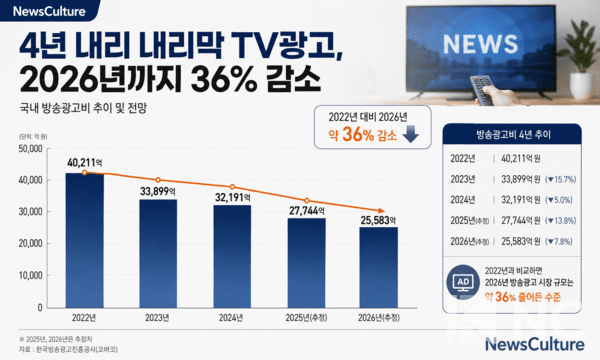
According to the Korea Broadcast Advertising Corporation, or KOBACO, total broadcast advertising spending fell from 4.021 trillion won in 2022 to 3.390 trillion won in 2023 and 3.219 trillion won in 2024. The figure is estimated at 2.774 trillion won for 2025 and projected to decline further to 2.558 trillion won in 2026. That would leave the market roughly 36% smaller than it was four years earlier.
The downturn has been even more pronounced in television. Advertising revenue for terrestrial broadcasters dropped from 1.376 trillion won in 2022 to 1.036 trillion won in 2024. It is estimated to have fallen to 887.4 billion won in 2025 and is forecast to reach 827.1 billion won this year.
Advertising at program providers, including cable channels, is also expected to shrink from 2.152 trillion won in 2022 to 1.397 trillion won in 2026.
Advertisers’ changing media priorities have driven much of the retreat. Online advertising spending is projected to climb from 8.706 trillion won in 2022 to 11.495 trillion won in 2026. With overall advertising expenditure holding relatively steady, money once reserved for broadcasters has increasingly flowed into digital channels.
Mobile-first consumption has added further pressure. Advertisers favor platforms that can reach narrowly defined audiences quickly and provide immediate, measurable feedback. Broadcasters, meanwhile, are finding it increasingly difficult to recover soaring production costs through traditional commercial sales alone.
Streaming has also upended the market. Viewers no longer need to organize their schedules around broadcast times, choosing instead what to watch and when to watch it. That shift has weakened conventional television viewing while forcing broadcasters to reconsider how content is produced, distributed and monetized.
Television has not lost its value as an advertising medium, however. Major dramas, hit entertainment shows, live sports and news can still draw large audiences and prompt advertisers to move quickly. TV’s ability to give a brand nationwide exposure within a short window remains difficult for most digital platforms to replicate.
The clearest sign of change is the projected pace of contraction. The broadcast advertising market plunged 15.7% in 2023, followed by a 5% decline in 2024 and an estimated 13.8% drop in 2025. KOBACO expects another 7.8% decrease in 2026—still a loss, but considerably milder than the previous year’s estimated fall.
Terrestrial television shows a similar pattern. Advertising spending dropped 19.4% in 2023 and another 6.6% in 2024. The decline widened to an estimated 14.4% in 2025 but is projected to ease to 6.8% this year.
A smaller loss does not amount to a recovery. Yet in a market under prolonged structural pressure, stabilization is the necessary first step toward finding a floor.
Programming competition could shape the outlook for the second half. Broadcasters are concentrating resources on dramas and entertainment formats capable of delivering both ratings and public attention. Tentpole sporting events, elections and other high-interest occasions could also create short-term surges in demand.
Changes in the production business may offer another route forward. Korean broadcasters are expanding partnerships with streaming services to secure financing and maximize the value of each program across multiple outlets. Advertising packages are also evolving beyond a single television slot to include short-form clips, digital extensions and streaming distribution.

Growing collaboration between broadcasters and global streaming platforms such as Netflix is accelerating that transition. Pairing domestic production expertise with an international distribution network gives Korean content access to a much wider audience. While that may not directly restore television advertising revenue, it can help broadcasters build a more diversified and resilient business model.
Advertisers are also moving beyond the idea that television and digital are competing choices. A campaign can use high-profile TV programming to establish broad brand awareness before turning to online platforms for more precise targeting. As broadcast content travels across digital services, a single campaign can now follow viewers through several media environments.
Content will ultimately determine whether the TV advertising market can recover. Must-watch programming with demonstrable reach and cultural impact can support higher rates and larger commitments from advertisers. If audiences continue to fragment and broadcasters struggle to create such programming, spending will keep moving online.
The broader outlook still leaves little room for unqualified optimism. KOBACO expects broadcast advertising expenditure to fall another 7.8% in 2026. Total advertising spending, by contrast, is projected to rise 3.8% to 17.935 trillion won, while online advertising expands to 11.495 trillion won. The advertising industry is growing, but broadcasting continues to claim a smaller share.
Even so, the market is beginning to send signals of change. The long-running decline is slowing, broadcasters are sharpening their programming strategies and partnerships with streaming platforms are opening new ways to generate revenue from content.
A genuine turnaround will begin not with a sudden jump in advertising spending, but with the end of the decline. If the market can move from smaller losses to a sustained plateau—and eventually to growth—the mood across the industry could change quickly. That possibility is fueling hopes that television advertising’s prolonged slump may finally be approaching a turning point.
Reported by News Culture M.J._mj94070777@nc.press
Copyright ⓒ 뉴스컬처 무단 전재 및 재배포 금지


