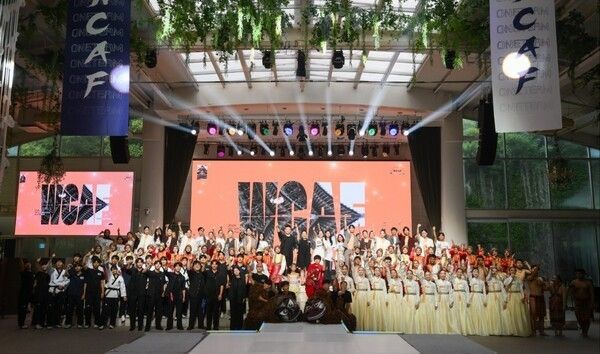
[News Culture] Seoul became a meeting point for young artists from across Asia as the 2026 World Culture & Arts Festival (WCAF) in Seoul brought performers from four countries together for a day of music, dance and cultural exchange.
Held Aug. 14 at the World K-POP Center, the festival welcomed youth performers and instructors from Korea, Indonesia, the Philippines and China. Rather than putting the groups head-to-head, the event centered on collaboration, giving each delegation a chance to introduce its own artistic traditions while sharing one stage with peers from different cultural backgrounds.
The festival was hosted by nonprofit organization LOVEROCK and organized by the World Culture and Arts Exchange Committee as part of a Seoul Metropolitan Government initiative supporting international cultural exchange.
Arts and culture figures, partner organizations and supporters also attended the event to encourage the young performers.
Congratulatory messages were delivered by National Assembly Speaker Cho Jung-sik, National Assembly Culture, Sports and Tourism Committee Chair Lee Jae-jung, Seoul Metropolitan Council Culture, Sports and Tourism Committee Chair Hwang Cheol-gyu and Seoul Superintendent of Education Jeong Geun-sik.
Their messages shared a common theme: the arts can create connections where language and nationality might otherwise divide people, and exchanges among young performers can help turn cultural differences into opportunities for understanding.
LOVEROCK Chair Kim Ji-yeon echoed that idea in her opening remarks.
“Culture and art have a special power to bring different hearts together,” Kim said. “The dreams and passion of the young people on today’s stage are the future of WCAF.”
One Team, Many Traditions
This year’s theme, “WCAF ONE TEAM,” framed the festival around a simple idea — young people do not have to be the same to create something together.
Korea’s lineup featured National Gugak Middle School, the Korean Lion Dance Research Association, the Hwasung Medi-Science University Taekwondo Demonstration Team, Joy Percuss, Aya Dance Company and Cute Angels.
National Gugak Middle School introduced audiences to the elegance and expressive range of Korean traditional performing arts, while the Korean Lion Dance Research Association injected the program with fast-paced, theatrical energy.
The Hwasung Medi-Science University Taekwondo Demonstration Team turned martial arts into spectacle, combining precise forms with acrobatic movement and powerful group choreography.
Joy Percuss shifted the mood with a rhythm-driven cajón performance, and Aya Dance Company presented contemporary choreography blending movement with interdisciplinary elements. Cute Angels added a gentler visual note with a performance built around traditional Korean cheongsachorong lanterns.
The international performances gave the program an equally distinct character.
Indonesia’s Jakarta Islamic School Ratoh Jaroe Team performed Ratoh Jaroe, a traditional dance from Aceh known for tightly coordinated seated formations, rapid hand movements and striking ensemble precision.
The Cavite Institute Marilag Folk Dance Troupe from the Philippines brought a burst of color and movement to the stage, using traditional dress and lively choreography to showcase the festive spirit of Filipino folk culture.
China was represented by musician Chen Shuang and young singer Dora, whose special performances added another dimension to the festival’s multinational lineup.
The full program moved freely across genres and traditions, from Kim Baek-bong-style fan dance and lion dance to taekwondo, Ratoh Jaroe, Philippine folk dance, cajón percussion, contemporary choreography and cross-genre performance.
Recognition Without Rankings
Recognition was also part of the day, but the festival deliberately stayed away from a winner-takes-all format.
Before the performances, certificates and awards were presented to participating teams, instructors and individual performers in recognition of their work and contribution to international cultural exchange.
Team leaders received certificates of merit and letters of appreciation, while participating groups were recognized with outstanding performance awards and certificates of appreciation. Individual youth participants were also presented with participation certificates.
The emphasis was less on who performed “best” and more on acknowledging the work required to build an international stage together.
That spirit carried into the festival’s finale.
All performers returned to the stage for “I Stand by You,” a joint closing performance built around the messages “Different, Together!” and “Wherever you are, we stand by you!”
By then, the festival’s “ONE TEAM” theme was no longer just a slogan. Performers who had spent the day presenting very different artistic traditions stood side by side for a shared finale, turning the closing number into a visible statement of solidarity and mutual support.
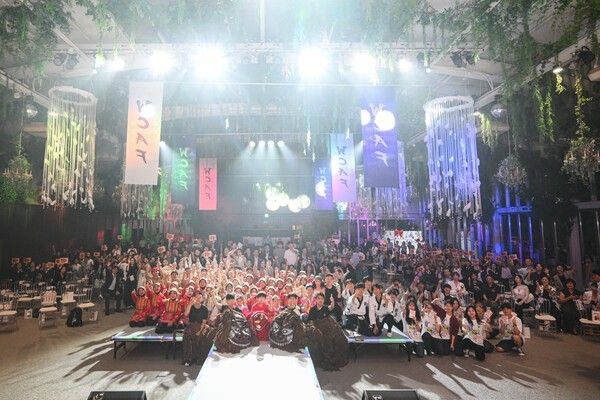
For the young artists, the event offered more than an opportunity to perform abroad or in front of an international audience. It gave them direct exposure to other cultural traditions and a chance to experience artistic exchange as something lived rather than simply studied.
The program also showed how traditional culture can remain relevant when younger generations are given room to reinterpret it through their own performance styles and creative sensibilities.
LOVEROCK has continued to develop arts education, performance and international exchange programs aimed at helping children and teenagers discover their talents while engaging with a wider global community.
Kim said the long-term goal is to turn WCAF into a sustainable platform where young artists can continue meeting, collaborating and growing together.
“This festival was meaningful because the participants did more than introduce their own cultures,” she said. “They respected one another’s differences and created one stage together.”
“We hope WCAF will grow into an international cultural and arts platform where young people from around the world can dream, connect and develop side by side.”
In Seoul, that vision took shape not through a single winning performance, but through a stage where different cultures were allowed to remain distinct — and still move as one team.
Reported by News Culture M.J._mj94070777@nc.press
Copyright ⓒ 뉴스컬처 무단 전재 및 재배포 금지


