Kolmar Korea is accelerating its push into the North American market, buoyed by the FDA's approval of a new sunscreen ingredient and the expansion of its local production base.
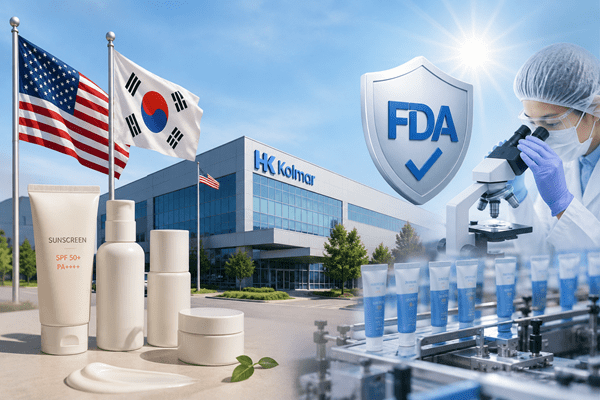
Kolmar Korea is expanding its North American business following recent regulatory changes in the U.S. sunscreen market. (AI-generated image)
■ FDA Approves New Sunscreen Ingredient After 20 Years
On June 9, the U.S. FDA added bemotrizinol, an organic UV filter, to its list of approved sunscreen active ingredients. It's the first new sunscreen ingredient approved in the U.S. in roughly 20 years, since the late 1990s — a decision the industry views as a major regulatory turning point for the American sun care market.
Bemotrizinol is a broad-spectrum UV filter that blocks both UVA and UVB rays and is already widely used in Europe and elsewhere, but had not been permitted in the U.S. until now. The approval is expected to give Kolmar Korea and other domestic cosmetics ODM firms an opportunity to develop US-tailored products by drawing on their extensive sunscreen formulation expertise.
However, since the U.S. regulates sunscreens as over-the-counter (OTC) drugs — a different regulatory framework than Korea's — and given exclusive distribution rights held by ingredient suppliers, commercial launches are still expected to take time.
■ North American Business Grows as Production Capacity Expands
Kolmar Korea's North American business continues to grow. Direct cosmetics exports to the U.S. rose from 32 billion won in 2023 to 53.3 billion won in 2024 and 90.6 billion won in 2025 — nearly tripled over two years. Over the same period, net losses at its U.S. subsidiary have narrowed sharply, improving profitability, with some in the market suggesting a possible swing to profit in the second half of this year.
Production infrastructure has also expanded. Kolmar Korea completed a second plant in Pennsylvania, boosting annual production capacity to 300 million units. Adding basic skincare and sun care lines to the existing color-cosmetics-focused first plant has established a full local production system across all product categories, and the company completed an additional capital injection in its U.S. manufacturing subsidiary in the first quarter of this year to further its North American push.
■ Domestic Business Stays Steady; Analysts See Continued Improvement
Kolmar Korea's domestic business is also maintaining stable growth. Consolidated revenue rose year-on-year last year, and the Kolmar Group was recently newly designated as a corporate group subject to disclosure requirements by the Korea Fair Trade Commission. The resolution of a leadership dispute within the founding family has also freed the company to focus more on expanding its North American business.
Securities analysts expect Kolmar Korea's earnings improvement to continue, citing rising seasonal demand for sun care products and growing orders from global clients. However, this is a securities-industry forecast and actual results may differ.
■ FAQ
Q. Why is this FDA approval drawing attention?
A. The FDA's approval of bemotrizinol as a sunscreen active ingredient is the first new ingredient approval in about 20 years, seen as a signal of regulatory change in the U.S. sun care market.
Q. What kind of ingredient is bemotrizinol?
A. It's a broad-spectrum UV filter that blocks both UVA and UVB rays. It has long been widely used in Europe, but this is the first time it can be used in the U.S.
Q. How does the approval benefit Kolmar Korea?
A. It lays the groundwork for domestic ODM companies to develop and produce sunscreen products tailored to the U.S. market, drawing on their accumulated sun care formulation expertise.
Q. Will products reach the U.S. market immediately?
A. Not quite. The U.S. regulates sunscreens as over-the-counter (OTC) drugs, and exclusive distribution rights held by ingredient suppliers remain in place, so the industry expects actual product launches to take some time.
Q. How much has Kolmar Korea's U.S. business grown?
A. Direct cosmetics exports to the U.S. grew from 32 billion won in 2023 to 53.3 billion won in 2024 and 90.6 billion won in 2025 — nearly tripling in about two years. Net losses at the U.S. subsidiary have also narrowed, improving profitability.
Q. How has the North American production base expanded?
A. Kolmar Korea completed a second plant in Pennsylvania, boosting annual production capacity to 300 million units, establishing a local production system covering basic skincare and sun care as well.
Q. What additional investment is Kolmar Korea making in North America?
A. The company carried out an additional paid-in capital increase for its U.S. manufacturing subsidiary in the first quarter of this year, continuing investment to expand local production and business.
Q. What changes have occurred in Kolmar Korea's domestic management environment?
A. The leadership dispute within the founding family has been resolved, and Kolmar Group was newly designated as a corporate group subject to Korea Fair Trade Commission disclosure requirements, laying the groundwork to focus more on North American expansion.
Q. How do securities analysts view Kolmar Korea's outlook?
A. They expect earnings to improve, citing seasonal sun care demand and growing orders from global clients. However, this is an analyst forecast, not a confirmed result.


