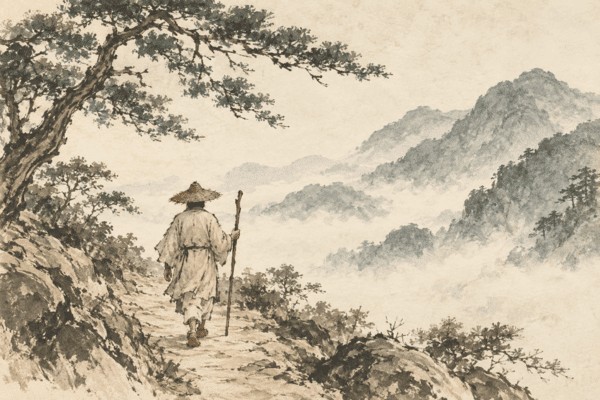
[News Culture] The danga “Jukjang Manghye” opens with a scholar setting off along a mountain path, carrying only a bamboo staff, a pair of straw sandals and a gourd. With wealth and status left behind, he enters nature in search of a freer way of being. The song brings that long-held ideal to life through voice.
Its opening line establishes the entire world of the piece: “With a bamboo staff, straw sandals and a single gourd, I enter the thousand-li landscape.” These few possessions represent a deliberate departure from material comfort and social authority. The traveler’s simple attire becomes a declaration of inner freedom.
“Jukjang Manghye” is more than a song about wandering through the countryside. Its lyrics distill an ideal shared by the literati of late Joseon, who looked to nature as a place for quiet reflection and release from the demands of worldly life.
The phrase “thousand-li landscape” carries meaning beyond physical distance. It marks the beginning of an inward journey and an entry into a realm where humanity and nature meet. Through the voice of the singer, an expansive visual landscape emerges within the sound world of pansori.
The piece is sung in jungmori, a moderately paced rhythmic cycle. Its measured alternation between tension and release follows the natural breath of the journey. Moving at a pace neither hurried nor slow, jungmori echoes the rhythm of walking and draws listeners into the traveler’s path.
Classical Chinese stories form another important layer of the song. The lyrics invoke Chang Ju and Jie Ni, the Four Hoaryheads of Mount Shang, Xu You and Chao Fu, Qu Yuan and Zhuge Liang. Each figure represents a different response to power, duty and personal conviction.
Their appearance is not simply a display of literary knowledge. They are remembered for keeping their distance from worldly ambition or remaining true to their principles. Their stories deepen the song’s central theme, turning one scholar’s excursion into a broader meditation on how a person should live.
“Jukjang Manghye” has been passed down in several versions. Slight differences appear from the opening lines, while the length and arrangement of later passages vary according to the singer. Such variations show how pansori and danga have survived not as fixed texts, but as living arts continually renewed in performance.
The version sung by master singer Lee Dong-baek has a particularly distinctive structure. It begins with reflections on youth, old age and the passage of time before moving into the journey through nature. This extended opening broadens the familiar form of the piece and gives the traveler’s departure a deeper sense of time.
Certain versions also reverse details from the stories of Xu You and Chao Fu. The confusion is believed to have arisen during oral transmission, but it also illustrates the fluidity of a tradition carried from singer to singer.
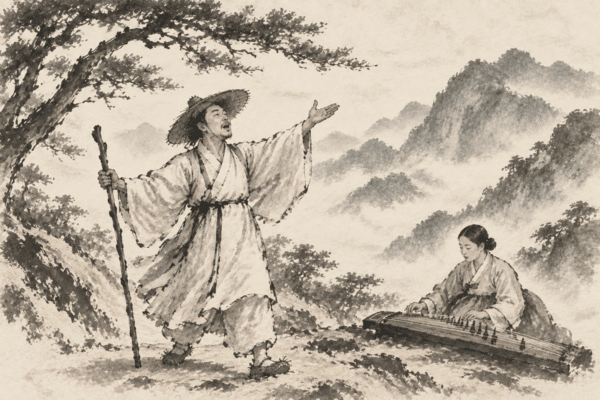
Although classified as a danga, “Jukjang Manghye” contains a rich dramatic element. The singer does more than deliver the melody and lyrics. Gesture, gaze and physical movement join the voice through neoreumsae, a central part of pansori performance.
Late Joseon master singer Kim Se-jong stressed the importance of neoreumsae in this piece. Rising from a seated position, pointing toward the road stretching a thousand li into the distance and allowing the body to follow changes in emotion all had to be fully integrated with the singing.
“Jukjang Manghye” also occupies an important place in gayageum byeongchang, a tradition in which a performer sings while playing the gayageum. Master musicians including Kang Tae-hong frequently performed the piece, allowing it to take on a different character through the meeting of voice and instrument.
The gayageum brings finer emotional shading to the song. As the resonance of its strings crosses the singer’s voice, the performance evokes both the natural scenery and the traveler’s inner world.
At the heart of “Jukjang Manghye” is a question about how life should be lived. The song finds its answer in a scholar who sets aside desire and turns to nature to reflect on his place in the world.
That sensibility still carries meaning today. The measured rhythm and unhurried journey offer listeners a moment to pause and look back on the course of their own lives.
Preserved by generations of master singers, “Jukjang Manghye” is more than a work of traditional music. Its lyrics, rhythm and performance practice offer a window into Korea’s cultural and intellectual heritage, where freedom, restraint and harmony with nature remain closely intertwined.
“Jukjang Manghye” is, in the end, the story of a person standing on the road. Having set aside worldly possessions, the traveler gains the freedom to embrace the landscape before him. That unburdened stride continues to resonate in the voices of singers today.
Reported by News Culture M.J._mj94070777@nc.press
Copyright ⓒ 뉴스컬처 무단 전재 및 재배포 금지


