[News Culture] Lee Dai Won’s orchards glow with reds, blues and yellows. His mountains pulse with countless marks, while trees and ponds seem to shimmer in their own light. The brightness that defines his work, however, was never simply the product of an optimistic temperament.
The National Museum of Modern and Contemporary Art, Korea is examining the ideas and discipline behind those radiant surfaces in “Lee Dai Won: Nothing Here Makes You Sad,” on view at MMCA Deoksugung from Aug. 6 through Nov. 8.
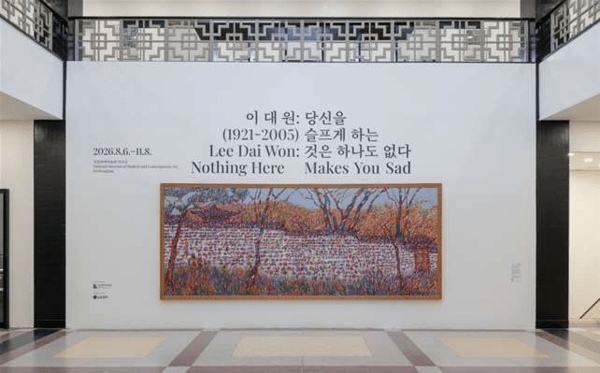
The exhibition is the first major retrospective devoted to Lee, who was variously known as “the gentleman of the Korean art world,” “the magician of color” and “the happiest painter in the world.” More than 120 oil paintings, approximately 100 archival materials and a selection of Korean antiques trace an artistic career that stretched across seven decades.
The exhibition takes its title from a comment by art historian Kim Won-yong. Rather than treating Lee’s vivid palette as evidence of uncomplicated cheerfulness, the retrospective argues that his colors emerged from sustained engagement with Korean craft and the formal principles of East Asian painting.
Born in 1921 and active until his death in 2005, Lee became known for landscapes built from primary-colored dots, lines and planes. Orchards, mountains and ponds were among the subjects he returned to throughout his life.
Yet he resisted simply following the Western art movements that dominated his era. Instead, he studied the color, sheen and surface rhythms of embroidery, mother-of-pearl lacquerware and painted ox-horn craft, translating them into the medium of oil paint. He also explored the movement of the brush in East Asian painting, pursuing a question that remained central to his work: What might a distinctly Korean modern painting look like?
His influence extended well beyond the studio. From 1959, Lee operated Bando Gallery for about eight years, helping shape the exhibition, circulation and international promotion of Korean art. Through the gallery, he introduced overseas audiences to artists including Park Soo-keun, Chang Ucchin, Kim Ki-chang, Kim Whanki and Yoo Youngkuk.
In the late 1960s, he became the inaugural dean of Hongik University’s College of Fine Arts and later served as the university’s president. He also led the National Academy of Arts and worked as a cultural ambassador for the Ministry of Foreign Affairs and Trade, treating art as both a private practice and a public responsibility.
Learning Without Being Confined
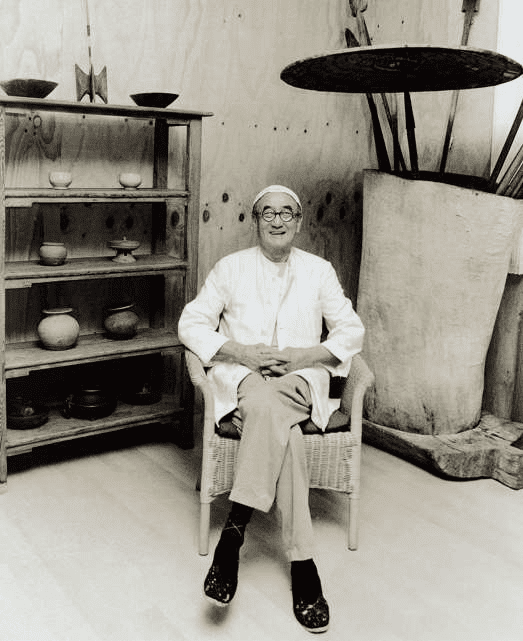
The first section, “Learning Without Being Confined,” follows Lee’s development from the 1930s through the 1950s.
While attending Cheongun Public Elementary School and Keijo Second Higher Common School, Lee studied under Japanese art teacher Kunio Sato, who introduced him to both Western art and Korean craft. Lee went on to receive recognition in the craft and Western painting divisions of the Joseon Art Exhibition in 1937 and 1938.
The retrospective includes the first presentation in Korea of Sato’s painting “Snowy Landscape.” Sato also taught Chang Ucchin and Yoo Youngkuk, placing him at an important point in the formation of several major Korean modernists.
The exhibition additionally corrects the title of one of Lee’s early works. A 1938 painting long known as “Bukhansan” is presented under its original title, “Autumn Mountain.”
Paintings made after Lee traveled through the United States and Europe are markedly darker and more restrained than the works for which he later became famous. Rather than imitating Western modernism, they reveal an artist testing its limits and searching for firmer ground on which to build his own visual language.
Extending Tradition Without Following the Crowd
The second section, covering the 1950s through the 1970s, examines Lee’s search for a Korean formal language during the rise of Art Informel.
The movement rejected established pictorial conventions in favor of rough textures, spontaneous gestures and expressions of inner anxiety. Lee did not ignore those developments, but neither did he allow himself to be absorbed by them.
Documents from Bando Gallery illuminate his parallel role as an artist, administrator and intermediary within the Korean art world. The exhibition also places his paintings alongside objects he collected and lived with, including embroidered ornaments, bandaji chests, mother-of-pearl lacquerware, painted ox-horn objects and wooden furniture.
A landscape by ink painter Byeon Gwan-sik is shown in the same context. Together, these works allow visitors to see how the brilliance of traditional craft, its ordered surfaces and the structural logic of Korean painting entered Lee’s canvases.
Freedom Built Layer by Layer
The third section, “Building Until It Becomes Free,” begins in the 1970s, when Lee established a studio on his farm in Paju.
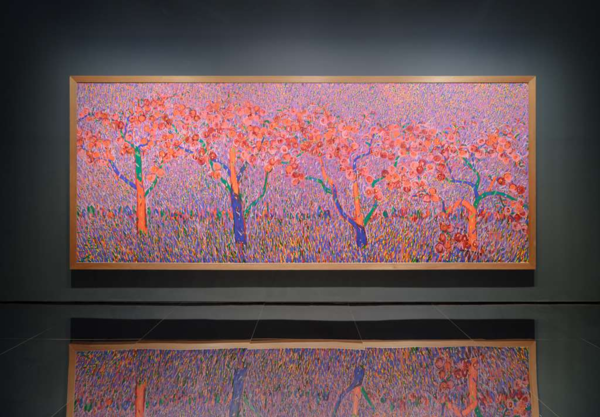
There, he developed the distinctive language that would define his mature work. Dots, lines and broad areas of color were applied repeatedly, building depth and movement through accumulation rather than conventional perspective.
Lee painted the same places for decades, yet the results were never simple repetitions. Shifts in season, light and atmosphere generated a new pictorial order each time. Major works including “Farm” from 1987, “Mountain” from 1978 and “Tree” from 1983 demonstrate how a familiar landscape could remain inexhaustible.
His dots also differed from those of Western Pointillism. They were not intended to merge optically in the viewer’s eye. Each retained its own identity, like an individual strand of colored thread in embroidery.
His lines drew on the texturing strokes, moss dots and layered-ink methods of traditional painting. Recast through oil and brushwork, they introduced velocity, depth and a sense of living energy.
Lee’s late paintings therefore did not simply move from Korean sansu painting toward Western landscape. They began with the modern landscape and found their way back to the spatial and philosophical world of sansu.
Nothing Here Makes You Sad
The final section presents the culmination of Lee’s lifelong exploration of color and light.
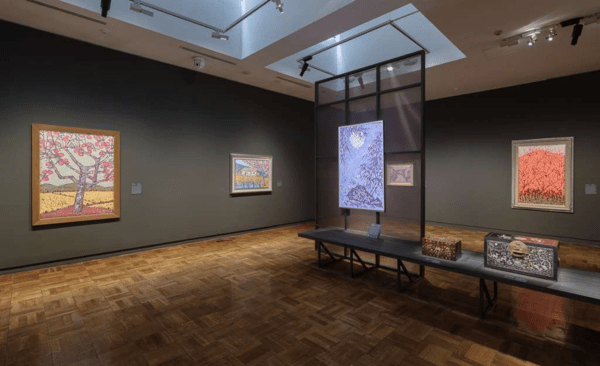
In monumental paintings stretching more than five meters, his visual language becomes expansive and unrestrained. Works from the “Orchard” and “Four Seasons” series, along with “Inwangsan,” do more than place a landscape before the viewer. They create the sensation of entering it.
Large canvases face one another across the gallery, while reflective flooring extends the painted orchards into the space beneath visitors’ feet. The installation effectively places the audience in the position Lee once occupied when he sat outdoors painting on weekends at his Paju farm.
The exhibition’s central argument is not that sadness was absent from Lee’s life or work. His brightness was achieved through research, repetition, restraint and the long discipline of painting.
What appears effortless was carefully constructed. Rather than turning away from the weight of life, Lee transformed it into color, rhythm and space. That sustained act of transformation is why, in the world of his paintings, nothing is allowed to remain merely sad.
An international symposium will be held on Sept. 10 following the exhibition’s opening. Art historian Hong Sun-pyo will deliver the keynote address, while researchers including Bae Won-jung, Chung Moo-jeong, Lee Min-soo, Katsue Iuchi and Choi Kyung-hyun will discuss Lee’s work and position within modern art history.
The museum will also offer specialist lectures for adults, programs designed for visitors with visual or hearing impairments, sign-language and audio interpretation, and exhibition materials written in accessible language.
Reported by News Culture M.J._mj94070777@nc.press
Copyright ⓒ 뉴스컬처 무단 전재 및 재배포 금지


