[News Culture] In Andong, food has never been separate from family ritual. For generations, the city’s historic households prepared elaborate tables for ancestral rites, welcomed guests with carefully made dishes and passed recipes down through the women who ran their kitchens. Andong sikhye grew out of that way of life.
The city has long been associated with Confucian scholarship and etiquette. Prominent families preserved their customs through jongga, or head-family households, where ancestral ceremonies remained central to domestic life. Food prepared for those occasions demanded time, precision and a clear sense of order.
Among the most significant were bulcheonwi rites, held for ancestors whose memorial tablets were permanently enshrined and honored across generations. These large ceremonies brought together extended families and required an extensive range of dishes. Repeated over decades and centuries, they gave household cooks room to refine recipes and develop distinctive local techniques.
The same care extended to guests. In jongga homes, serving food well was part of maintaining the dignity of the household. What began as ceremony became habit, and what became habit eventually shaped the wider character of Andong cuisine: clean presentation, restrained seasoning and flavors that deepen slowly.
A Fermented Dish Unlike Any Other Sikhye
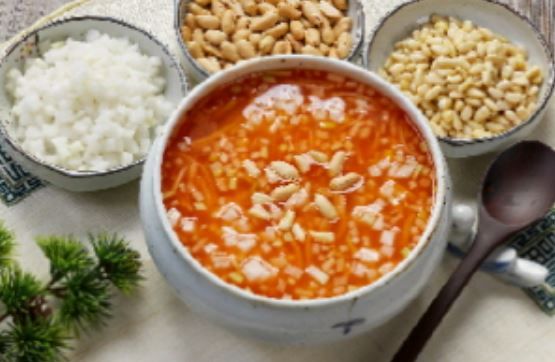
Andong sikhye shares a name with Korea’s familiar sweet rice drink, but little else.
Instead of a clear, sugary liquid, it arrives in a reddish broth filled with rice and slices of radish. Ginger gives it a sharp fragrance, while red pepper powder adds warmth and color. The first taste may be sweet, but mild spice, acidity and the earthiness of fermentation soon follow.
Malted barley is used to release sweetness from the rice, just as it is in ordinary sikhye. The addition of vegetables and the reliance on fermentation, however, bring the dish closer to sikhae, an older style of preserved food traditionally made with grain and other ingredients.
Radish plays a central role. It provides crunch, absorbs the seasoning and develops a deeper flavor as the mixture ferments. Without using fish, the dish still achieves the complexity associated with many traditional fermented foods.
There is no final boiling stage. Time does the work instead.
As the ingredients rest, the sweetness softens and a light tang begins to emerge. Ginger remains bright and assertive, while the radish and rice take on the flavors around them. The finished dish is difficult to place in a single category: part drink, part side dish and part fermented dessert.
Its textures are just as distinctive. Crisp radish sits against soft grains of rice, creating a contrast rarely found in conventional sikhye.
Andong sikhye is often served after a meal, when its cool, gently tart flavor helps refresh the palate. It also appears on tables prepared for visitors, making it both a household staple and a gesture of welcome.
Local vocabulary reflects that difference. In Andong, the sweet rice drink commonly known elsewhere as sikhye is usually called gamju. The word sikhye is reserved for this spicy, fermented specialty.
A Family Recipe That Still Lives on
Andong sikhye remains closely tied to holidays, ancestral rites and family gatherings. Preparing and sharing it is part of the occasion, a familiar taste that connects one generation with the next.
There is no single fixed recipe. Some households use more ginger, others prefer a stronger red pepper flavor, and fermentation times vary depending on the season and family preference. Those differences are not seen as departures from tradition. They are the tradition.
As Andong has grown into a major cultural tourism destination, the dish has also reached diners far beyond the region. To newcomers, its combination of sweetness, spice and acidity can be surprising. For local families, however, it remains something far more familiar: food made at home, taught by hand and remembered by taste.
Modern life has changed the way many traditional dishes are prepared, but Andong sikhye has not disappeared. Its survival owes much to the fact that it is more than a recipe. It carries family history, local language and the memory of shared tables.
The dish also reveals how inventive Korean fermentation can be. Rice, radish, malted barley, ginger and red pepper are simple ingredients, yet together they create a flavor found nowhere else.
Some families continue to follow methods handed down through generations, while local producers have adapted the dish for wider distribution. The form may change, but its identity remains rooted in Andong’s household kitchens.
Andong sikhye is not simply a regional variation of a familiar drink. It is a food shaped by ritual, hospitality and repetition, made distinctive by the people who kept preparing it year after year.
Reported by News Culture M.J._mj94070777@nc.press
Copyright ⓒ 뉴스컬처 무단 전재 및 재배포 금지


