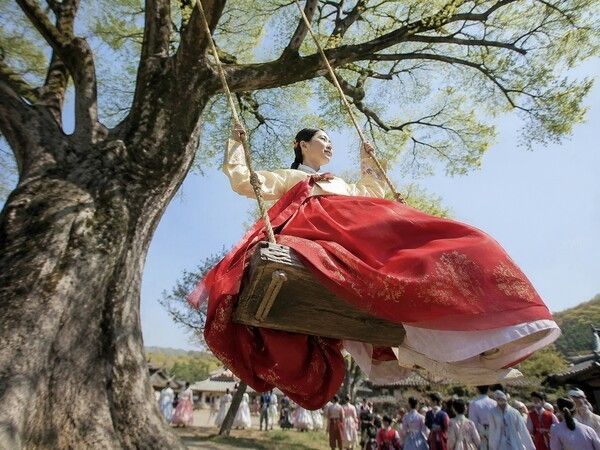
[News Culture] On Dano, the fifth day of the fifth lunar month, a thick rope is fastened to the sturdy branch of a towering zelkova tree at the edge of a village. A rider steps onto the wooden board, leans back and drives forward, climbing higher with each swing.
Fabric flashes through the air as the ground drops away. The rush comes not simply from speed, but from the sensation of rising above the world below. Swinging was one of Dano’s defining spectacles, a traditional game built around height, balance and the thrill of momentary flight.
Its documented history in Korea reaches back to the Goryeo Dynasty. The Chinese historical record History of Song notes that people in Goryeo enjoyed chucheon, an old term for swinging, during Dano around the reign of King Hyeonjong.
A more vivid account appears in the History of Goryeo. Its biography of the military ruler Choe Chung-heon describes swings installed at Baekjeongdong Palace, where senior civil and military officials were invited to a three-day banquet.
The game was incorporated into lavish court celebrations featuring towering temporary structures, instrumental music, acrobatics and other forms of entertainment. A 13th-century collection by the scholar Yi Gyu-bo also depicts young men and women tying red ropes to a walnut tree and soaring into the air.
Swinging was therefore more than a village pastime. In Goryeo, it flourished as a prestigious physical spectacle enjoyed by the court and the ruling elite.
That status shifted during the Joseon Dynasty, when Confucian social codes placed increasingly strict limits on women’s movement outside the home. Members of the ruling class condemned the sight of women swinging high in public as improper and undignified.
The restrictions, however, did little to extinguish its popularity. An entry in the Annals of King Seongjong describes a large swing ground created near the backstreets of Jongno in 15th-century Hanyang. The capital was divided into northern and southern teams for a major competition.
At the Dano ritual held around Mount Songak in Gaeseong, swinging was treated with an almost sacred reverence. Participants even brought out a wooden image from the Daewangdang shrine and staged gestures suggesting that the deity itself was joining the ride.
Despite official disapproval, the swing became one of the most eagerly anticipated outdoor activities for women. It survived not because social controls weakened, but because communities continued to embrace it.
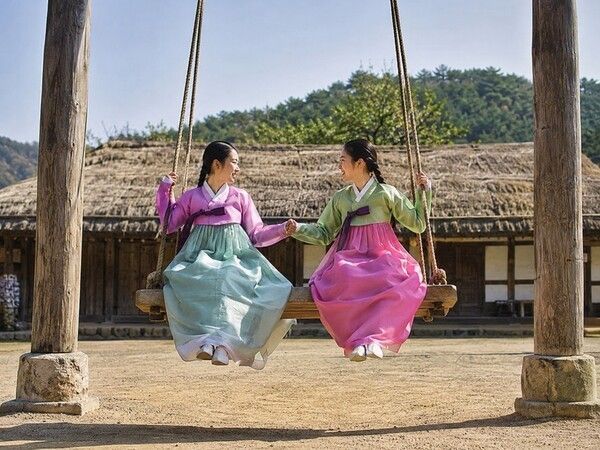
The game developed into several distinct forms. In its most familiar version, ropes were tied to a strong tree branch. In open fields, two upright posts were installed to create a freestanding swing known as a ground swing.
A swing designed for one rider was called an oegeune, while a ssanggeune, or double swing, allowed two people to stand facing each other. Skilled performers pushed the form further, stacking riders above one another or twisting the ropes before releasing them in a spinning maneuver known as the “twist.”
Competitions were decided by how high a rider could climb. Some participants attempted to kick or bite a flower branch suspended overhead. Others rang a bell attached to the end of a pole with the tips of their feet.
More precise methods eventually emerged. Measuring cords could be connected beneath the swing board to record the highest point reached, turning a seasonal pastime into a carefully judged athletic contest.
For women, the physical significance was inseparable from the social one. Swinging strengthened the legs and demanded timing, coordination and courage. More importantly, it allowed women confined to domestic spaces to move through the open air with rare visibility and force.
A folk belief also held that sweating during Dano would protect people from summer heat and mosquito bites. Yet the swing’s lasting appeal went beyond seasonal custom. For one day each year, women could rise above the walls that ordinarily enclosed them and turn the village sky into a space of release.
Reported by News Culture M.J._mj94070777@nc.press
Copyright ⓒ 뉴스컬처 무단 전재 및 재배포 금지


