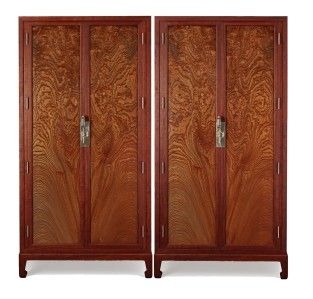
[News Culture] More than five centuries of growth are etched into the grain of a zelkova wardrobe, where mirrored patterns reveal the tree’s age before the craftsmanship behind the piece comes into view.
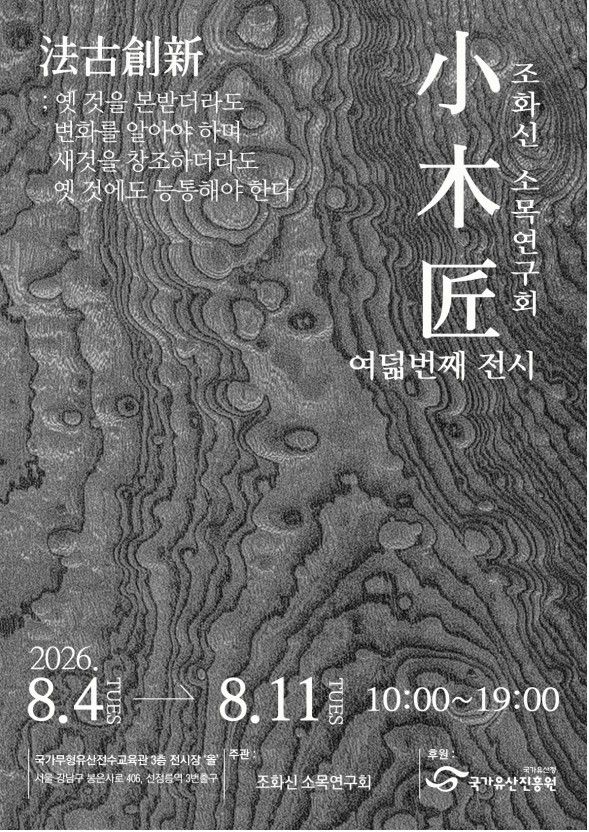
The work is among 43 pieces featured in “Beopgo Changsin,” the eighth exhibition by the Hwa-Shin Jo Somok Research Group. The exhibition runs from Aug. 4 to 11 at the National Intangible Heritage Training Center in Seoul.
Thirty-five artisans are participating, including Hwa-Shin Jo, a certified transmission educator in somok craftsmanship. The group, selected through a Korea Heritage Agency open call, is composed largely of graduates from the traditional somok course at the Korea Traditional Craft Architecture School. Around 50 members are currently active.
Somok refers to the Korean craft of making wooden furniture and household objects, including wardrobes, chests and document cabinets. Pieces are assembled primarily through interlocking joints rather than nails, demanding exact measurements while allowing the wood’s natural grain to define the finished form.
Jo has spent decades preserving these methods and passing them on to younger craftspeople.
The exhibition title, “Beopgo Changsin,” expresses the idea of studying the old to create the new. That philosophy runs through the show, which preserves the structure and restraint of traditional furniture while adapting its proportions and functions to modern homes.
Three signature works by Jo form the centerpiece of the exhibition.
An “uigeorijang,” a wardrobe traditionally used to store men’s clothing during the Joseon period, was made with zelkova wood more than 500 years old. Its striking mirrored grain, known as “yongmok,” gives the cabinet a sense of movement while carrying the visible record of the tree’s long life.
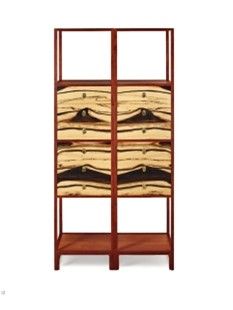
A bookcase modeled after an artifact in the National Museum of Korea collection emphasizes balanced proportions and bilateral symmetry. A four-sided display shelf, or “sabangtakja,” combines a Chinese mahogany frame with the dark, fluid patterns of black persimmon wood, creating an effect reminiscent of an ink-wash painting.
The exhibition also highlights distinct interpretations by other members of the group.
Mi-Ri Kim recreated a bamboo reading desk once used by Seoae Ryu Seong-ryong, who served as chief state councilor during the Imjin War. Her version uses the swirling grain of zelkova wood to bring depth and rhythm to the restrained form.
Jun-Hee Kim’s bedside chest employs “nakdong,” a technique in which the surface of paulownia wood is scorched before the ash is scraped away. The process deepens the grain and gives the piece a subdued, timeworn character.
Rather than treating traditional furniture as a fixed historical form, the exhibition presents somok as a craft that continues to evolve. The works retain the precision and construction principles of Korean joinery while responding to the dimensions, uses and visual language of present-day interiors.
“Beopgo Changsin” ultimately shows how inherited technique can remain relevant without losing its roots—allowing old timber, patient hands and contemporary space to shape something new together.
Reported by News Culture M.J._mj94070777@nc.press
Copyright ⓒ 뉴스컬처 무단 전재 및 재배포 금지


