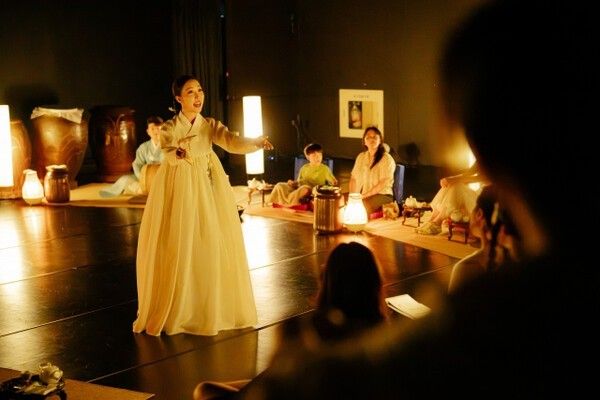
[News Culture] An intimate stage where audiences can hear every breath of a pansori singer is opening a new way into Korean traditional performance.
Rather than relying on elaborate sets or amplified spectacle, “Onggi Concert” places the focus on the human voice, the performers and the resonance of the room. With only 40 seats, the venue recreates the closeness of a Joseon-era pungnyu chamber, allowing every expression, vocal inflection and emotional shift to reach the audience with unusual clarity.
Presented by the Traditional Performing Arts Foundation of Korea, the concert runs at Gwangmudae Hall in the Traditional Performing Arts Creative Studio every Wednesday and Thursday at 4 p.m. through Aug. 13. The current season, designed primarily for international visitors, is dedicated to pansori.
The production is built around a “human-scale” approach. Instead of surrounding the performers with large sound systems, the space is designed to preserve the natural relationship between voice and listener. Audiences can follow the singer’s breathing, facial expressions and even the smallest tremors in the sound.
Traditional earthenware jars placed throughout the venue also function as part of the acoustic design. Their rounded surfaces add a soft, natural resonance, enriching the weight and texture of the pansori voice. The result evokes the atmosphere of an old salon, where listeners once sat close to master singers and absorbed the music without distance or distraction.
At the center of the program is “Simcheongga,” one of Korea’s major pansori works and part of UNESCO’s Intangible Cultural Heritage of Humanity. Singers Soomin Kim and Seung-hoon Lee perform selected scenes from the epic narrative.
Kim, a recipient of the Minister of Culture, Sports and Tourism Award at the Park Rok-ju National Gugak Competition, has continued to develop her craft through appearances with institutions including the National Changgeuk Company of Korea. Lee, who won the Presidential Award at the Onnara Gugak Competition, is regarded as one of the leading pansori voices of his generation.
The performance opens with the short song “Sacheolga,” or “Song of the Four Seasons,” before moving into two of the most dramatic passages from “Simcheongga”: Simcheong’s plunge into the sea and the moment her blind father regains his sight. The compact selection is structured to convey the work’s sweeping narrative and emotional intensity within a limited running time.
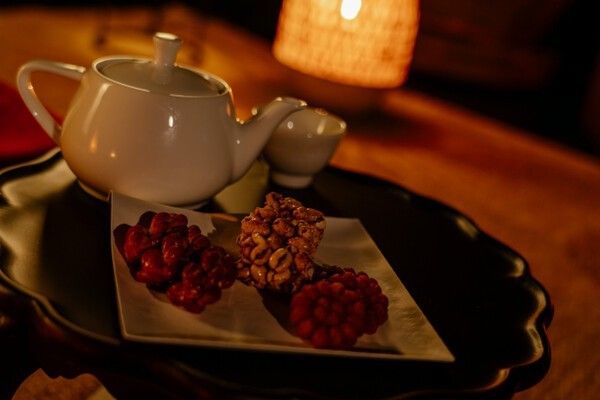
The experience begins before the first note is sung. Visitors are welcomed in a “White Room,” where they receive a drink and an introduction to the performance. They then move into the “Black Room” for the concert itself.
An English-language docent explains the history, structure and key listening points of pansori, making the genre accessible even to those encountering Korean traditional music for the first time.
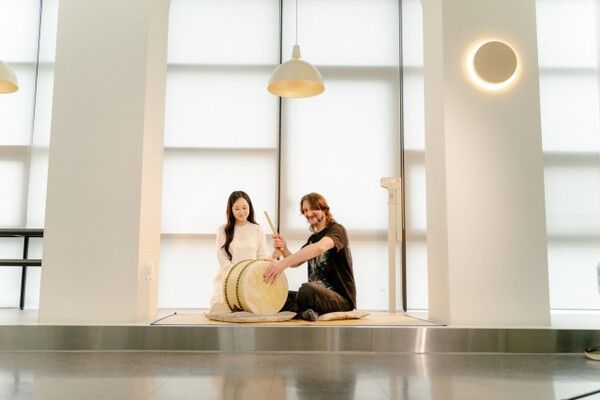
After the performance, audience members can speak directly with the artists. The program continues with opportunities to play traditional instruments, including the gayageum and sori drum, and to try on hanbok. The concert therefore unfolds not simply as a stage presentation, but as a guided encounter with Korean sound, clothing and performance culture.
The venue carries its own historical significance. First opened in 1907, Gwangmudae served as an important home for pansori and changgeuk during a period of rapid Western cultural influence. The original building was destroyed by fire in 1930.
Ninety-six years later, the theater has returned near its former site, reopening on the ninth floor of the new wing of Dongdaemun Shopping Complex as a renewed platform for traditional performance.
The pansori edition of “Onggi Concert” continues through Aug. 13. A second season featuring traditional dance and folk performance will run from Oct. 7 through Dec. 10, presenting another side of Korea’s performing arts heritage.
Reported by News Culture M.J._mj94070777@nc.press
Copyright ⓒ 뉴스컬처 무단 전재 및 재배포 금지


