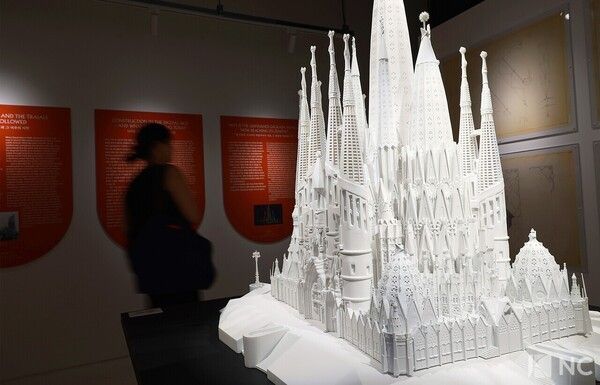
[News Culture] A century after Antoni Gaudí’s death, the architect’s restless imagination has found a new home in Seoul.
“Gaudí: Reborn in Seoul,” jointly organized by the Gaudí Foundation and Gaudí Seoul, opens at Sinsa House on Aug. 1 and runs through Oct. 31. The exhibition coincides with the completion of the Tower of Jesus Christ at Barcelona’s Sagrada Família and marks the foundation’s first official world-tour presentation in Korea.
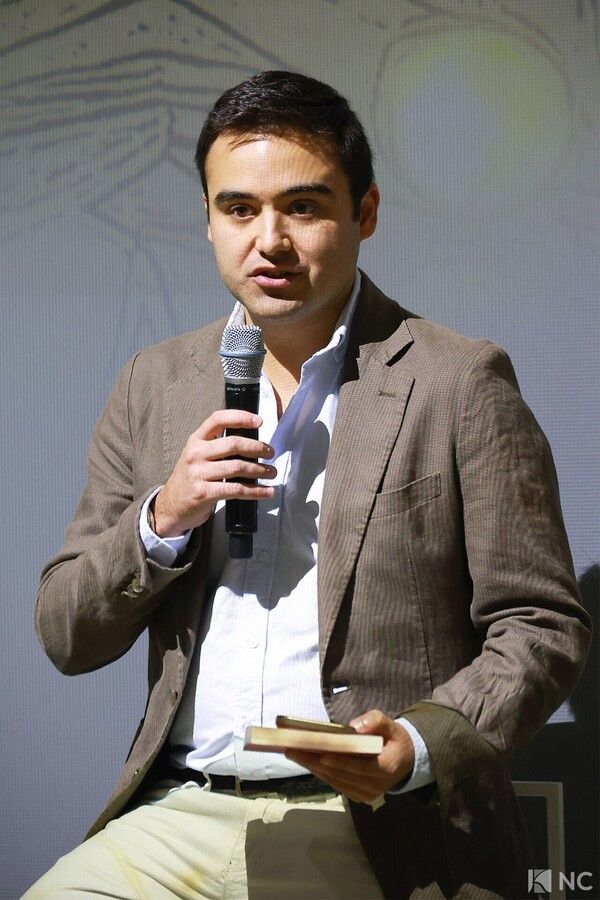
At a press conference on July 31, Gaudí Foundation International Director Alex Canals Grau, exhibition director Jo Yoon-ji and members of Junglim Architecture jpa. introduced a project designed not simply to celebrate Gaudí’s famous buildings, but to reveal how his ideas took shape.
“Korean audiences have shown a deep understanding of and affection for Gaudí,” Canals Grau said. “Following the strong response in Japan, it feels especially significant to bring the exhibition to Seoul.”
The foundation has spent more than four decades building its archives and international research network. That work now underpins a touring program scheduled to continue through 2030. Earlier exhibitions in Tokyo and Osaka drew a combined audience of roughly 330,000.
Korea has also maintained its own connection to Gaudí scholarship, hosting an international conference in Busan in 2013 and the seventh Gaudí World Congress in Seoul in 2023.

Beyond the masterpieces: original materials and never-built visions
The exhibition features around 30 original items, including Gaudí’s notes, drawings and tile models, together with 42 officially certified replicas.
Across seven thematic sections, archival material is woven into large-scale media art and AI-based interactive installations. Rather than offering a greatest-hits tour of Gaudí’s completed landmarks, the exhibition follows the ideas, observations and experiments that shaped his architecture.
“We wanted the originals, certified replicas and immersive digital elements to feel like parts of one continuous story,” Jo said. “The aim is to show where the work came from, what Gaudí believed and how his thinking continued to resonate long after his lifetime.”
Among the exhibition’s biggest draws are 3D reconstructions of three unrealized projects: Hotel Attraction, the Tower for Tangier and Colònia Güell. All three are being shown to the public in this form for the first time.
The models are not presented as definitive versions of buildings that were never completed. They are closer to research proposals—visual arguments that allow visitors to imagine how Gaudí’s unfinished ideas might have evolved.
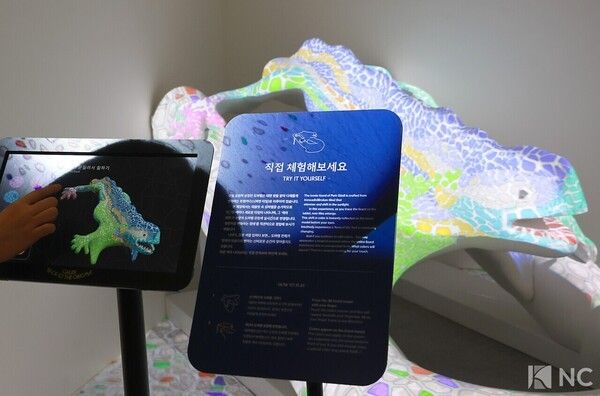
The exhibition’s visual identity also comes directly from Gaudí’s working methods. Its central motif is based on the catenary curve, a structural principle he explored by observing the forms created by gravity and then turning them upside down.
The logo developed for Seoul is expected to travel with the exhibition to later stops, including Taiwan and Singapore.
Sinsa House itself plays an active role in the experience. Architect Seung H-Sang led the remodeling of the venue, reworking two existing buildings and preserving the irregular character of their staircases and room layouts.
Junglim Architecture jpa. designed the exhibition route as a gradual descent from the fifth floor to the first. Along the way, visitors encounter “Reborn Space,” where they can leave their own responses; “Calle Gaudí,” a reimagining of a Barcelona street; and a rooftop terrace that extends the experience beyond the gallery rooms.
Architecture meets neuroscience
Actor Ryu Seung-ryong lends his voice to the audio guide, walking visitors through Gaudí’s life and the structural logic behind his work.
Neuroscientist Jang Dong-sun approaches the architecture from a different angle through the “Art & Brain Salon,” examining how people physically and emotionally respond to curves, light, color and scale.
The program translates architectural theory into everyday language while asking how a curved form can make the body feel at ease, how color can shift emotion and how ceiling height can alter perception.
The Seoul exhibition works best when technology remains in service of the research. Its media installations may be visually striking, but the real focus lies elsewhere: in the sketches, failed ideas and unrealized plans that reveal Gaudí as a tireless investigator rather than a distant genius.
As visitors move through Sinsa House, they encounter not only the buildings that made Gaudí famous, but also the uncertainty and experimentation that came before them. The exhibition’s central argument is clear: originality did not appear fully formed. It grew out of close observation, repeated failure and an uncompromising search for structure.
News Culture M.J._mj94070777@nc.press
Copyright ⓒ 뉴스컬처 무단 전재 및 재배포 금지


