[News Culture] Under the punishing summer sun, ripe ears of corn are being transformed into some of Korea’s most distinctive seasonal foods.
EBS1’s ‘Extreme JOB’ visits the farmers, cooks and artisans behind those flavors, from a father-daughter team steaming freshly harvested waxy corn over a wood fire to specialists making makgeolli-fermented bread, traditional corn noodles and yeot by methods passed down through generations.
The episode follows a family handling thousands of ears each day, a married couple who have spent 29 years selling giant corn bread at a traditional market, a veteran cook preserving a disappearing Gangwon specialty and a family carrying on a 150-year-old confectionery tradition. Behind every familiar summer snack is a day shaped by heat, repetition and relentless physical work.
A Day That Begins at 5 A.M.: Waxy Corn Steamed Over a Wood Fire
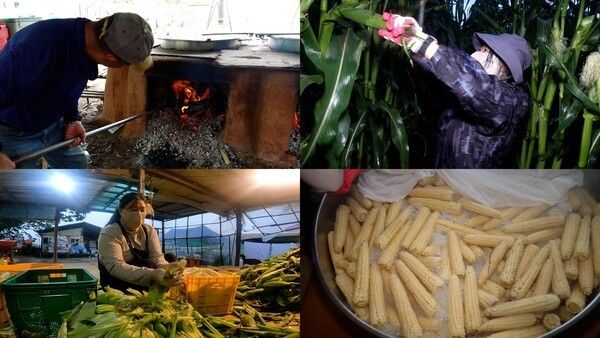
In a cornfield in Goesan County, North Chungcheong Province, work begins before sunrise. Once the harvest reaches its peak, a father and daughter head into the field at 5 a.m., hoping to finish the hardest part before the midday heat settles in.
Even at that hour, moving between corn stalks taller than a person is demanding. More than 4,000 ears are harvested each day from a field measuring roughly 2,300 square meters, with every stalk cut and inspected by hand.
The work cannot simply be handed over to machinery. Enough of each stalk must remain attached to prevent moisture loss, while every ear requires further trimming before it can be sold.
Once the harvest is complete, the corn is husked, cleaned and moved into a massive cauldron that can hold about 500 ears at a time. Steaming them over firewood takes considerably longer than using modern equipment, but the family considers the method essential to preserving the corn’s dense, chewy texture and naturally nutty flavor.
With 30 years of experience, the father watches the flames constantly. Too little heat leaves the corn undercooked; too much can alter its texture. As he teaches his daughter how to manage each stage, the grueling seasonal routine also becomes an act of succession.
The Secret Behind a 5-Kilogram Loaf: Sokcho’s Corn Bread Couple
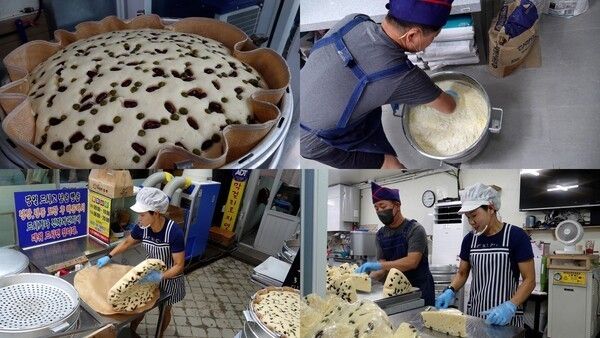
At a traditional market in Sokcho, Gangwon Province, customers line up for an oversized corn sulppang, a steamed bread naturally fermented with makgeolli.
The husband-and-wife team behind the stall has spent 29 years refining the recipe. Corn flour is blended with wheat flour to retain its mild, earthy flavor, while makgeolli helps the dough ferment and gives the finished bread its soft, springy texture.
Kidney beans and green peas are scattered across the surface before the dough is loaded into a large steamer. The fermentation continues as the bread cooks, making the process slower and less predictable than conventional baking. Once removed, each loaf must be handled carefully before its shape has fully set.
A finished batch weighs about 5 kilograms, and even a single slice is substantial. Repeatedly lifting, carrying and cutting the heavy loaves takes a physical toll, but the couple keeps working as long as customers continue to arrive.
Preserving a Vanishing Flavor: Five Hours to Make Olchaengiguksu
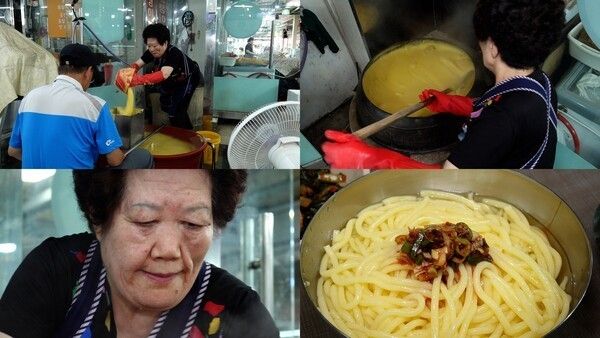
At a traditional market in Hongcheon County, another corn specialty is kept alive through a process that begins at 4 a.m.
Known as olchaengiguksu, or corn starch noodles, the Gangwon dish takes its name from the short, rounded strands that resemble tadpoles. Once commonly prepared in homes across the region, it has become increasingly difficult to find outside traditional markets.
Chun-ok, now in her 70s, begins by grinding flint corn and repeatedly straining it to remove the husks and isolate the fine starch. The starch is then cooked in a cauldron large enough to produce around 80 servings.
For hours, she must stir without pause. Even a brief lapse can cause the thickening mixture to scorch and stick to the bottom. Once it reaches the correct consistency, it is left to rest before it can finally be pressed through a noodle frame.
The final stage requires close coordination. One worker handles the scalding-hot dough while another catches and cools the strands in cold water. The entire process takes about five hours, but Chun-ok continues to begin each day before dawn to ensure the regional specialty does not disappear.
Hwanggol Yeot, Made the Same Way for 150 Years
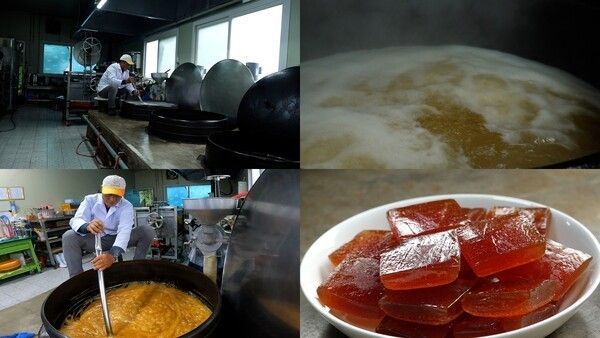
In a mountain village in Wonju, Gangwon Province, one family continues to make Hwanggol yeot, a traditional corn taffy whose local production method dates back more than 150 years.
Kim Chan-yeol, who has practiced the craft for 55 years, begins by grinding rice and corn in carefully measured proportions. Malt is added to convert the grain starches into sugar before the mixture is transferred to a cauldron and slowly boiled.
The most punishing part is the constant stirring. Using a long wooden paddle, Kim must keep the syrup moving so it does not burn against the bottom of the pot. The heat rising from the cauldron is intense even in winter and nearly overwhelming at the height of summer, but stopping is not an option.
After the liquid is strained, it is boiled down once more. Even after it reaches the consistency of grain syrup, further cooking is required to develop the color, texture and deep sweetness associated with Hwanggol yeot.
Years of handling heavy tools and working beside the fire have left visible marks on Kim’s hands. Still, he continues the work inherited from his family, preserving a technique that survives only through patience, endurance and repetition.
Long before corn reaches a market stall or dining table, countless hours have already gone into harvesting, steaming, fermenting, grinding and boiling it. ‘Extreme JOB: A Taste of Summer — The Corn Rush’ turns its camera on the people behind those processes, revealing the labor embedded in some of Korea’s most familiar seasonal foods.
The episode airs Aug. 1 on EBS1.
Reported by News Culture M.J._mj94070777@nc.press
Copyright ⓒ 뉴스컬처 무단 전재 및 재배포 금지


