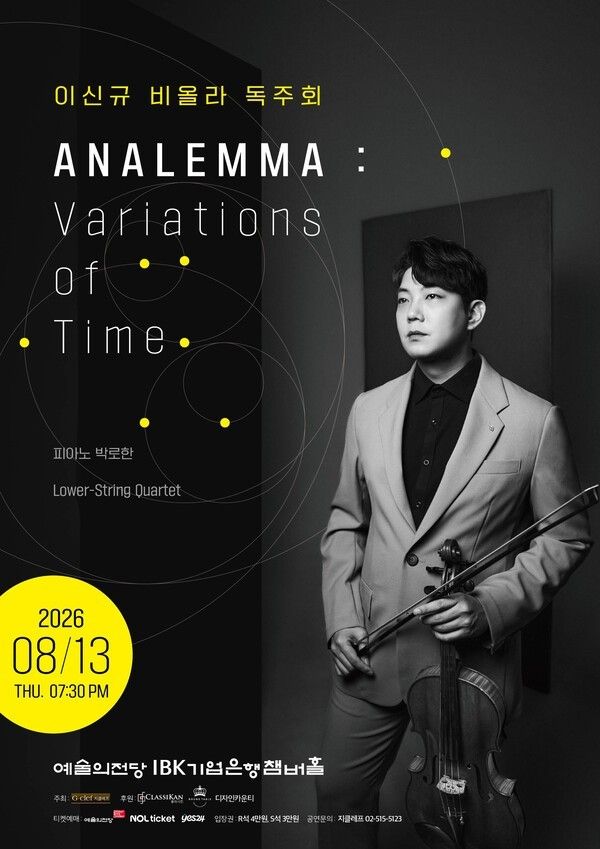
[News Culture] Violist Shin-kyu Lee will explore the ways music circles back, changes shape and gathers new meaning in Analemma: Variations of Time, a recital set for Aug. 13 at the Seoul Arts Center’s IBK Chamber Hall.
Pianist Rohan Park will join Lee for a four-work program spanning Arvo Pärt, Vazha Azarashvili, Arcangelo Corelli and Sergei Rachmaninoff. The concert will also feature the Lower String Quartet, extending the evening beyond the traditional viola-and-piano format.
An analemma is the figure-eight pattern traced by the sun when its position is recorded at the same time each day over the course of a year. That recurring path provides the organizing idea for the program, which moves through music built on repetition, variation and the return of familiar material in altered form.
The recital opens with Pärt’s Fratres for Viola and Piano. Rather than following a conventional narrative arc, the piece unfolds through recurring harmonies, measured silences and carefully controlled shifts in intensity. Lee will perform the 2003 version prepared by violist Lars Anders Tomter and published by Universal Edition.
Pärt’s tintinnabuli style is rooted in economy. A small amount of material is allowed to resonate and evolve, with the viola’s dark middle register set against the piano’s clear, bell-like sonorities. The tension lies not in density but in the space between the two instruments.
Azarashvili’s Poema for Viola and Piano follows in its Korean premiere. Brief, lyrical and direct, the work draws out the viola’s vocal quality and places melody at the center. Its warmth provides an immediate contrast to the austerity of Fratres, revealing how differently the same instrument can carry emotional weight.
The program broadens with Corelli’s La Folia, Op. 5, No. 12: Theme and Variations. Lee will be joined by violist Yong-eun Park, cellist Kyung-jun Lee and double bassist Yong-woo Cho as the Lower String Quartet recasts the violin original for two violas, cello and double bass.
The familiar La Folia theme is built over a repeating harmonic pattern, with each variation reshaping its rhythm, texture and melodic contour. Moving the work into a lower register gives the arrangement its character. The two violas share the melody and inner lines, while the cello and double bass deepen the recurring bass pattern beneath them.
The result is less a straightforward transcription than a rethinking of the piece’s center of gravity. Corelli’s Baroque structure remains intact, but the darker instrumentation gives the music greater weight and a more contemporary sense of drama.
The evening closes with Rachmaninoff’s Sonata in G Minor, Op. 19, heard in an arrangement for viola and piano. Originally written for cello, the four-movement sonata is one of the composer’s most expansive chamber works, moving from the brooding opening of the first movement through a restless scherzo, a broad lyrical slow movement and an energetic finale.
The viola arrangement changes the balance of the work without diminishing its scale. Passages that sit naturally in the cello’s upper register take on a more urgent, exposed quality on the viola, while the instrument’s middle range brings a rougher edge to Rachmaninoff’s long melodic lines.
The piano part is orchestral in both size and ambition, making Park a full partner rather than a supporting player. Across the sonata’s four movements, the two musicians must negotiate its momentum, tonal weight and sweeping emotional range together.
Lee attended the Juilliard School’s Pre-College Division before completing both his bachelor’s and master’s degrees at Juilliard on full scholarship. He studied with Toby Appel and later completed doctoral coursework in viola performance at Yonsei University.
His competition honors include first prize across all instrumental categories at the CCMF Concerto Competition, second prize in the strings division of the Five Towns Young Artist Competition and the Mendelssohn Fellowship awarded by the Chamber Music Society of Lincoln Center.
Lee has appeared as a chamber artist at Bargemusic in New York and participated in several U.S. music festivals as a scholarship recipient. Since returning to Korea, he has performed at Kumho Art Hall, the Seoul Arts Center, the Sejong Center and Lotte Concert Hall.
He currently serves as artistic director of Classikan Ensemble, music director of the CMS Roundtable, a member of Club M, leader of the Lower String Quartet and artistic director of Delight Art Hall. He was also selected for the performance category of the Bucheon Cultural Foundation’s 2025 Artists of Tomorrow program.
Park studied on full scholarship at Yale University and the Juilliard School before continuing his training with Arie Vardi at the Hanover University of Music, Drama and Media in Germany.
A prizewinner at the Long-Thibaud, Clara Haskil, Morocco, Animato and BNDES international competitions, Park has performed at venues including the Gewandhaus, Lincoln Center, the Kennedy Center and the Théâtre des Champs-Élysées.
Reported by News Culture M.J._mj94070777@nc.press
Copyright ⓒ 뉴스컬처 무단 전재 및 재배포 금지


