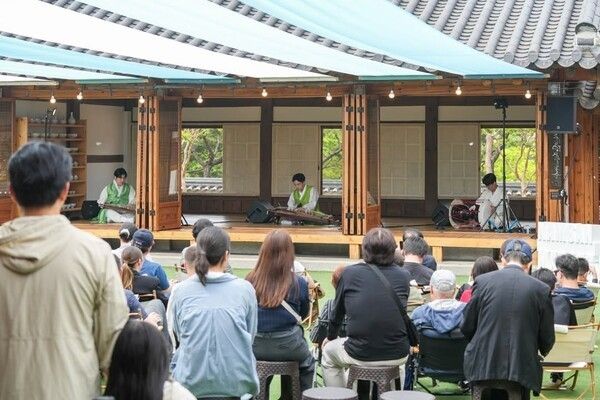
[News Culture] Korean traditional music is reaching more audiences across South Korea, but the expansion of stages and ticket bookings has yet to produce comparable growth in the paid market.
According to Arts Management Korea’s 2025 report on ticket sales in the performing arts market, the Korea Performing Arts Box Office Information System, or KOPIS, recorded 1,426 Korean traditional music productions and 2,368 performances nationwide. A total of 489,967 tickets were booked, generating approximately 4.84 billion won in ticket revenue.
Compared with 2023, the number of productions rose 19.8% and ticket bookings increased 18.8%. Total revenue, however, grew by just 2.8%. Average revenue per booked ticket fell 13.5%, from 11,427 won to 9,882 won.
The figures show that opportunities for artists and audiences to meet have expanded nationwide, but that growth has not translated into a stronger commercial market. A closer look at data from South Korea’s 17 major administrative regions reveals an even deeper structural imbalance.
More Stages Nationwide, More Revenue in the Capital
On the supply side, Korean traditional music has become less concentrated in Seoul. The capital accounted for 45.4% of all productions in 2025, or 648 titles, down 6.2 percentage points from 51.6% in 2023. Across the wider capital region, the share fell from 64.5% to 59%, with 842 productions.
Activity outside the capital region grew sharply over the same period. The number of productions increased 38.1%, from 423 to 584, while ticket bookings rose 33.6%, from 145,322 to 194,165.
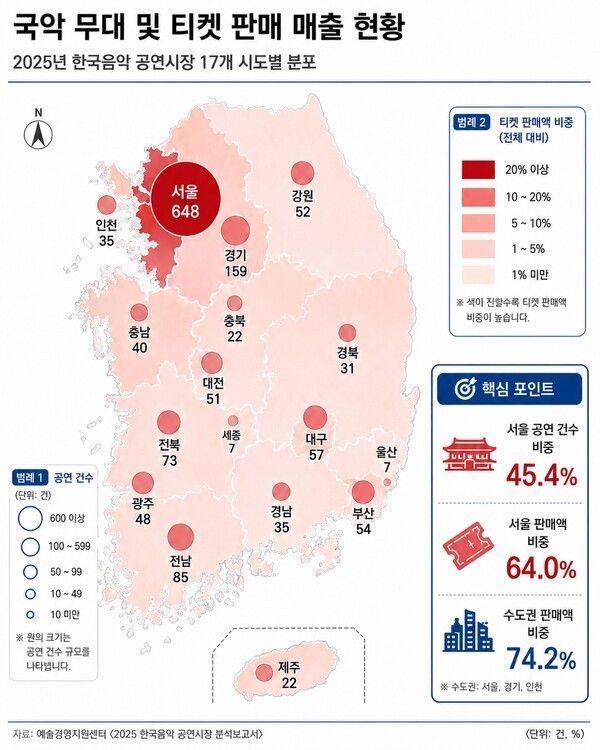
The financial returns moved in the opposite direction. Seoul’s share of national ticket revenue climbed from 55.2% in 2023 to 64% in 2025, reaching approximately 3.1 billion won. The capital region’s overall share also increased, from 69.2% to 74.2%, or nearly 3.6 billion won.
The stages have spread across the country, but the market’s spending power has become even more concentrated in the capital region.
The Paradox of Rising Bookings and Falling Revenue
The most pressing issue outside the capital region is that more productions and bookings are not producing more revenue. Ticket bookings increased 33.6% over two years, but total ticket sales fell 14%, from approximately 1.45 billion won to 1.25 billion won.
The gap becomes clearer when revenue per booking is compared. Each ticket booked in the capital region generated an average of 12,153 won, while the figure outside the capital region stood at just 6,422 won—roughly half the metropolitan level.
Daegu recorded a 48.5% decline in ticket revenue, while North Gyeongsang fell 69.7%, South Chungcheong 22.5%, North Chungcheong 21.5% and Gyeonggi 12.9%. In each region, the number of productions and bookings increased year over year, but revenue still declined.
Paid tickets accounted for only 58.2% of all Korean traditional music bookings nationwide in 2025. The revenue decline outside the capital region suggests that the continued expansion of free, invitation-only and low-priced performances sponsored by local governments may be delaying the development of an independent commercial market.
When Performance Volume and Revenue Rankings Diverge
A regional comparison shows a pronounced disconnect between the number of productions and the amount of ticket revenue they generate.
South Jeolla presented 85 productions in 2025, ranking third nationwide, and staged 87 performances, tied for fourth. Its ticket revenue, however, totaled just 21.26 million won, placing it 16th among the 17 regions. Average revenue per booking was approximately 1,294 won.
North Jeolla showed a similar pattern. It ranked fourth in production volume with 73 titles and third in ticket bookings with 24,373, but fell to seventh in revenue with 120.48 million won.
Both regions possess extensive traditional music resources and host frequent performances, yet that activity has not translated into sustained paid demand.
Busan and Gwangju, by contrast, generated stronger revenue through a smaller number of commercially successful productions. Busan ranked sixth in production volume with 54 titles but placed third in ticket revenue with 218.71 million won. Its average revenue per booking reached approximately 11,112 won.
Gwangju ranked ninth with 48 productions but rose to fourth in revenue, generating 148.6 million won.
Five Regions Capture Nearly 84% of Revenue
Revenue concentration in the paid Korean traditional music market is significantly steeper than in the performing arts market as a whole.
The five leading regions—Seoul, Gyeonggi, Busan, Gwangju and South Chungcheong—generated a combined 4.06 billion won in ticket sales in 2025. That amounted to 83.8% of nationwide revenue.
Their share of total production volume was 71.7%, nearly 12 percentage points lower than their share of revenue. The disparity reflects the concentration of paying audiences, professional producers and marketing infrastructure in a small number of major cities.
Other regions recorded sharp gains after securing a major production or establishing a long-running show. Gangwon saw ticket revenue jump 212.5% year over year to 128.4 million won, supported by productions including the Jeongseon Arirang resident show “Ttaekkun.”
Jeju also benefited from a low comparison base. Its number of productions rose from eight to 22, while ticket revenue increased 36.7%.
From Counting Stages to Building a Sustainable Paid Market
Central and local governments have long treated touring support programs and the number of free performances as key measures of success in expanding access to traditional arts.
The data presents a colder reality. Increasing the number of stages has not created a stable base of paying regional audiences. Instead, the revenue gap between the capital region and the rest of the country has widened.
Revitalizing regional traditional arts ecosystems will require a shift away from administrative evaluations centered on the number of visits or performances. Policymakers must examine whether public arts companies and regional cultural centers are increasing audiences’ willingness to pay without crowding out private productions.
Paid-ticket ratios, average ticket revenue and the long-term development of local audiences should become central performance indicators.
The critical question is no longer simply where a production was staged or how many times it was performed. It is whether the revenue generated by those stages is circulating back into the livelihoods of local artists.
Reported by News Culture M.J._mj94070777@nc.press
Copyright ⓒ 뉴스컬처 무단 전재 및 재배포 금지


