[News Culture] Three performers shaped by different Korean traditions are joining forces for Itda, Itta, Ikda, a new collaborative work built around a connection they share: Gyeonggi Sinawi Dance.
Presented by the National Intangible Heritage Center as part of its 2026 Isujajeon series, the performance will take place Aug. 8 at 4 p.m. at the Eolssumaru Small Theater in Jeonju. The program brings together Lee Ju-won of Hahoe Byeolsingut Talnori, Kim Young-chan of Cheoyongmu and Jang Boreumi of Jindo Buknori.
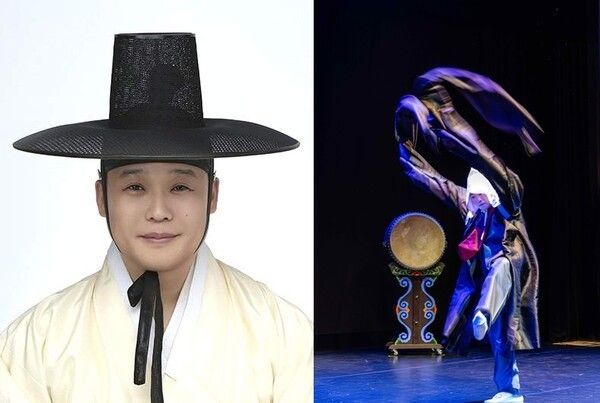
Their respective traditions could hardly be more distinct. Hahoe Byeolsingut Talnori is steeped in the wit and theatricality of Korean mask performance, Cheoyongmu carries a stately and highly controlled movement vocabulary, while Jindo Buknori is driven by the physical force and rhythm of the drum. What connects the three performers is their training in Gyeonggi Sinawi Dance, a form rooted in the improvisatory rhythms and movement of Korea’s sinawi tradition.
That common ground becomes the starting point for the new work. Rather than presenting the three traditions as separate repertory pieces, Lee, Kim and Jang draw their individual movement languages into the framework of Gyeonggi Sinawi Dance, allowing contrasting styles to meet and develop within the same performance.

The Korean title Itda, Itta, Ikda captures the idea behind the project through three closely related words. Itda refers to carrying a tradition forward from one generation to another; itta speaks to its continuing presence in the present; and ikda evokes the years of practice through which an artist and a tradition mature.
The concept reflects the broader aim of Isujajeon, which gives trained practitioners of intangible heritage room to move beyond preservation alone and develop work for today’s stage. Here, the humor of Hahoe mask dance, the composure of Cheoyongmu and the kinetic pulse of Jindo drumming are not treated as fixed relics, but as traditions capable of meeting, changing and generating something new.

Admission is free, with advance reservations opening July 29 through the National Intangible Heritage Center’s website.
Reported by News Culture M.J._mj94070777@nc.press
Copyright ⓒ 뉴스컬처 무단 전재 및 재배포 금지


