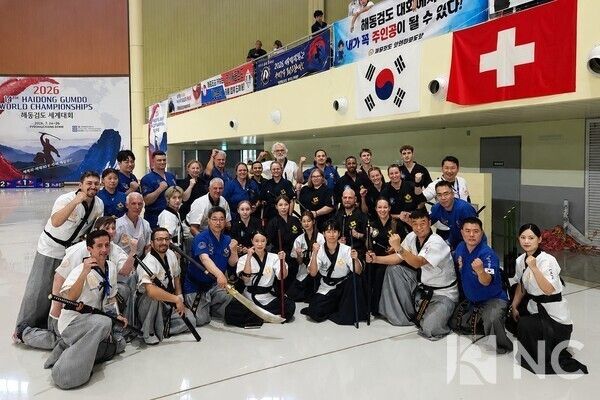
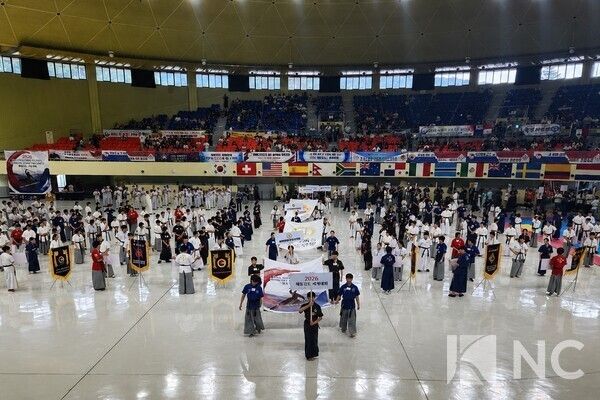
[News Culture] Pyeongchang has become an international gathering point for traditional martial arts, with some 1,500 athletes, family members and officials arriving from around the world for the 14th Haidong Gumdo World Championship.
The participants include roughly 500 overseas practitioners from more than 50 countries, including the United States, Australia, New Zealand, Spain, Switzerland, Sweden, Mexico, South Africa, Nepal and Italy.
Hosted by the Korea Haidong Gumdo Association and organized by the 2026 Haidong Gumdo World Championship Organizing Committee, the tournament opened July 24 and runs through July 26 around Pyeongchang Dome Gymnasium in Gangwon Province. The event is supported by Pyeongchang County and the World Haidong Gumdo Federation, headed by President Kim Jeong-ho.
Martial arts from Korea, a global gathering in Pyeongchang
Haidong Gumdo draws on martial traditions associated with Korea’s ancient Goguryeo kingdom. Its philosophy emphasizes the values of loyalty, filial duty, courtesy, righteousness, trust, wisdom, virtue and physical discipline under what the organization calls the “SAMURANG” spirit.
Its practice also incorporates the concept of geomgwang, or “sword light,” symbolizing the radiance of the rising sun reflected on a blade.
Since its first world championship in 2002, the event has steadily expanded into an international meeting point where practitioners test their skills while building friendships across national and cultural boundaries.
The championship is designed not simply as a competition, but as a platform for athletes from different linguistic and cultural backgrounds to meet through a shared martial art and experience the values of discipline and mutual respect.
According to the organizing committee, turnout remained strong despite geopolitical instability, regional conflicts and rising airfares linked to high energy prices.
The substantial overseas participation, organizers said, underscored the commitment of practitioners who traveled long distances to reach Pyeongchang despite the added cost and logistical challenges.
The official opening ceremony was held at 11 a.m. on July 25 at Pyeongchang Dome Gymnasium, with national delegations from participating countries in attendance.
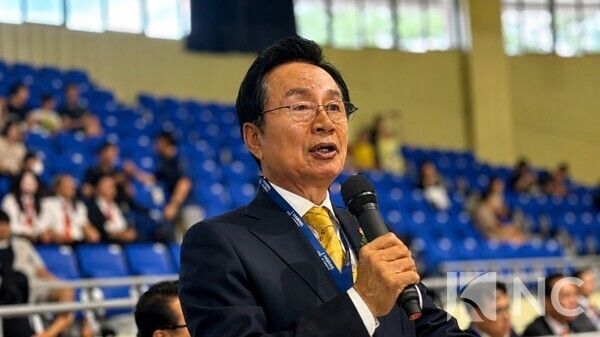
“Haidong Gumdo has grown into a global martial art practiced by around 1 million people in 182 countries,” Kim said at the ceremony. “This championship is a meaningful occasion for martial artists from around the world to come together and introduce Korea’s traditional martial arts to a wider international audience.”
Athlete and referee representatives then took the oath, pledging fair competition throughout the championship.
K-food and longer stays extend the event beyond the arena
The championship has also developed into a broader K-culture experience for foreign visitors.
Outside the venue, food trucks serving tteokbokki, dakgangjeong and hotteok drew long lines of overseas participants eager to sample Korean street food. Even those visibly feeling the heat from spicy dishes returned with enthusiastic reactions.
The influx of international athletes and accompanying family members is also translating into longer stays across Pyeongchang, generating demand for local accommodation, restaurants and nearby attractions.
That spending is giving the martial arts championship a second role beyond competition: as a sports-marketing vehicle capable of attracting international visitors and channeling tourism spending into the host region.
Support facilities for athletes have proved popular as well.
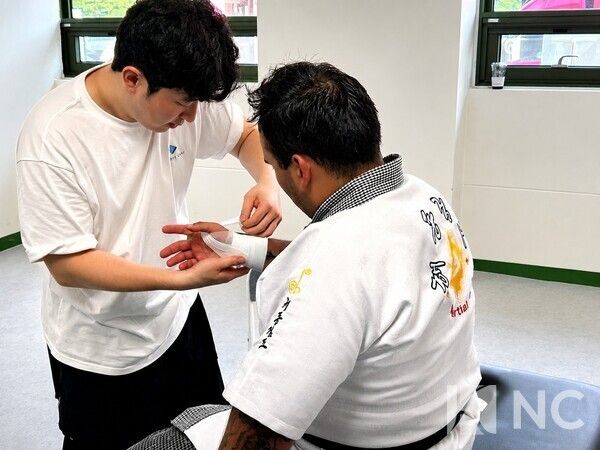
A conditioning booth operated by sports healthcare company Remote Care drew a steady stream of competitors seeking treatment after long-haul flights and intensive training. Athletes received sports massage, taping and other recovery support aimed at helping them maintain competition form.
One overseas competitor said the service made a noticeable difference.
“I felt heavy from jet lag and muscle fatigue, but the professional and attentive care helped me get back into my best condition,” the athlete said.
Student volunteers help bridge the language gap
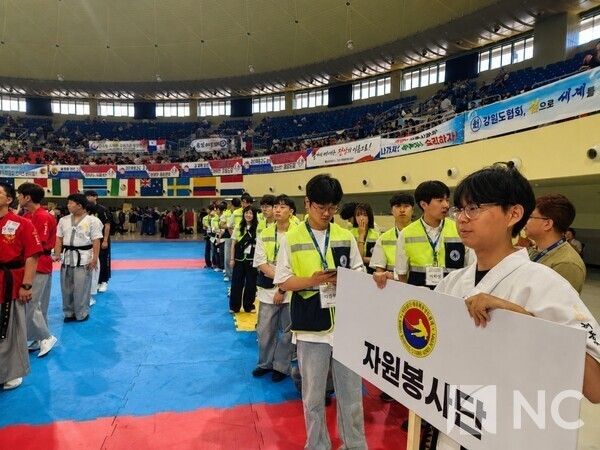
Behind the event’s operation is a volunteer team made up of students from Myongji University’s Sports Industry Management program.
The students have supported interpretation, visitor guidance, crowd movement and general event operations, helping international delegations navigate the venue and competition schedule.
Woo Jong-woong, a professor of sports industry management at Myongji University’s College of Future Convergence, said the championship also offered students a hands-on educational opportunity.
“Experiencing the operation of a major international sporting event firsthand gives students a valuable chance to build practical capabilities for the global sports industry,” Woo said.
At the center of the arena, competition and demonstrations continued throughout the event, with athletes from different countries applauding one another while showcasing their techniques.
Precision demonstrations including candle extinguishing, target cutting and paper cutting repeatedly drew cheers from the stands, turning the competition floor into a shared stage for martial arts performance and cultural exchange.
Mariana Orozco of Mexico, who took part in a special demonstration team, said the setting and local reception helped ease the pressure of performing.
“Korea’s pleasant natural environment and the warm welcome from local residents helped me relax and successfully complete my sword-cutting demonstration,” Orozco said. “The memories I made in Pyeongchang with practitioners from so many countries will stay with me for the rest of my life.”
Senior Vice President Lee Jong-gu and other members of the organizing committee are looking beyond the tournament itself, envisioning a sustainable K-sports tourism model that brings martial arts, culture and the sports industry together.
The championship is showing how an international martial arts event can do more than determine winners and losers. By bringing together practitioners across borders and languages while connecting them with local food, tourism and services, the event is also offering Pyeongchang a potential model for regional growth built around international sports exchange.
Reported by News Culture M.J._mj94070777@nc.press
Copyright ⓒ 뉴스컬처 무단 전재 및 재배포 금지


