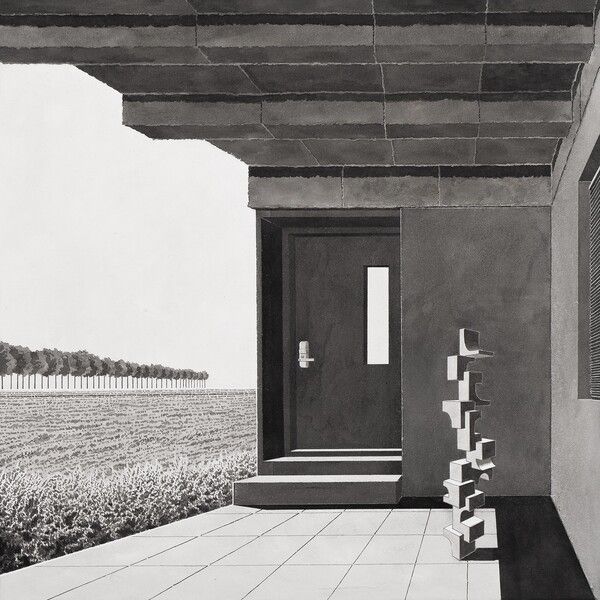
[News Culture] A cave is a place to disappear. It keeps the noise of the outside world at bay and offers shelter from whatever one is trying to escape. But refuge can change with time. Stay too long, and the walls that once offered protection begin to close in. Safety and confinement are never entirely separate.
That tension lies at the heart of Deokyoung Lee's solo exhibition "Grotto." Lee has long explored the uneasy space between anxiety and repose, tracing the emotional pressures that emerge from social relationships and private experience. During his 2024–2025 residency at Chapter II, his attention shifted toward the tensions embedded in the city—the surfaces of aging buildings, the unruly patterns of vegetation and the hidden systems of order running through apparent chaos.
The starting point was Lee's own studio in Seoul. Measuring barely 16.5 square meters, it was a place where everyday life and artistic practice inevitably overlapped. What initially felt unfamiliar gradually became comfortable, only for that comfort to give way to a growing sense of enclosure.
"When I try to escape society or something that has happened in my private life, I run toward a hiding place of my own," Lee says.
But every hiding place carries a contradiction. It protects the person who retreats into it, while also making it easier to remain hidden. The longer the refuge lasts, the harder it becomes to distinguish shelter from isolation.
Outside the studio, Seoul remained relentlessly noisy. Inside, Lee felt increasingly detached. Eventually, he began leaving the room to photograph the city. The camera was not simply a means of documenting what he saw. It became a way out—a temporary passage from the suffocating interior into the world beyond it.
One of the first places he visited was Chungjeong Apartment.
Among Seoul's aging architectural landmarks, the building is often discussed for its history. What caught Lee's attention, however, was something less tangible: the sensation of time left unattended. Standing beside a major thoroughfare, the worn structure seemed almost abandoned by the city surrounding it. Peeling paint, tangled wires, dust and debris turned its interior into something closer to a psychological ruin than an architectural relic.
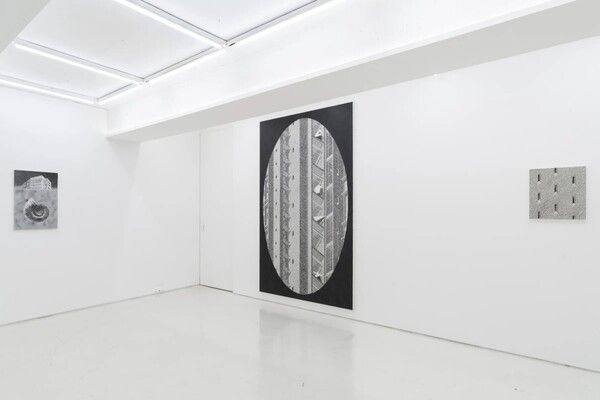
Lee describes the building as "a giant fossil on the street."
The image captures the strange duality he found there. Chungjeong Apartment remains part of the living city, yet it also resembles a shell left behind by another era. The past appears hardened into its surfaces. People pass without noticing, while the building quietly retains the weight of accumulated fatigue and unease.
Its interior intensified that sensation. Corridors wound around the structure, folding back on themselves. The deeper Lee moved through the building, the less it felt like a functional passageway and the more it resembled a maze.
Architecture, in his paintings, begins to operate in much the same way. Rooms, corridors, concrete walls and tangled wires lose their purely physical function and become structures of the mind. Lines and planes map confusion, pressure and the desire to find a way out.
The decaying cityscape also brought back another landscape from Lee's memory: the Demilitarized Zone he encountered during his military service.
There, in areas largely beyond ordinary human reach, summer vegetation grew taller than a person. Wind moved through the dense growth like waves across an ocean. Rain striking the leaves created an almost aquatic rhythm. Then winter arrived, and the overwhelming abundance seemed to retreat almost entirely.
The DMZ presents its own profound contradiction. A territory born from war and division has, precisely because human access is restricted, allowed ecosystems to flourish with relatively little intervention. Destruction exists alongside preservation; prohibition alongside regeneration.
What stayed with Lee was not an idealized vision of untouched nature. It was nature's ability to establish an order beyond human control.
The weathered surfaces of Chungjeong Apartment awakened that memory. An aging concrete structure and the dense vegetation of the DMZ might appear unrelated, but for Lee they share a common condition. Both reveal what happens when human control weakens. Forms become rougher, boundaries less certain. And from that disorder, another kind of beauty emerges.
Haneul Park offered a different variation on the same idea.
Its fields of silver grass stretch beneath an open sky, momentarily obscuring much of the surrounding city. When the plants rise above eye level, the landscape can recall the dense vegetation Lee remembers from the DMZ.
But this is nature under supervision.
Ropes define the boundaries of the fields and direct visitors along designated paths. The silver grass appears to grow freely, while people are required to remain within carefully drawn lines. What seems like a minor piece of park infrastructure becomes, in Lee's eyes, a visible expression of regulation.
Nature grows outward. Society draws a boundary around it.
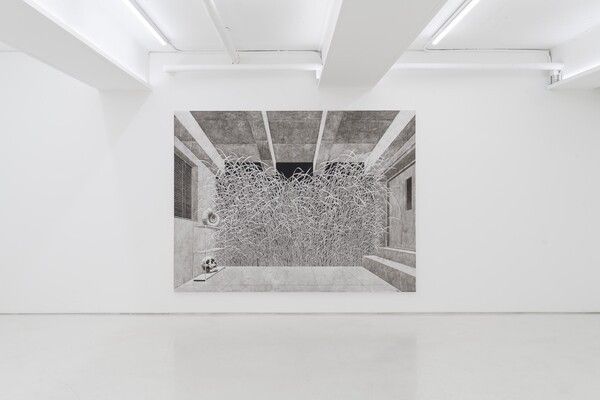
This tension carries directly into Lee's paintings. Silver grass is no longer simply vegetation. Its dense, overlapping stems take on the rhythm of anxiety—restless, proliferating and difficult to contain. The lines that restrain it suggest another force: the social structures that keep disorder at bay.
The boundary holds, but only just.
Ivy functions in a similar way. Its vines seem to move without a destination, climbing walls and spreading across surfaces according to no obvious plan. Yet within that apparent disorder lies repetition, rhythm and structure. Nature may resist human geometry, but it is not without rules of its own.
Lee brings those organic systems into confrontation with concrete.
Walls are cleanly divided, rigid and cold. They embody a different kind of order—one imposed through architecture, boundaries and closure. Yet their precision does not necessarily produce comfort. A wall protects, but it also blocks. It keeps danger out while keeping the person inside.
Against those walls, vines and silver grass continue to grow.
At moments, Lee's paintings seem to capture nature on the verge of breaking through the architecture altogether. The resulting tension turns the canvas into something like a measure of internal pressure: anxiety accumulating behind a surface that may no longer be able to contain it.
Lee recalls imagining, during long periods alone in his studio, that one of the walls might suddenly collapse and nature would rush inside.
It is an image charged equally with fear and relief.
The collapse of a wall means the loss of protection. It also means the end of confinement. Nature entering the room can therefore signal destruction and liberation at once—the breakdown of an established order, but perhaps also the beginning of recovery.
"Was the wall like the rope that held back the silver grass?" Lee asks. "Was it a rule, or perhaps an unspoken social agreement?"
The question reaches beyond architecture.
The walls of a city, the ropes around a park, the door of a studio and the unwritten rules governing relationships all serve a purpose. They create stability and protect those within them. But the same structures determine where a person may go, how they should behave and what they are expected to conceal.
"Grotto" remains suspended inside that contradiction.
Does the person hiding in the cave want someone to come and pull them out? Or must they decide to leave on their own?
Lee offers no resolution. His exhibition is less concerned with escape itself than with the moment immediately before it—the hesitation between remaining somewhere safe and stepping into a world where breathing may be easier.
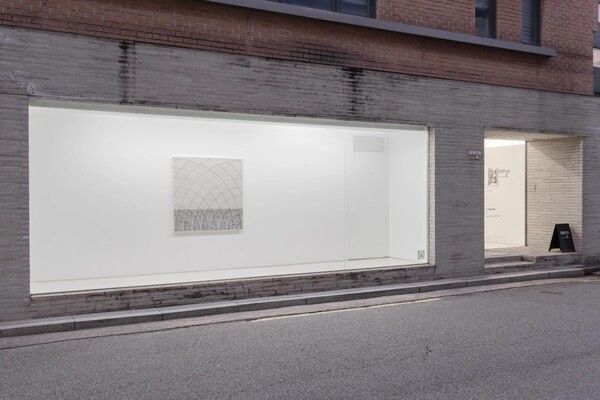
The anxiety running through Lee's work is therefore never merely personal. It absorbs the exhaustion of social relationships, the residue of private events, the density of urban life and the claustrophobia of prolonged isolation. The decaying surfaces of old buildings and the artificial boundaries imposed upon nature become part of the same psychological landscape.
Lee rarely describes those emotions directly. Instead, architecture and nature speak for them.
A hiding place becomes both sanctuary and trap. Nature suggests freedom, yet remains contained behind a boundary. An aging building carries the scars of neglect while revealing an unexpected beauty.
Lee allows those contradictions to remain unresolved.
Even the visual density of his paintings follows this logic. Lines without obvious beginnings or endings overlap with repeating structures and tightly packed patterns. At first, the surfaces can feel disorienting. Look longer, however, and a rhythm begins to emerge.
Chaos reveals its own order.
For a brief moment, the anxiety does not disappear. It simply finds a way to coexist with stability.
That fragile equilibrium is where "Grotto" ultimately resides—not safely inside the cave, and not yet fully outside it, but somewhere at the threshold between the two.
Deokyoung Lee earned his bachelor's degree in Western painting from Mokwon University and later completed a master's degree in fine arts at the same university. He has held solo exhibitions at Cheongju Art Studio, ArtSpace128, the Lee Ungno Museum and Wooyeon Gallery. His work has also been featured in group exhibitions at Chapter II, Daejeon Museum of Art, Seoul National University Museum of Art, Gallery MIM and Chang Ucchin Museum of Art Yangju.
Reported by News Culture M.J._mj94070777@nc.press
Copyright ⓒ 뉴스컬처 무단 전재 및 재배포 금지


