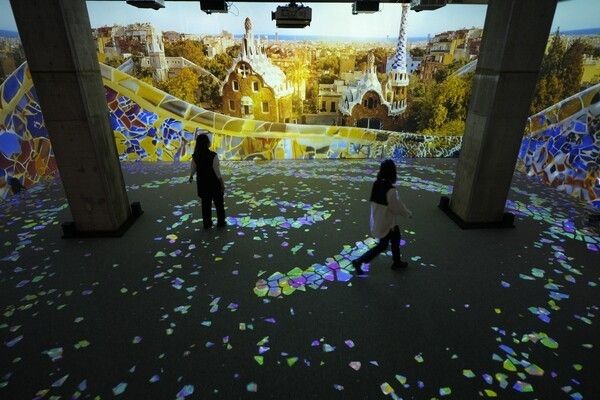
Antoni Gaudí's architecture has long challenged conventional ideas of form. Rejecting straight lines in favor of organic geometry, he drew inspiration from forests, skeletal structures, natural light, and the rhythms of the living world. This summer, that vision becomes the focus of a major exhibition in Seoul.
Opening this August at Sinsa House in Seoul's Gangnam district, "Gaudí: Reborn in Seoul" marks the first official exhibition in Korea organized in collaboration with the Gaudí Foundation. Presented in conjunction with the centennial of the architect's death, the exhibition also celebrates the completion of the Tower of Jesus Christ at the Sagrada Família, one of the defining milestones in Gaudí's lifelong masterpiece.
Rather than functioning as a conventional retrospective, the exhibition examines the creative principles behind Gaudí's architecture. Visitors encounter original notebooks, drawings, tile studies, archival materials, and certified reproductions while tracing the relationships between nature, engineering, faith, and artistic expression that shaped his work.
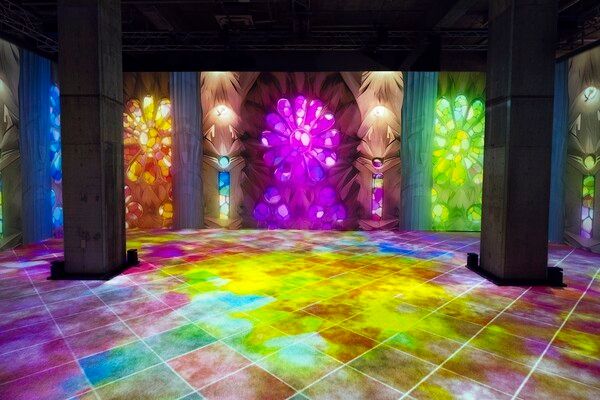
Built around seven immersive thematic sections, the exhibition explores architecture as an evolving dialogue between structure and imagination. Large-scale media installations recreate the spatial atmosphere of Gaudí's buildings, while interactive AI experiences encourage visitors to experiment with the design logic behind his signature forms. Digital technology complements—rather than replaces—the historical materials, keeping the architect's research process at the center of the experience.
Among the exhibition's highlights are three-dimensional reconstructions of Gaudí's unrealized projects, including the Hotel Attraction, Tangier Tower, and Colònia Güell studies. Developed from more than four decades of research conducted by the Gaudí Foundation alongside an international team of architects and scholars, the models are being presented to the public for the first time. Together, they offer a rare opportunity to examine ideas that existed only in sketches, fragmented documentation, and unfinished structural experiments.
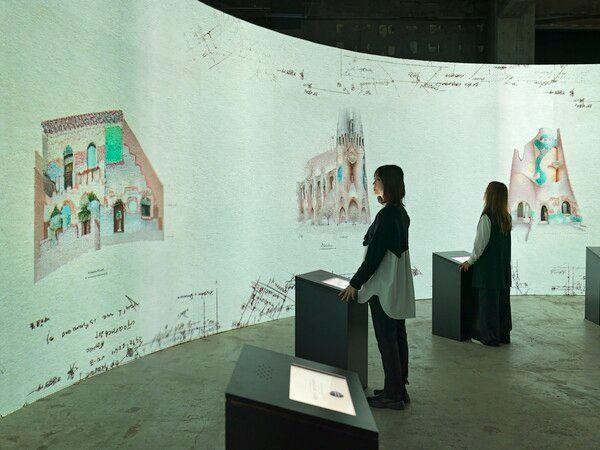
The Seoul presentation has also been designed specifically for its venue rather than simply adapting an international touring format. Spatial planning by Junglim Planning Advisory (jpa.) introduces several Korea-exclusive installations, including the interactive Ribbon Space, where visitors contribute their own interpretations of Gaudí's design philosophy, and Calle Gaudí, an environment inspired by the streets of Barcelona. A rooftop terrace further extends the exhibition beyond the gallery itself, encouraging visitors to experience architecture as an atmosphere rather than a collection of objects.
Special programming broadens the exhibition's perspective beyond architectural history. Actor Ryu Seung-ryong provides the official audio guide, translating complex architectural concepts into accessible storytelling, while neuroscientist Jang Dong-seon leads the Art & Brain Salon, examining how the human brain responds to curves, light, color, and spatial composition. Together, these programs position Gaudí's work at the intersection of architecture, perception, and cognitive science.
For the Gaudí Foundation, the exhibition is less about celebrating an architectural icon than revealing the ideas that shaped his creative practice. Nature was never something Gaudí simply imitated; it served as a system to be observed, analyzed, and transformed into architecture. Growth patterns, structural balance, gravity, and light became the foundation of a visual language where ornament and engineering functioned as one.
By combining original archival materials, newly reconstructed three-dimensional models, and contemporary digital interpretation, "Gaudí: Reborn in Seoul" presents one of architecture's most influential figures through a fresh lens. Instead of treating Gaudí as a historical monument, the exhibition invites audiences to engage with the questions that continue to define his legacy—how nature informs design, how structure shapes beauty, and how imagination turns unfinished ideas into enduring works of art.
Reported by News Culture M.J._mj94070777@nc.press
Copyright ⓒ 뉴스컬처 무단 전재 및 재배포 금지


