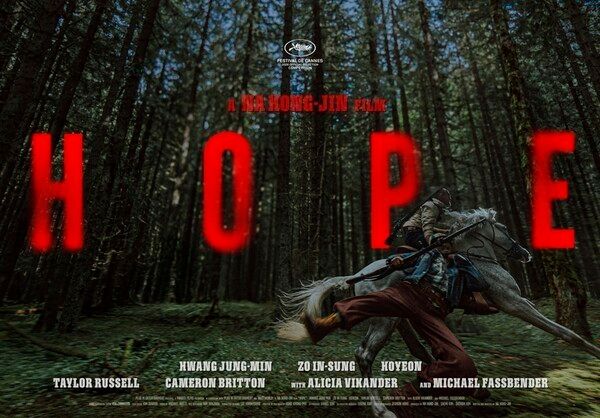
This review contains spoilers for HOPE.
Some films leave audiences entertained. Others leave them arguing long after the credits roll. HOPE manages to do both.
Ten years after The Wailing, writer-director Na Hong-jin returns with a 156-minute epic that refuses to stay within a single genre. Action, thriller, science fiction and unexpected flashes of dark comedy all coexist within a film that constantly shifts its shape without losing its momentum.
Its greatest achievement comes early. The opening hour is so relentlessly gripping that it immediately pulls viewers into Na's world, delivering one unforgettable set piece after another before expanding into something far more ambitious. It is an opening stretch that ranks among the strongest sequences of the director's career.
Set in Hopo Port near the Korean Demilitarized Zone, the story begins with local administrative chief Beom-seok (Hwang Jung-min), who learns from villagers—including Seong-gi (Zo In-sung)—that a tiger has been spotted nearby. The gruesome discovery of a mutilated dog lying in the middle of the road signals that something far more dangerous has entered the village.

The situation quickly spirals into chaos. Entire areas are left devastated as if a war has swept through the town. With emergency personnel dispatched to fight nearby wildfires, Beom-seok is forced to confront the unknown with little official support. Elderly villagers take up rifles themselves, while Seong-ae (Jung Ho-yeon) joins the desperate effort to contain the unfolding disaster. Meanwhile, Seong-gi and the young men who venture into the mountains unexpectedly become the hunted instead of the hunters.
What begins as a terrifying local incident gradually grows into a tragedy of far greater proportions.
Once the film delivers one of the most exhilarating action sequences seen in Korean cinema in years, HOPE seamlessly transforms again. The survival thriller evolves into an unsettling science-fiction story as the extraterrestrial lifeform that generated so much discussion following the film's Cannes premiere finally emerges in full view.
Na never abandons suspense, but he also isn't afraid to disrupt it. At unexpected moments, dark humor slips into even the bleakest situations, producing uneasy laughter without undermining the overwhelming sense of dread. It is an unlikely tonal balance, yet one the director controls with remarkable confidence.
The film's constant shifts should feel excessive on paper. Instead, they rarely do, thanks largely to Na's meticulous direction and a cast fully committed to the material. Hwang Jung-min anchors the escalating crisis with quiet authority, while Zo In-sung and Jung Ho-yeon bring emotional weight to a story that continually expands beyond familiar genre conventions.




Not every creative decision will divide audiences in the same way. The extraterrestrial creature—particularly its appearance and movement in broad daylight—is likely to prove one of the film's most polarizing elements. Some viewers may also question the narrative turn that unfolds during the final minutes.
Yet those choices are inseparable from Na's larger artistic vision. Rather than presenting the alien as a conventional movie monster, he uses the encounter to reflect fears, violence and social anxieties rooted in realities that people already recognize. Whether or not viewers embrace every aspect of the creature's design, it becomes difficult to dismiss the achievement of the film as a whole. The visual composition, scale and atmosphere remain consistently striking.
By the time HOPE reaches its conclusion, Na deliberately leaves many doors open. The central story may be complete, but the questions it raises continue long after the credits roll. Instead of providing easy answers, the film invites audiences to imagine what comes next—and to keep debating what they have just witnessed.
That lingering conversation may ultimately become HOPE's greatest strength. It is a film that demands interpretation rather than simple resolution, and one that feels likely to secure a lasting place in the ongoing evolution of Korean cinema.
Reported by News Culture M.J._mj94070777@nc.press
Copyright ⓒ 뉴스컬처 무단 전재 및 재배포 금지


