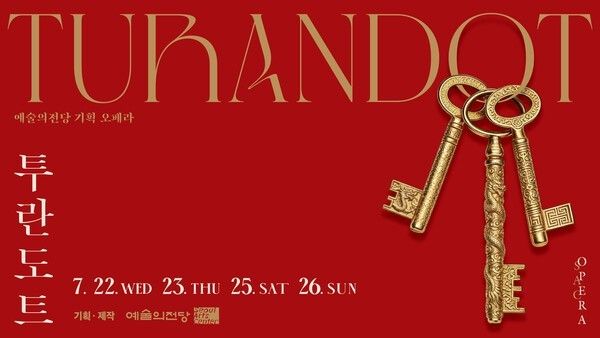
As Giacomo Puccini's Turandot marks the centenary of its premiere, the opera is returning to the stage with a contemporary perspective that shifts its focus from conquest to coexistence.
The Seoul Arts Center will present its 2026 production of Turandot at the Opera Theater from July 22 to 26. Anticipation has been exceptionally strong, with all performances selling out within three weeks of ticket sales opening.
Long recognized for its spectacular staging and grand score, Turandot is traditionally remembered as the story of the icy princess and the prince Calaf, who dares to challenge her. This production, however, moves beyond the familiar romantic narrative to examine deeper questions embedded within the work: Can people truly understand one another and coexist beyond the frameworks of victory and defeat, domination and submission?
Director Sunyoung Jung expands the opera's central conflicts into a reflection on the divisions and tensions that define contemporary society. Her interpretation particularly draws on the symbolism of the third riddle, exploring power dynamics and hierarchy while emphasizing the possibility of empathy, transformation and mutual understanding. In this reading, the relationship between Calaf and Turandot becomes less a tale of conquest than a journey toward confronting personal wounds and accepting another person.
That concept extends visually throughout the production. Jung also designed the stage set, creating a cohesive world in which towering fortress walls and gates lined with iron spearheads function both as defenses against external threats and as symbols of self-imposed isolation.
Turandot's domain is conceived as a hybrid of fortress and warship. Red iron bars and sharp architectural forms evoke a society shaped by conflict and fear, while rusted and damaged surfaces hint at the insecurity and trauma hidden beneath displays of strength. As the opera progresses, those seemingly impenetrable structures begin to fracture, opening the possibility of renewal, reconciliation and hope.
The cast is led by internationally acclaimed tenor Baek Seok-jong as Calaf. Having appeared at major houses including the Metropolitan Opera, the Royal Opera House and the Deutsche Oper Berlin, Baek will make his Korean opera-stage debut in the role. Audiences are expected to pay particular attention to his interpretation of Puccini's iconic aria "Nessun Dorma."
The title role will be performed by soprano Ewa Płonka, whose career has taken her to leading venues including La Scala, the Royal Opera House and Bavarian State Opera. She is joined by an accomplished cast that includes Hwang Sumi, Shim In-sung, Seo Sun-young, Kim Young-woo, Shin Eun-hye and Park Young-doo.
The production will be performed by the National Symphony Orchestra of Korea under the baton of Roberto Abbado. Together, the creative team seeks to revisit Puccini's final masterpiece through a distinctly contemporary lens while remaining faithful to its emotional and musical power.
A century after its debut, Turandot continues to pose a question that remains strikingly relevant today: Is it possible to move beyond winners and losers and find a way to live together? Seoul Arts Center's new production offers its own artistic response.
Reported by News Culture M.J._mj94070777@nc.press
Copyright ⓒ 뉴스컬처 무단 전재 및 재배포 금지


