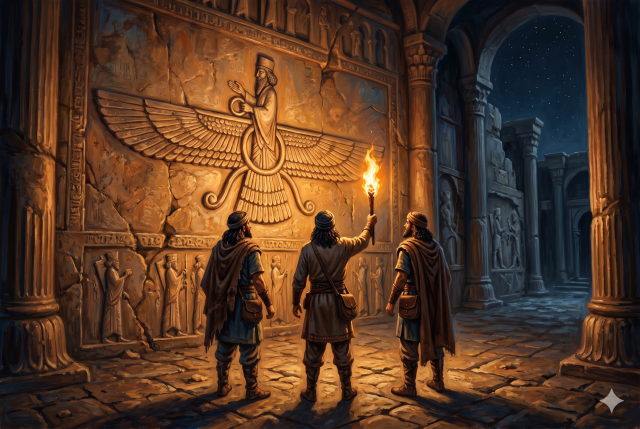
This is the eleventh installment of AJP's Spiritual Asia series exploring the religious traditions, philosophical ideas and moral foundations that have shaped Asia's civilizations. This chapter turns to Zoroastrianism, one of the world's oldest living faiths, and examines how its teachings on truth, free will and moral responsibility continue to resonate in an age increasingly shaped by artificial intelligence.
India and Iran, a Grand Epic of Spirituality Born Under the Same Sky
Delving deeply into the history of human civilization reveals a surprising fact: Hinduism and Zoroastrianism, which appear to be entirely different religions today, actually originated from a single root. One developed along the Ganges River in India, while the other grew centered around the Iranian plateau. One walked the path of reincarnation and spiritual liberation, while the other walked the path of a cosmic struggle between good and evil. Yet, at their starting point, an astonishing number of commonalities exist.
We often think of India and Iran as distinct civilizational spheres, but this was not the case in antiquity. Thousands of years ago, Indo-Iranian Aryans inhabited the Central Asian steppes and the region east of the Caspian Sea. They spoke similar languages, shared similar myths, and held a largely common religious worldview. Later, some migrated south to form the Indian civilization, while others moved west and south to form the Iranian civilization.
Linguists point out that modern Sanskrit and ancient Avestan are strikingly similar. Words sharing the exact same etymological roots appear repeatedly in the Vedas, the Hindu scriptures, and the Avesta, the Zoroastrian scriptures. This is no mere coincidence. It is evidence that both religions share a common spiritual ancestor.
A prime example is the concept of cosmic order. The word 'Rta' appears in the Hindu Vedas. Rta is the order that governs the universe, the ultimate truth, and the law of nature. It is the reason the sun rises, the seasons change, and humans must lead a moral life.
In Zoroastrianism, the concept of 'Asha' emerges. Asha is also truth, justice, and the order that operates the universe. Its meaning and role are remarkably similar to Rta. Scholars view this as one of the oldest spiritual legacies shared by the two civilizations.
However, history always sends the waters of the same river into different seas. Over time, these two religions, which started from the same root, began to develop in completely divergent directions.
Hinduism moved toward exploring Brahman, the source of the universe, and Atman, the true inner self of human beings. It taught that humans endlessly reincarnate, experiencing the consequences of their karma. And finally, through enlightenment, one can reach Moksha, or liberation, breaking free from the cycle of rebirth.
To the people of India, the world was one giant cycle. Life and death repeat, and the universe endlessly reiterates creation and destruction. Time was not a straight line, but a circle.
Conversely, Zoroastrianism chose an entirely different path. Zoroaster viewed humans as beings who must actively choose between good and evil. The world was not a simple cycle, but a historical process marching toward a distinct purpose. Human choices mattered, and it was believed that justice would ultimately triumph in the end.
Time was not a circle, but a straight line.
This difference went beyond mere religious ideology to determine the direction of entire civilizations.
Where Hinduism emphasized inner enlightenment and spiritual perfection, Zoroastrianism emphasized social justice and moral responsibility. Where Hinduism explored the roots of existence, Zoroastrianism prioritized human choices and actions.
Of course, the two are not mutually exclusive. Rather, they are closer to a complementary relationship.
Indian civilization explored the universe within the human mind, while Iranian civilization stressed moral practices aimed at transforming the real world in which humans live. One was the path of meditation, and the other was the path of action.
The Hindu Upanishads declare, "Tat Tvam Asi," meaning "Thou art that." This signifies that the truth of the universe resides within the human being. In contrast, Zoroastrianism champions "Good thoughts, good words, good deeds," meaning that truth must be realized through human behavior.
Interestingly, both religions underscored human freedom.
In Hinduism, individuals can change their future through their karma. In Zoroastrianism, individuals decide for themselves whether to choose good or evil. Neither religion viewed humans as slaves to destiny.
In the intellectual history of humanity, this holds profound significance.
Many religions in the ancient world viewed humans as playthings of the gods. However, Hinduism and Zoroastrianism granted humanity both responsibility and freedom simultaneously. Humans are not merely beings dragged along by fate, but beings who actively create their own lives.
This tradition would later profoundly influence Buddhism, Judaism, Christianity, and Islam in various forms.
In fact, comparing Zoroastrianism and Hinduism reveals commonalities even in the names of deities. In India, Deva was a positive entity meaning god, but in Iran, Daeva morphed into a negative entity. Conversely, in India, Asura was depicted as an evil being, but in Zoroastrianism, Ahura came to mean the supreme God.
They started from the same root but evolved in opposite directions.
This is much like brothers from the same family living entirely different lives. The starting point is the same, but different experiences and environments lead them down vastly different paths.
As India encountered the Ganges civilization, it walked deeper into the path of spiritual contemplation. As Iran interacted with Mesopotamian and Central Asian civilizations, it placed greater emphasis on the issues of history, statehood, justice, and governance.
As a result, India developed the world's grandest religious philosophy, while Iran developed the world's first advanced ethical monotheism.
Zoroastrianism, in particular, would go on to have a massive impact on later Judaism, Christianity, and Islam. Concepts such as angels and demons, the Last Judgment, heaven and hell, and messianism later became the core of the Western religious worldview.
Meanwhile, Hinduism gave birth to Buddhism, Jainism, and Sikhism, forming the massive current of Eastern spirituality.
It is no exaggeration to say that the two great pillars of world religion today perhaps diverged at this very juncture.
One is the tradition of enlightenment that began in India, and the other is the tradition of justice that began in Iran.
However, we do not need to choose only one of the two.
The greatest crisis facing modern civilization is that the pace of technological advancement has outstripped the maturation speed of the human spirit. Artificial intelligence can process more information than humans, but it cannot judge what is a good deed. Algorithms can increase efficiency, but they cannot teach us the meaning of life.
At times like this, Hinduism tells us to look inward. It teaches that the true universe is within us. On the other hand, Zoroastrianism tells us to practice justice in reality. It teaches us to change the world through good thoughts, good words, and good deeds.
One asks about the depth of existence, and the other asks about the direction of life.
And perhaps what humanity needs is ultimately both.
Action without thought is dangerous. Enlightenment without action is empty. Only when inner reflection and real-world practice meet can civilization develop healthily.
Hinduism and Zoroastrianism, which diverged from a single root thousands of years ago, are meeting again today at the ends of their respective paths. One questions the essence of human existence, and the other questions the responsibility of human action.
And those two questions ultimately converge into one.
Who are humans, and how should we live?
Asia's great spiritual traditions have not let go of that question for thousands of years. Today, living in the era of AI, we too stand once again before that question.
Copyright ⓒ Aju Business Daily 무단 전재 및 재배포 금지


