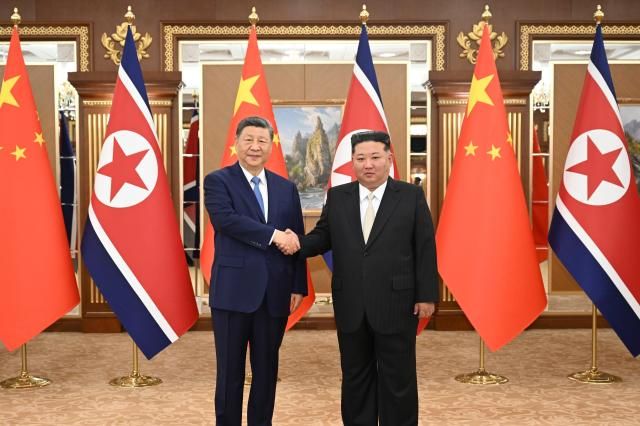
SEOUL, June 09 (AJP) - North Korea's young ruler Kim Jong-un, who once dominated international headlines through his unprecedented courtship with U.S. President Donald Trump during the latter's first term, is back on front pages – this time under the arms of the elder strongmen of a resurgent authoritarian axis.
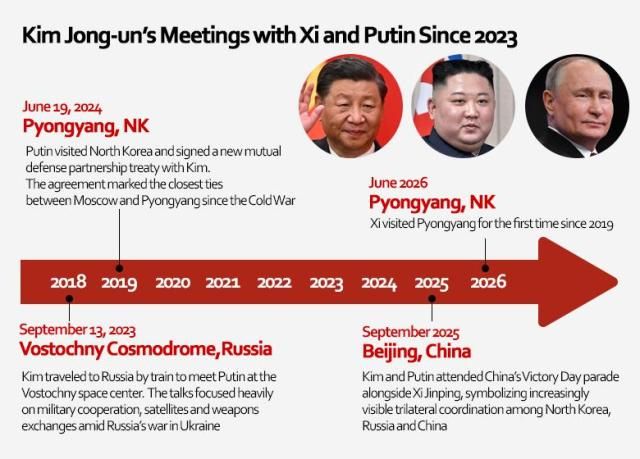
During his latest visit to Pyongyang — his first in seven years — Chinese President Xi Jinping called for expanded exchanges with North Korea in diplomacy, law enforcement and, notably, defense, reflecting Beijing's growing concern over Pyongyang's rapidly deepening military ties with Moscow.
Xi arrived in Pyongyang shortly after hosting both U.S. President Donald Trump and Russian President Vladimir Putin in Beijing, highlighting North Korea's rising strategic value as U.S.-China competition intensifies and Russia's war in Ukraine reshapes global alignments.
According to China's state-run Xinhua News Agency, Xi urged deeper cooperation across a wide range of sectors, including military exchanges — a rare public reference that underscored Beijing's determination to remain North Korea's primary strategic partner.
Chinese Defense Minister Dong Jun accompanied Xi on the trip, unlike Xi's previous visit to Pyongyang in 2019, when China's defense chief was absent from the delegation.
Xi's visit, his first overseas trip of the year, came less than three weeks after his summit with Putin in Beijing.
The timing suggested that China was seeking not merely to celebrate traditional friendship with North Korea but to recalibrate the evolving triangular relationship among Beijing, Pyongyang and Moscow following the Ukraine war.
The summit also comes ahead of the 65th anniversary next month of the China-North Korea Treaty of Friendship, Cooperation and Mutual Assistance, signed in 1961. The treaty, which includes a mutual defense clause often described as an "automatic intervention" provision, had largely faded into irrelevance after the Cold War.
Despite their deep-seated alliance between Pyongyang and Beijing, North Korea's growing military partnership with Moscow has reshaped regional dynamics.
Since Pyongyang signed a comprehensive strategic partnership treaty with Moscow in 2024, North Korea has emerged as one of Russia's most important wartime partners, supplying artillery shells, missiles and troops for the war in Ukraine in exchange for military technology, energy and economic support.
For the first time since the Soviet collapse, North Korea is no longer reliant on a single benefactor. Russia needs Pyongyang for its war effort, while China increasingly sees strategic value in preventing North Korea from drifting too far into Moscow's orbit.
The result is a rare geopolitical moment in which Kim enjoys greater diplomatic leverage than at any point in recent decades.
That shift helps explain the significance of Xi's visit. While Beijing welcomes closer Russia-North Korea ties insofar as they complicate U.S.-led security cooperation among Washington, Seoul and Tokyo, it has little interest in seeing Moscow emerge as Pyongyang's dominant strategic patron.
Analysts say Xi's decision to visit Pyongyang shortly before the treaty anniversary reflects Beijing's anxiety.
Chinese analyst Deng Yuwen recently wrote in Foreign Policy that if Beijing distances itself from North Korea, it risks pushing Pyongyang entirely toward Russia and weakening China's influence on the Korean Peninsula.
North Korea's strategic importance has risen significantly since the outbreak of the Ukraine war, allowing Kim to strengthen his diplomatic leverage between Beijing and Moscow.
Russia is eager to preserve its hard-won partnership with North Korea, while China is moving to reaffirm its own influence over Pyongyang.
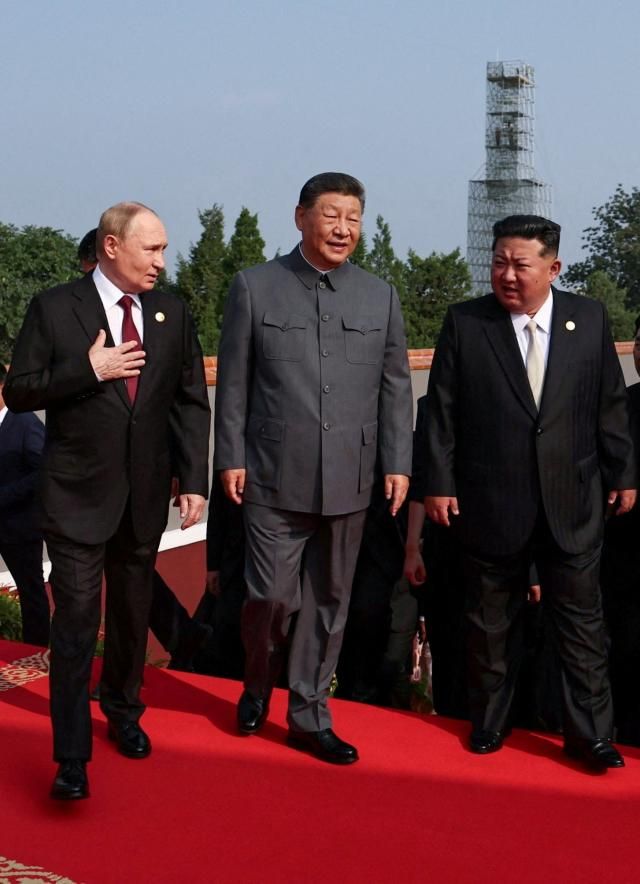
The three countries publicly displayed their growing alignment during China's military parade marking the 80th anniversary of victory in World War II last September, when Putin and Kim stood alongside Xi atop Beijing's Tiananmen Gate.
Yet despite its closer ties with Russia, North Korea remains economically dependent on China. More than 90 percent of North Korea's external trade is believed to involve China, making Beijing the country's indispensable economic lifeline.
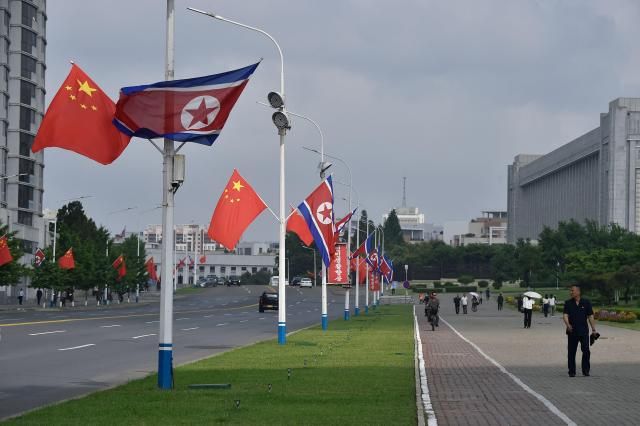
Xi's delegation included Commerce Minister Wang Wentao, who oversees sanctions-related trade issues, and Zheng Shanjie, head of China's National Development and Reform Commission, signaling that economic cooperation was a major topic of discussion.
China had long adopted a cautious approach toward economic engagement with North Korea because of international sanctions, refraining from large-scale direct investment even before the COVID-19 pandemic largely shut down cross-border trade in 2020.
But the geopolitical environment has changed dramatically.
When Xi made his first state visit to North Korea seven years ago, Pyongyang was heavily dependent on Beijing and largely in the position of seeking Chinese support. Today, China also sees growing strategic value in maintaining close ties with North Korea as competition with the United States intensifies.
North Korea, meanwhile, has broadened its diplomatic options through its wartime alignment with Russia and no longer relies exclusively on Beijing.
During Kim's visit to China last September, he called for deeper economic and trade cooperation between the two countries. Analysts say Xi's remarks during this week's summit suggest Beijing may now be prepared to restore bilateral economic cooperation to levels exceeding those seen before the pandemic.
Xi also directly mentioned fully reopening border trade ports between the two countries, signaling a likely expansion of cross-border commerce through more than 10 major crossing points, including Dandong-Sinuiju and Hunchun-Rason.
The message was clear. Beijing is not merely reaffirming a traditional alliance; it is re-engaging North Korea at a moment when Pyongyang has acquired new strategic options.
As strategic competition deepens across Eurasia, North Korea has regained something every small state seeks in international politics — leverage. The greatest beneficiary of the renewed China-Russia rivalry may ultimately be Kim Jong-un himself.
Copyright ⓒ Aju Business Daily 무단 전재 및 재배포 금지


