This is the eighth installment of AJP’s “Spiritual Asia” series exploring the religious traditions and philosophical foundations that have shaped Asia’s spiritual consciousness. This chapter turns to the ancient texts of Hinduism — the Vedas and Upanishads — and their enduring ideas on cosmos, consciousness and the nature of existence in the emerging AI era.
Humanity in the 21st century is passing through the greatest civilization shift in history. Artificial intelligence (AI) learns human languages, robots replace human labor, and algorithms have even begun to predict our choices. We are enjoying more material wealth than any generation before us, but ironically, our anxiety, loneliness, conflicts, and feelings of emptiness are only growing deeper. Technology has advanced brilliantly, yet the fundamental questions about our existence remain. Why do we live? What are we here for? And how can we find true freedom and peace?
Facing these questions, humanity is looking toward Asia once again. At the center of this attention is Buddhism, which has explored human suffering and the meaning of life for over 2,600 years. Buddhism is not merely a religion. It is an intense reflection on human existence and a great spiritual revolution that analyzed the causes of our pain and offered clear answers. Today, hundreds of millions of people around the world find their life's direction within Buddhist teachings, and it is no exaggeration to say that much of East and Southeast Asian civilization was built upon the massive spiritual foundation of Buddhism.
Buddhism began with a human being, not a god. Siddhartha Gautama, the founder of Buddhism, was born around the 6th century BC in the Lumbini region of modern-day southern Nepal. He lived a comfortable life as a prince, but one day outside his palace, he saw an old person, a sick person, and a corpse. In that moment, he realized that no human being can escape aging, illness, and death. At the time, Indian society was ruled by a caste system and a culture of rituals centered on the Vedas. People believed their fate was decided entirely by the class they were born into, and religion focused heavily on ceremonies. However, the young Siddhartha felt that a religion or philosophy that couldn't solve the core problem of human suffering was not the true answer. Ultimately, at the age of 29, he left his royal life behind and chose the path of an ascetic seeker.
The six years of training that followed were a challenge to human limits. He sought out the best spiritual teachers of his time and endured extreme hardships. Yet, he eventually realized that physically torturing the body was not the way to end human suffering. Finally, he sat beneath the Bodhi tree, entered deep meditation, and achieved enlightenment at the age of 35. From that moment on, he became the Buddha, meaning "the awakened one." And the core of his realization became the central teaching of Buddhism: the Four Noble Truths.
The Four Noble Truths are the most concise yet profound insights into human life. First is the truth of suffering. This is the reality that suffering exists in life. Birth is suffering, aging is suffering, and illness and death are suffering. Parting with someone you love is painful, and meeting someone you dislike is painful. Failing to get what you want is also a form of suffering. Buddhism does not ignore the harsh realities of life. Instead, it faces them with absolute honesty.
Second is the truth of the cause of suffering. This is the teaching that every suffering has a root cause. This cause does not come from the outside world, but from human greed, attachment, and ignorance. The desire to have more, the urge to climb higher, and the clinging wish for things to never change are what ultimately make us suffer. This is not much different when we look at the lives of modern people today. Endless competition, comparison, excessive consumption, and an obsession with success are only making humans more anxious.
Third is the truth of the end of suffering. This is the teaching that suffering can be overcome. If we let go of our greed, attachment, and ignorance, we can break free from our pain. Buddhism does not leave humans in despair. Rather, it sees that we hold the potential to change ourselves from within.
Fourth is the truth of the path. This is the teaching that there is a practical path to overcome suffering. That path is the Eightfold Path: right view, right resolve, right speech, right action, right livelihood, right effort, right mindfulness, and right concentration. Buddhism does not simply tell us what to believe. It teaches us how to live. The Eightfold Path is a practice that aligns our thoughts, words, actions, and minds in the right direction.
To understand Buddhism, you must ultimately understand the Four Noble Truths and the Eightfold Path. These are not merely religious doctrines. They serve as a form of spiritual medicine and a life philosophy that diagnoses and treats the problems of human life. In fact, this is why many scholars call Buddhism the world’s very first psychology. The Buddha observed the human mind, analyzed the roots of pain, and offered a clear path to healing.
Another great insight of Buddhism is the concept of dependent origination. This is the teaching that everything in the world is connected, and nothing exists entirely on its own. A single flower cannot exist without sunlight, rain, soil, and wind, and humans, too, live within families, societies, nature, and the universe. In this way, all beings depend on and connect to one another. In today’s era of climate and ecological crises, this thought carries even greater meaning. The realization that humans are not the masters of nature, but a part of it, is the very wisdom that modern civilization desperately needs to relearn.
Buddhism also views compassion as its highest virtue. Compassion is more than just feeling pity. It is the heart that feels another person's pain as its own and seeks to ease that pain together. After achieving enlightenment, the Buddha did not stay hidden away in the mountains. He walked across India for 45 years, sharing his truth with the people. Buddhism never tried to change the world with swords or force. It sought to change the world by changing the human heart. This is the greatest power that Buddhism holds.
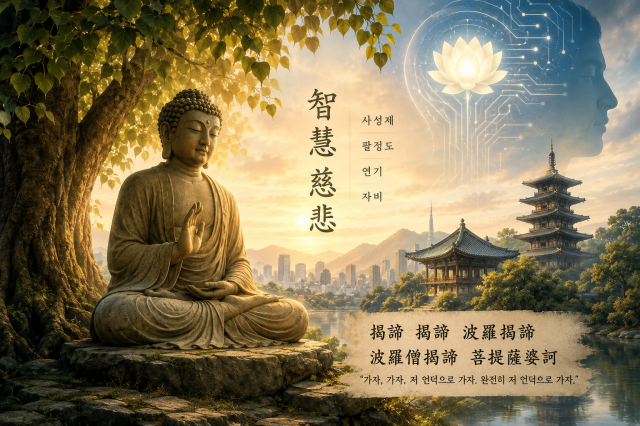
One of the most beautiful summaries of the Buddhist spirit is the final mantra of the Heart Sutra.
"Gate, gate, pāragate, pārasaṃgate, bodhi, svāhā."
In traditional characters, it is written as: 揭諦 揭諦 波羅揭諦 波羅僧揭諦 菩提薩婆訶.
Its meaning is, "Let us go, let us go. Let us go to that other shore. Let us completely go to that other shore. Let us go to the world of enlightenment."
Buddhism does not want humans to stay trapped in worldly desires and attachments. It teaches us to cross over from this shore of greed, anger, and ignorance to the other shore of wisdom, compassion, and freedom. This is not just talking about the afterlife. It means that even right now, in this very moment, we can cross over from ignorance to wisdom, from hatred to love, and from desire to freedom. This single verse from the Heart Sutra captures the pure essence of the spirit Buddhism pursues.
From there, Buddhism spread beyond India and across all of Asia. It traveled along the Silk Road into Central Asia, reaching China, Korea, Japan, and Vietnam, becoming the spiritual pillar of East Asian civilization. In China, it met Confucianism and Taoism to develop into Zen Buddhism. In Tibet, it formed the esoteric tradition, and in Japan, Zen combined with the samurai spirit. Korea, too, was deeply influenced by Buddhism from the Three Kingdoms period straight through the Goryeo and Joseon dynasties. Bulguksa Temple, Seokguram Grotto, and the Tripitaka Koreana at Haeinsa Temple are not just cultural relics. They are magnificent spiritual legacies left behind by Buddhist civilization.
In particular, Korean Buddhism produced outstanding thinkers like Wonhyo, Uisang, and Jinul. Wonhyo introduced the philosophy of hwajaeng, offering the wisdom to harmonize different ideas. This provides a profound lesson for modern South Korean society today, where conflict and division are deepening. It reminds us that true wisdom lies not in defeating opponents, but in harmoniously integrating different truths.
Today, Western society is also turning its attention back to Buddhism. Meditation and mindfulness have become a global lifestyle, and leading institutions like Harvard, Stanford, Oxford, and Cambridge are actively researching the intersections of Buddhism, brain science, and psychology. Tech companies in Silicon Valley are also bringing meditation into their corporate cultures. They have begun to realize that technological innovation alone cannot make human beings happy.
The age of AI is throwing new questions at humanity. Machines can calculate faster and store more information than humans. But machines cannot feel compassion. They do not hold pity in their hearts. They do not seek enlightenment. Ultimately, Buddhism reminds us that what makes us truly human is not our ability to calculate, but our capacity for self-reflection. It is compassion, not competition, and freedom, not possession.
The awakening of a single seeker under a Bodhi tree 2,600 years ago remains perfectly valid today. Human greatness does not come from owning more things. It comes from understanding more deeply, loving more widely, and living more freely. That is the greatest legacy Buddhism has left for humanity, reaching far beyond Asia, and it is a voice of wisdom that all of us living in the AI era must listen to once again.
Copyright ⓒ Aju Business Daily 무단 전재 및 재배포 금지


