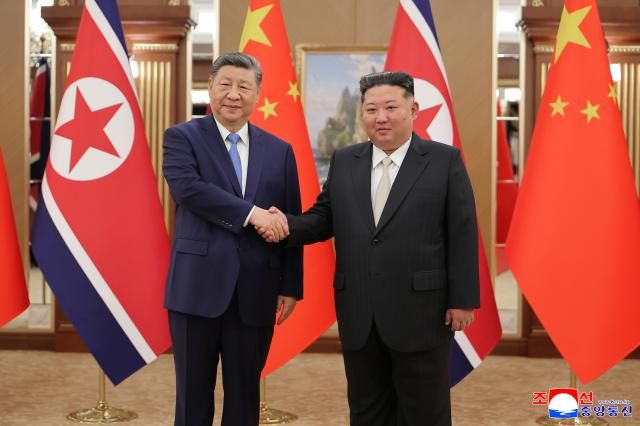
SEOUL, June 09 (AJP) - Chinese President Xi Jinping completely excluded references to denuclearization and the Korean Peninsula during his summit with North Korean leader Kim Jong-un in Pyongyang on Monday. The omission marks a fundamental realignment in how Beijing treats its neighbor, pivoting from managing regional security to utilizing the country as an active strategic asset against South Korea and its allies.
This strategic shift dismantles the long-standing framework for peaceful regional disarmament. By prioritizing institutionalized bilateral ties over regional stability, Beijing is providing diplomatic cover for Pyongyang while actively undercutting international efforts to counter its nuclear ambitions.
The state visit on June 8 marked the first time the Chinese leader traveled to Pyongyang in seven years. During talks at the Kumsusan Guest House, Xi proposed expanding official exchanges across diplomacy, law enforcement and military affairs. The two countries agreed to fully reopen border ports and resume international flights and passenger trains to significantly boost human and economic interaction.
Official Chinese state documents from previous encounters heavily featured the term peninsula, including nine mentions during the 2019 summit. The official Chinese briefing for the latest meeting completely replaced regional security terminology with language emphasizing sovereign state relations and global initiatives.
This integration deepens a northern trilateral alignment connecting North Korea, China and Russia, which directly challenges the security cooperation of South Korea, the United States and Japan. In a commentary published in the Rodong Sinmun newspaper on the day of his arrival, Xi emphasized that both countries must jointly safeguard their sovereignty, security and development interests.
The new alignment echoes a recent joint statement between China and Russia that explicitly opposed diplomatic isolation and economic pressure aimed at North Korea. The direct involvement of top defense officials during the talks indicated an immediate acceleration in trilateral military cooperation. Chinese Defense Minister Dong Jun and North Korean Defense Minister No Kwang-chol both attended the summit.
Analysts suggest this defense framework could pave the way for high-level personnel exchanges or joint naval drills among North Korea, China and Russia at facilities like Wonsan Port. Such maneuvers would serve as a direct counterweight to the joint maritime training conducted by South Korea and its partners.
On the economic front, Beijing indicated a greater willingness to bypass international trade restrictions to revitalize the North Korean economy. The two sides discussed linking development strategies and expanding practical cooperation in trade, agriculture, construction, science, technology and public health.
The cross-border agreements are expected to revive several stalled infrastructure projects. These initiatives include opening the New Yalu River Bridge, renewing the ten-year usage rights for Rajin Port and developing the Tumen River maritime exit project recently negotiated between Beijing and Moscow.
Xi concluded the state visit by calling for grand celebrations to mark the 65th anniversary of the bilateral treaty of friendship, cooperation and mutual assistance.
Copyright ⓒ Aju Business Daily 무단 전재 및 재배포 금지


