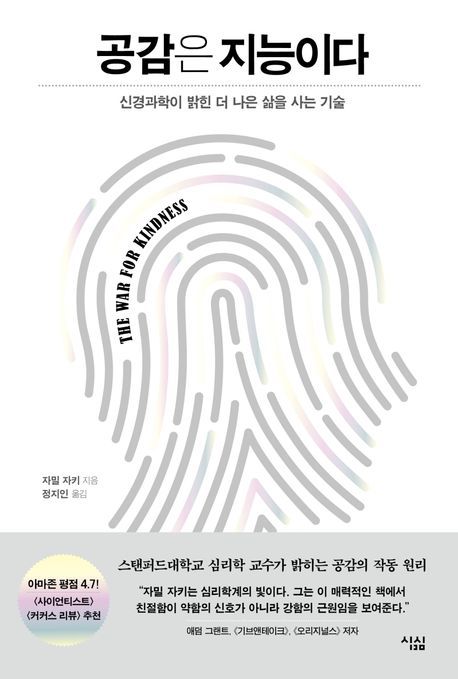
Empathy is often regarded as a matter of personality. Some people are naturally warm, while others seem inherently distant. Empathy Is Intelligence (Korean edition of The War for Kindness by Jamil Zaki, translated by Jung Ji-in) challenges that assumption by presenting empathy as a skill that can be cultivated. The book explores the ability to recognize another person's suffering, maintain healthy emotional boundaries, and choose meaningful action. Rather than an inborn gift, empathy emerges here as a complex competency shaped by practice, environment, and motivation.
One of the book's most compelling strengths is its refusal to romanticize empathy. Sharing another person's pain can be the beginning of care, but carrying that pain indefinitely often leads to exhaustion. Through examples such as medical professionals working in neonatal intensive care units, the author demonstrates how excessive emotional absorption can ultimately hinder one's ability to help patients and families. The distinction between empathic distress and compassionate concern becomes a central argument, separating emotional overwhelm from a genuine commitment to another person's well-being.
Examples involving white supremacy, genocide, prisons, and police training further illustrate that empathy cannot remain an abstract moral virtue. The book argues that even small moments of recognizing another person's humanity can alter patterns of prejudice and hostility. At the same time, it does not offer empathy as a universal solution. When confronted with structural violence and unequal power dynamics, relying solely on empathy risks shifting responsibility onto victims and marginalized communities.
Those with less power often must learn to understand the emotions and expectations of those above them simply to survive. By contrast, those in positions of authority can frequently navigate life without making the same effort. Within these unequal conditions, calls for mutual understanding may sound balanced in theory, yet the burden is rarely shared equally. The book therefore refuses to treat empathy as a comforting slogan. Instead, it asks a more difficult question: who is expected to understand whom?
Ultimately, Empathy Is Intelligence seeks to redefine the role of empathy in modern society. Kindness is neither an automatic virtue nor a demand for endless self-sacrifice. It is a capacity that can be strengthened through practice, weakened through neglect, and exhausted through misuse. More than emotional warmth, the book leaves readers with an appreciation for judgment, discipline, and intentional cultivation. In an age where cynicism and isolation often feel easier than connection, empathy is not a hobby for good people. It is a form of intellectual labor necessary to make both society and human relationships less cruel.
Reported by News Culture M.J._mj94070777@nc.press
Copyright ⓒ 뉴스컬처 무단 전재 및 재배포 금지


