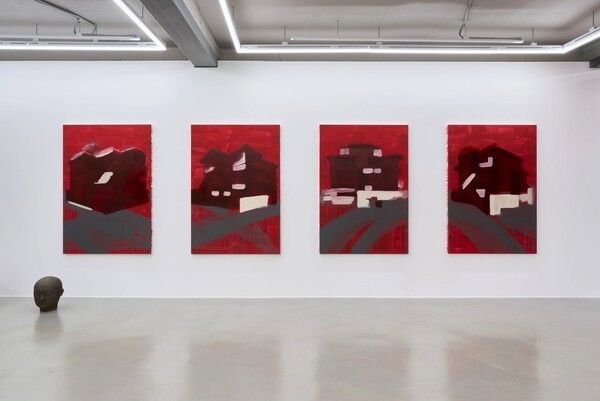
A solitary red house stands like a monument. Resembling an apartment building left alone on an open plain or a low hillside, the image recalls Jung Jik-seong's renowned "Apartment House" series that first brought him recognition more than two decades ago. The sense of construction once expressed through carefully stacked red bricks has now been condensed into dark crimson brushstrokes and solid silhouettes.
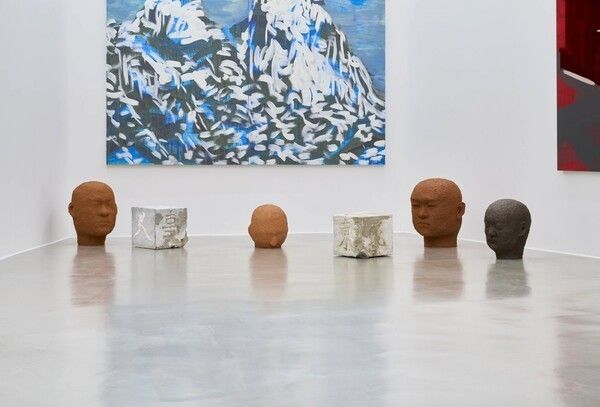
Jung's solo exhibition Headstone marks the beginning of a new chapter following his move to Pungnap-dong in eastern Seoul. In November last year, the artist relocated both his residence and studio there, his forty-eighth move. After presenting MOVE BACK HOME at Space Jiun in Pungnap-dong, Headstone emerges as the next stage of that journey. The exhibition's title refers to a gravestone, and the gallery includes three 35-kilogram cement headstones inscribed with text.
According to Page Room 8 director Park Jung-won, the exhibition represents a significant turning point in Jung's practice. Even while preparing his solo exhibition Everyday Kaleidoscope three years ago, the artist frequently spoke about "headstones" and "placeness." Following his move to Pungnap-dong, those ideas became increasingly concrete.
For Jung, place is not merely a backdrop. It forms both the psychological and physical coordinates of his life. Pungnap-dong lies close to Dunchon-dong, where he spent his childhood, and is home to the ancient earthen fortress associated with the first capital established by King Onjo of Baekje along the Han River. The district developed rapidly after the 1960s, while only fragments of the historic fortress remain today.
Park recalls walking through the neighborhood surrounding Jung's studio and encountering the apartment houses that inspired the "Red House" paintings. Unlike the densely packed residential areas found elsewhere in Seoul, these buildings appeared as independent masses visible from all sides. The houses in Jung's paintings share a similar presence. They are no longer simply representations of urban density or labor, themes that defined his earlier apartment series, but become vessels carrying accumulated memory and emotion. The red color functions simultaneously as the hue of brick and as a marker of time hardened within the human heart.
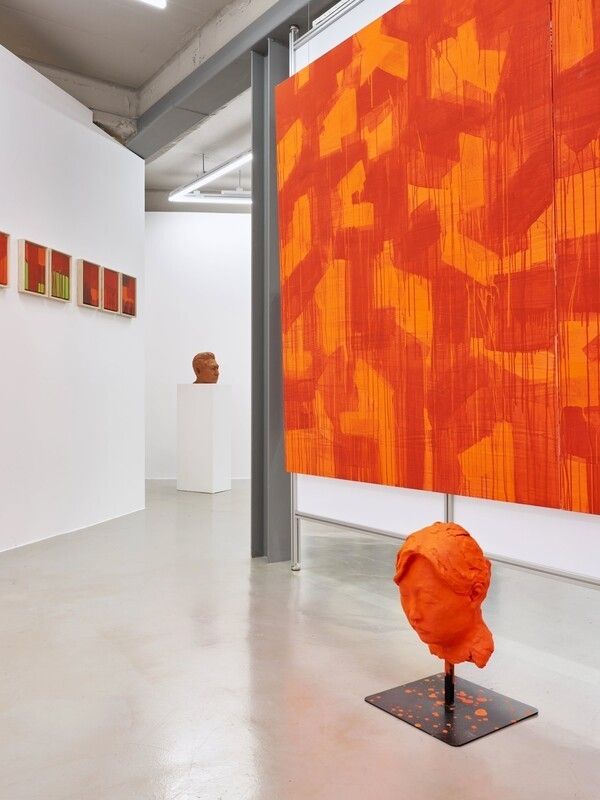
Alongside painting, the exhibition incorporates calligraphy, cement sculptures, and terracotta heads. While these media may appear new to some viewers, they have occupied an important place in Jung's artistic development since his residency at the Lee Ungno Residency in Hongseong in 2020. That experience provided an environment in which he could immerse himself in ceramics and calligraphy, leading to a broader sculptural vocabulary.
Works such as the calligraphy series Letters Settled in the Heart (2020–2021) and terracotta sculptures including Sad Head, Half-and-Half Head, Big Head, Small Head, Open-Lid Head, Ugly Apple Head, and White Head emerged from that period. The heads created over the past two years are modeled after self-portraits, family members, and close friends. They function both as portraits and as physical manifestations of emotion solidified into form.
Jung also gained recognition beginning in 2019 for his "Contemporary Mother-of-Pearl Paintings," which introduced mother-of-pearl into the language of contemporary painting. Traditionally associated with decorative craft, the material was reimagined through abstract motifs such as waves, climate, and machinery. Rather than emphasizing decorative brilliance, these works explored the direction of light, repetitive patterns, and material tension inherent in the medium itself. The artist's personal fascination with mother-of-pearl furniture also informs this body of work.
Headstone emerges during a quieter phase in Jung's artistic trajectory. The emotional turbulence of recent years has altered the rhythm of his painting. The energy that once expanded rapidly across multiple media has slowed, finding a lower and more deliberate current. Within that shift, a different ecology of expression has taken shape.
The symbolism of the headstone is not intended to proclaim existence. Instead, it operates closer to a memento mori, a reminder of mortality and remembrance. The cement forms become surfaces upon which traces of those who have passed, memories that return like mourning, and processes of reflection and recovery are inscribed.
Works such as Spring Snow 202601, 202602 and Spring Mountain 202603, 202604 similarly explore impermanence. Even mountains and seasonal landscapes are not eternal. Through images drawn from nature, Jung reflects on disappearance and persistence, absence and memory. The headstone ultimately functions less as a symbol of death than as a device prompting reflection on life itself: where one has lived, whom one has lost, and what remains etched into memory.
Recently returning to the neighborhood connected to his childhood while simultaneously experiencing the loss of people with whom he shared long histories, Jung describes his work as a process of acknowledgment and release.
"I am allowing emotions that seek to harden into knots to flow onward by recognizing and expressing them through the skills I possess," the artist wrote.
He further describes the exhibited works as "an act of overcoming and purification, commemorating things that have disappeared and people I can no longer see, preserving them as headstones so they do not remain as knots within my heart."
Emotion becomes painting. Painting becomes material. In Headstone, the monument is ultimately not for the dead, but for the living, a form through which memory can be honored and grief can move forward.
Jung Jik-seong was born in Seoul in 1976. He received his BFA from Seoul National University in 2000 and completed his MFA there in 2005. In 2012, he completed doctoral coursework in Painting and Printmaking at Seoul National University. He was selected as one of the KIAF Highlights 20 artists in 2023 and was named Artist of the Year by Chong Kun Dang Art Award in 2021.
Headstone opens a new chapter in Jung's Pungnap-dong years. Red houses recall the apartment dwellings of the past. Cement gravestones preserve emotions directed toward vanished people and places. Painting, calligraphy, mother-of-pearl, terracotta, and stone markers may differ in material, yet all move toward the same destination: a form of purification that allows life to continue forward.
Reported by News Culture M.J._mj94070777@nc.press
Copyright ⓒ 뉴스컬처 무단 전재 및 재배포 금지


