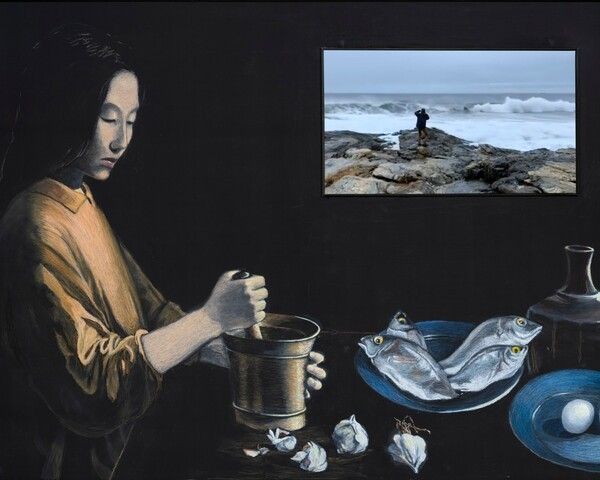
A blackboard is a surface for writing and erasing. Yet what lingers longest is often not what was written, but what has disappeared. In the paintings of Kim Myonghee, the blackboard is neither an educational tool nor a nostalgic reminder of childhood. It is a surface marked by the passage of life, a place where history once touched and faded away. It is a dark field upon which individual time expands into collective memory.
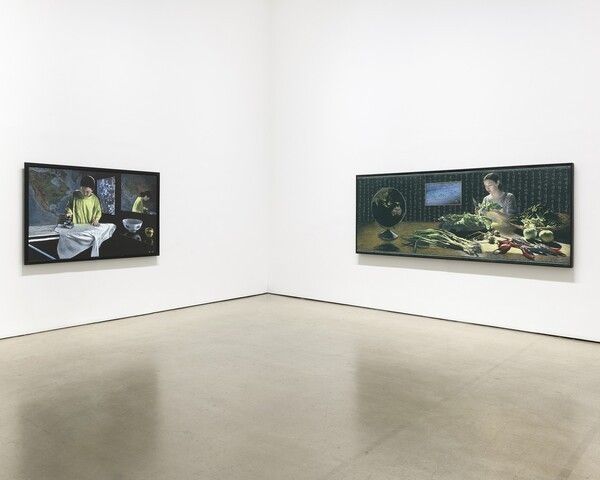
Deep Time, Kim Myonghee's latest solo exhibition, presents a condensed view of the artistic and personal journey she has built over the past half century. The exhibition features more than forty works, including charcoal drawings from her years in New York during the 1980s, the blackboard paintings that became central to her practice after the 1990s, large-scale mixed-media works incorporating video, and recent creations.
The exhibition title derives from a text by curator Hyun Si-won, who wrote, "Kim Myonghee's life occupies time and space on a broad scale. She imagines and explores that deep time as both a universal medium and a central concern." The statement offers a key to understanding her work. For Kim, time is not a sentimental recollection of the past. It is the gradual sedimentation of movement, labor, encounters, culture, history, and memory within the image.
The artist has often described herself not as a diaspora figure or a nomad, but as something closer to an ambulant being, someone who lives through movement. The term provides one of the most important lenses through which her work can be understood. An ambulant life exists between settlement and wandering, remaining in place while continuing to move, departing while leaving traces behind. Her paintings develop not through allegiance to a particular movement or theory but through an intimate relationship with lived experience and mobility.
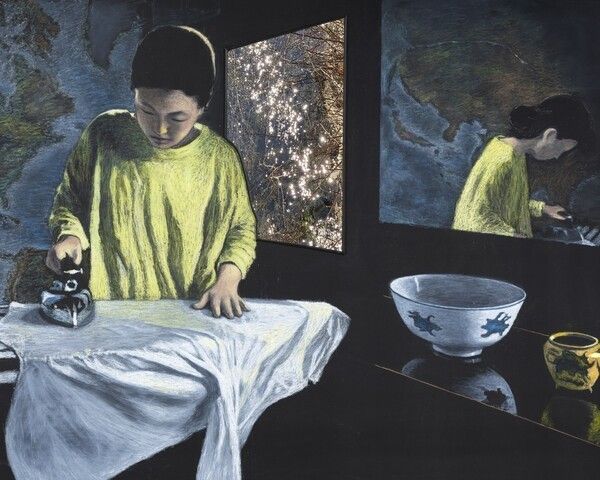
The Korean art world of the 1970s remained heavily male-dominated. Later, the influence of the Minjung Art movement grew significantly. Kim maintained a certain distance from both structures. Through her participation in the Expression Group, she explored how women artists could sustain creative practice over the long term. Seeking conditions that would allow artistic independence, she moved to New York.
Painting became a language through which she could continue living. Her relationship with artist Kim Cha-seop, whom she met during the creation of a mural for the Yu Gwan-sun Memorial Hall in 1974, became another important part of her life. The two later married in New York and shared decades of artistic and personal companionship. Drawing on her education at Parsons School of Design, Kim operated a fashion boutique to support herself financially. In this environment, where art and livelihood were inseparable, her artistic world continued to expand.
Her interest in women's narratives and culture gradually developed into a broader anthropological sensibility. Exchanges with Kim Hyang-an and fellow artists, along with journeys through New Mexico, the Silk Road, Vladivostok, Tashkent, and Samarkand, exposed her to diverse communities and experiences of diaspora. Rather than consuming foreign landscapes as exotic images, she observed ways of living, conditions of movement, and structures of memory. These observations became embedded in her paintings.
A decisive turning point arrived in 1990 when she discovered blackboards inside an abandoned school in Naepyeong-ri, Chuncheon. The surfaces already contained countless traces of handwriting, lessons, and accumulated time. Kim adopted the blackboard as a support for painting. Its inherent cycle of writing and erasing provided an ideal medium for exploring the themes that had long occupied her work: migration, historical memory, and the traces left by individuals and communities.
Dots and lines of oil pastel accumulate across the blackboard's dark surface like particles of light. The black ground simultaneously absorbs color and releases imagery. Figures, landscapes, maps, and crowds emerge with remarkable precision, yet they resist fixed narratives. The images appear suspended, allowing viewers to sense the depth of time between them.
These blackboard paintings function simultaneously as paintings and as sites of erased records. They are flat surfaces layered with multiple temporalities. Their fascination lies not merely in the symbolism of the medium. Small marks, accumulated pigments, and blurred forms insist upon the material reality of painting itself. The works resist easy translation into language. They are traces that remain after erasure, remnants that endure without yielding complete meaning. It is within this tension that their power resides.
Kim's large-scale works incorporating video reveal another dimension of her practice. In pieces such as Boy from Seoul, moving images interact with blackboard paintings to explore the dynamics of human and natural movement. Time enters the static surface of the blackboard through video. Painting is no longer confined to a fixed plane. Processes of disappearance and accumulation unfold as rhythms of life, generating a quiet yet profound sense of sublimity.
Her work resists simple categorization within specific periods or art historical frameworks. Although figurative imagery appears throughout, it cannot be reduced to representation alone. While rooted in personal experience, it never remains confined to private confession. Her ambulant experiences expand into a broader communal sensibility where human beings, nature, history, and lived time overlap.
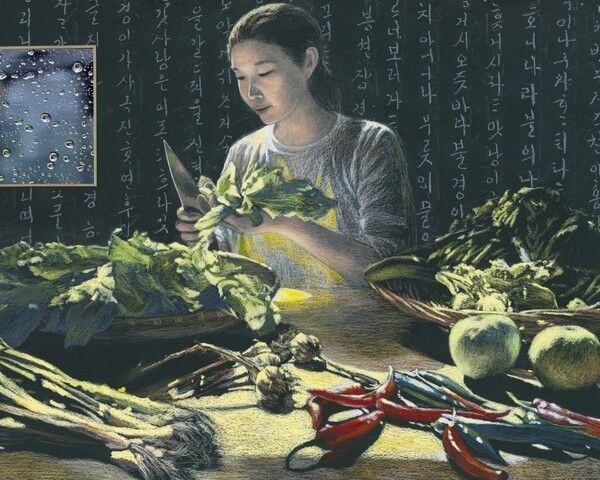
The exhibition includes landscapes of Naepyeong-ri, self-portraits, crowd scenes, and map series. The landscapes become surfaces upon which the artist's own passage through time is inscribed. The self-portraits function less as likenesses than as markers of a being that moves, remembers, and returns. Crowds and maps reveal how individual lives intersect with larger historical and geographical spaces.
The exhibition also features excerpts from a documentary by filmmaker Jang Woo-jin. The film provides another record of the dense relationship between Kim's life and artistic practice. Images of her studio, memories of movement, and rhythms of everyday life stand alongside the paintings, allowing viewers to understand the work in a richer and more layered way.
In Kim Myonghee's paintings, time is never simply something that has passed. It remains after erasure, returns after departure, and expands from personal experience into a universal human sensibility. For that reason, the blackboard becomes more than a surface. It becomes a repository of deep time itself.
Reported by News Culture M.J._mj94070777@nc.press
Copyright ⓒ 뉴스컬처 무단 전재 및 재배포 금지


