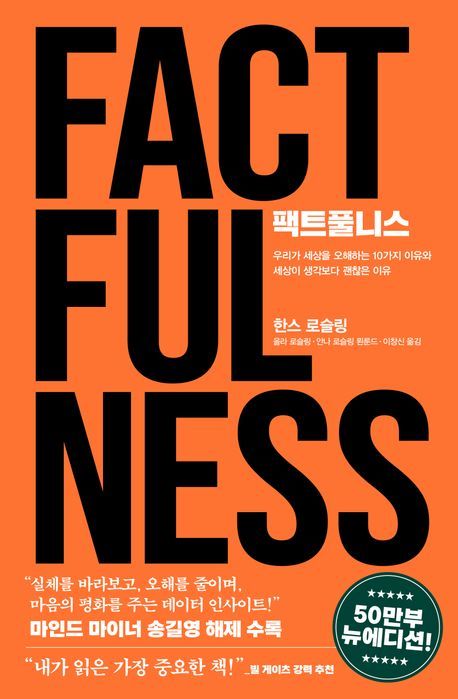
News coverage tends to magnify wars, disasters, infectious diseases, and acts of terrorism. Quiet improvements in public health, education, and living standards rarely occupy the center of the screen. In Factfulness, Hans Rosling uses data to correct the distortions created by human intuition.
The author conducted a global survey in 2017, asking approximately 12,000 people across 14 countries basic questions about the state of the world. Participants answered an average of only two out of twelve questions correctly. No one achieved a perfect score, and 15 percent failed to answer a single question correctly. Even highly educated and well-informed groups performed little better. Rosling argues that the problem is not a lack of knowledge but a set of instincts that cause people to confuse feelings with facts.
The book identifies ten common instincts that distort our perception: the gap instinct, negativity instinct, straight-line instinct, fear instinct, size instinct, generalization instinct, destiny instinct, single-perspective instinct, blame instinct, and urgency instinct. People naturally gravitate toward dramatic explanations of the world. The habit of dividing humanity into categories such as rich and poor nations or developed and developing countries often erases the vast middle ground that actually exists. Rosling proposes a four-level income framework to demonstrate that most people live somewhere in the middle of the global income spectrum.
His observations about the media are equally compelling. Rare events are more likely to become news. Earthquakes, wars, refugee crises, diseases, and terrorism dominate headlines, while declining malaria rates or expanding access to electricity receive far less attention. When dramatic events are repeatedly highlighted, people begin to mistake the unusual for the ordinary. Fear spreads quickly, while gradual progress arrives quietly.
The book also emphasizes the importance of understanding numbers correctly. Looking at a single large figure can make the world appear to be deteriorating. However, when statistics are viewed as proportions and compared with historical data, a different picture often emerges. Indicators such as child mortality, vaccination rates, electricity access, and girls' education have improved steadily over time. National carbon-emission totals can also be misleading without considering population size, making per-capita figures essential for meaningful comparison.
Factfulness is far removed from careless optimism. Rosling identifies pandemics, financial crises, wars, climate change, and extreme poverty as serious threats facing humanity. Rather than exaggerating risks, he advocates measuring them accurately and responding with appropriate action. Seeing the world clearly is not a way to eliminate anxiety. It is a tool for managing it.
After closing the book, one question lingers: Is the world we think we know grounded in reality, or is it shaped by fear and prejudice? Factfulness does not ask readers to memorize data. Instead, it encourages a habit of examining the world without being carried away by instinctive reactions.
Reported by News Culture M.J._mj94070777@nc.press
Copyright ⓒ 뉴스컬처 무단 전재 및 재배포 금지


