[By Joo-won Seong, Edaily] The negotiation table has been replaced by airstrikes. On February 28 (local time), while nuclear negotiations with Iran were still underway, the U.S. and Israel launched a sudden military strike. There was neither prior consultation with allies nor a U.N. resolution. The rules-based international order that had sustained global stability for more than 70 years since the end of World War II, has reached a decisive turning point. It signals a regression to an era where the logic of superiority and preemptive strikes has forcibly pushed aside multilateral consultation and international norms.
|
Han-beom Cho, Senior Research Fellow at the Korea Institute for National Unification (KINU), defined the current state of international affairs not as ’Multi-polarity,‘ but as ’Non-polarity.‘ During an interview with Edaily on April 28, Cho stated, “No one follows the rules anymore, and no one has the will or the capacity to do so. That is what defines non-polarity.” He added, “The Iran War is a representative case illustrating the transition of the international order into a state of de-facto anarchy.”
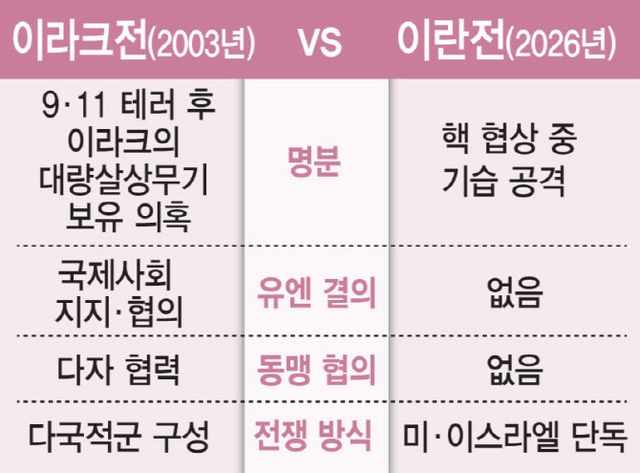
Gi-Wook Shin, a prominent scholar of international politics and professor of sociology at Stanford University, offered a similarly grim diagnosis. “The liberal international order has come to an end. What we are witnessing is not a ’New Cold War,‘ but a situation more similar to the 1930s,” he noted. The 1930s were characterized by the rise of fascism and Nazism, with major powers reshaping the international order through the logic of force. Power preceded rules, and preemptive action took precedence over negotiation. At least during the Cold War, there was a clear distinction between allies and adversaries, along with a certain degree of order. Even the Iraq War was justified by the “9/11 attacks” and secured international support via the U.N. However, the attack on Iran by the U.S. and Israel was launched abruptly during negotiations, without allied coordination.
As the rules-based order crumbles, nations are increasingly pursuing a race for self-reliant survival strategies. In a geopolitical scenario analysis following the outbreak of the Iran War, the Atlantic Council, a U.S. think tank, noted: “The first target of U.S. adversaries is the cohesion of alliances,” adding that “Pressure on energy and supply chains serves as the primary mechanism to create these fractures.” As alliance unity weakens or becomes uncertain, pressure grows on allied nations to reduce reliance on the U.S. and pursue self-reliant strategies for survival.
Dr. Cho emphasized that both excessive disregard for alliances and blind faith on them are problematic. “Under the current reality of alliance relationships, Korea has no choice but to pursue a strategy that prioritizes its national interest. In the end, competitive strength is the only way to survive.” Professor Shin also underscored the importance of adaptability, stating, “In an increasingly chaotic international environment, it is more important than ever for Korea to secure strategic diversification and flexibility.”
Copyright ⓒ 이데일리 무단 전재 및 재배포 금지


