In the semiconductor industry, this is the remark now being made about the unusually sharp rise in memory chip prices. For a long time, the memory market followed a boom-and-bust cycle tied to PCs and smartphones, known as the “Olympic cycle.”
However, the situation has now changed. The rise of artificial intelligence (AI) infrastructure has created structural, long-term demand for memory chips. AI data centers require enormous computing power, and that computing power can only be utilized effectively with memory where data is supplied and stored at extremely high speeds. As a result, alongside Graphics Processing Units (GPUs), the core processors powering AI workloads, major Big Tech companies are being desperate to secure various memory products, including High Bandwidth Memory (HBM), server DRAM, enterprise SSDs (eSSD), and high-capacity memory modules. Companies are now competing aggressively for Long-term supply agreements (LTAs) spanning 3 to 5 years, once almost unimaginable in the past. In other words, memory suppliers have rapidly transformed into “super sellers” with unprecedented bargaining power.
|
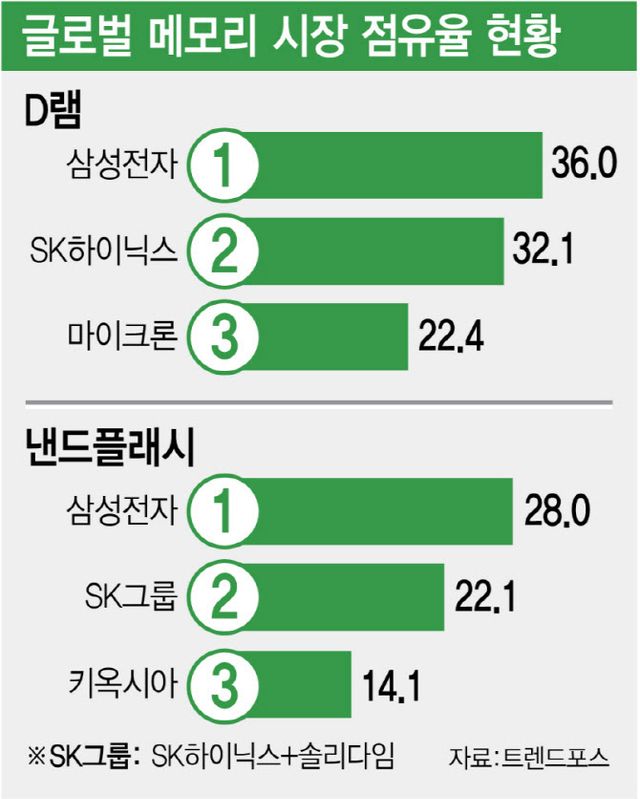
his shift has dramatically elevated Korea‘s strategic value in the global technology ecosystem. According to market research firm TrendForce, Samsung Electronics and SK hynix accounted for 36.0% and 32.1% of the global DRAM market, respectively, in the fourth quarter of last year. In NAND flash memory, during the same period, Samsung Electronics ranked first globally with a 28.0% market share, while the combined share of SK Group (SK hynix and Solidigm) reached 22.1%. Taken together, it is no exaggeration to say that Korea virtually dominates the global memory supply chain. “One could say that AI itself cannot function without Korea,” one industry official remarked.
Industry sources note that Global Big Tech companies including Microsoft, Meta, Google, Apple, Amazon, Oracle, Qualcomm, Dell, HP, and IBM remain heavily dependent on memory chips across their core business areas such as data centers, smartphones, PCs, servers, and AI accelerators.
Against this backdrop, voices from both industry and academia are growing louder, urging Korea to lead global semiconductor cooperation based on its strong influence in the memory sector. At a recent Korea Chamber of Commerce and Industry event, Seok-jun Kwon, Professor of Department of Chemical Engineering at Sungkyunkwan University, stated “Korea has strong competitiveness in memory manufacturing, Japan has advantages in packaging and semiconductor materials and equipment ecosystems, and the U.S. possesses diverse chip design technologies, AI-specialized models, and memory management algorithm capabilities.” He argued that Korea, the U.S., and Japan should pursue trilateral cooperation in AI chips.
Concerns surrounding a potential labor strike at Samsung Electronics have also demonstrated the immense influence of Korean-made memory chips on global supply chains. The industry impact has become so significant that disruptions at Samsung could affect the entire global technology supply chain. It is reported that some global companies have already expressed concerns to Samsung Electronics about the possibility of memory supply disruptions. Another industry official warned, “If delivery delays become reality, they could escalate into legal disputes involving penalty claims.”
Copyright ⓒ 이데일리 무단 전재 및 재배포 금지


