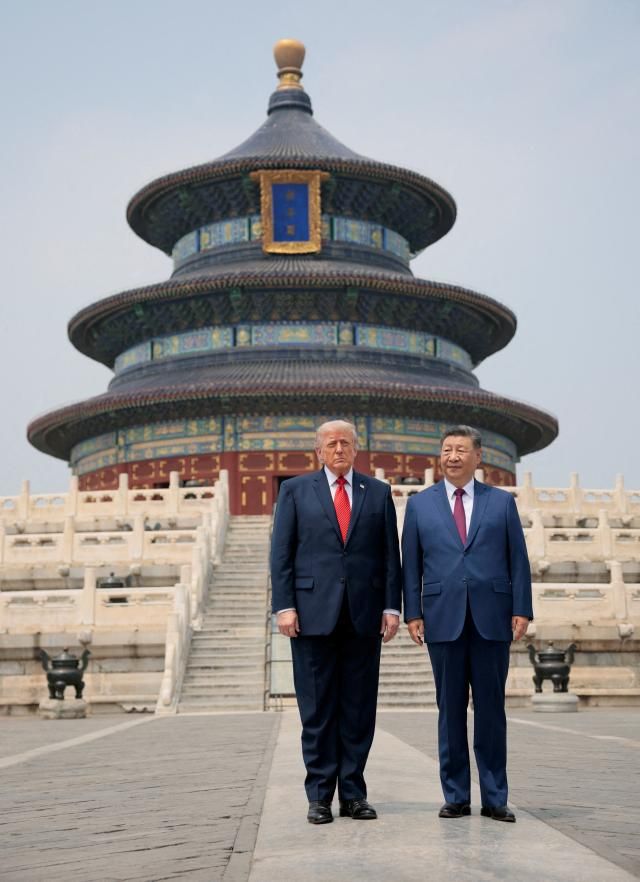
President Donald Trump and President Xi Jinping met once again in Beijing on May 14. A summit between the leader of the world’s foremost superpower and the head of the world’s second-largest economy invariably carries global significance. Yet this meeting possessed an unusually heavy symbolism and strategic gravity.
The wars in Ukraine and the Middle East, the intensifying contest for artificial intelligence supremacy, the semiconductor conflict, the Taiwan question, rare-earth export controls, supply-chain restructuring, the future of dollar dominance, and the internationalization of the yuan have all converged at the same historical moment.
This summit was therefore far more than a routine diplomatic engagement. In many respects, it amounted to a grand strategic exploration of who will shape the architecture of the mid-21st century world order — and how that order will ultimately be constructed.
The United States seeks to preserve the existing framework of global primacy. China, meanwhile, seeks to accelerate the emergence of a multipolar order. Between those two ambitions, the world watches with equal measures of anxiety and expectation.
The two leaders met for more than two hours at the Great Hall of the People in Beijing. Following the formal talks, they moved together to the Temple of Heaven, the sacred imperial site where Chinese emperors once prayed for peace, prosperity, and abundant harvests under the Mandate of Heaven. A state banquet followed later that evening.
China’s decision to include the Temple of Heaven in the summit itinerary was no accident.
The site is far more than a tourist destination. It is one of the great symbolic spaces of Chinese civilization itself — a place where the emperors of the Ming and Qing dynasties affirmed what traditional China regarded as heavenly legitimacy and cosmic order. It represents continuity, historical consciousness, and civilizational permanence.
The image of Trump and Xi walking together along the rain-darkened stone paths of the Temple of Heaven therefore carried extraordinary symbolic weight.
Trump reportedly remarked only briefly that the scene was “beautiful.” More notable was his unusual restraint regarding Taiwan, a subject on which he has often spoken bluntly in the past. The silence itself was revealing.
It reflected the complicated strategic reality now confronting the United States.
America remains the world’s most powerful nation. Yet it no longer possesses the effortless strategic dominance that defined the immediate post-Cold War era. The war in Ukraine drags on. Conflict between Iran and Israel threatens to widen across the Middle East.
Inside the United States, fiscal deficits, high interest rates, industrial hollowing, and deepening social polarization continue to intensify.
Washington seeks to contain China’s rise in artificial intelligence and advanced semiconductors. Yet it also understands an uncomfortable reality: the global supply chain itself cannot easily function without China.
Beijing faces its own profound vulnerabilities. China’s property crisis, local-government debt burdens, youth unemployment, and weak domestic consumption have created structural strains throughout the economy. Nevertheless, China remains the world’s largest manufacturing power and continues to dominate critical sectors ranging from rare earths and batteries to solar panels and electric vehicles.
Above all, Beijing sought through this summit to project an unmistakable message to the world: China considers itself not merely a modern nation-state, but a civilization-state standing as an equal to the United States.
That is precisely why the Temple of Heaven mattered.
The United States is a relatively young republic, barely 250 years old. China sees itself as the inheritor of a civilization stretching back five millennia. Xi Jinping’s decision to host Trump at the Temple of Heaven was therefore not simply ceremonial diplomacy. It was an assertion that China is not a temporary geopolitical actor, but an enduring civilization shaped by history, philosophy, and cultural continuity.
The summit itself revolved around six principal themes.
The first was trade and tariffs. Trump, acutely aware of American farmers and industrial workers as a crucial political constituency, is believed to have pressed strongly for expanded Chinese purchases of American soybeans, grain, and agricultural products, while continuing to raise concerns about trade imbalances. China, facing slowing economic momentum, likewise requires a degree of stability in access to American markets.
The second issue was semiconductors and artificial intelligence. The United States has tightened restrictions on exports of advanced AI chips and semiconductor technologies in an effort to slow China’s technological ascent. China, meanwhile, has accelerated domestic substitution efforts centered around companies such as Huawei. This is no longer merely a technological competition. It is increasingly a struggle over who will shape the operating system of the future global civilization.
The third issue concerned rare earths and supply chains. China has increasingly employed rare-earth export controls as a strategic instrument. Because critical sectors — electric vehicles, semiconductors, defense systems, and renewable energy infrastructure — remain deeply dependent upon Chinese-controlled supply chains, Washington’s efforts to diversify away from China face immense practical limitations.
The fourth issue was Taiwan. It was perhaps the most sensitive topic of the summit and also the one approached with the greatest caution. Xi reportedly warned that mishandling the Taiwan issue could dangerously increase the possibility of direct confrontation between the two powers. The United States cannot easily abandon Taiwan, yet neither can it afford a full-scale military conflict with China. As a result, the Taiwan Strait is increasingly emerging as one of the world’s most dangerous geopolitical flashpoints.
The fifth issue involved the Middle East. As tensions between Iran and Israel intensify, Washington increasingly recognizes the importance of China’s relationship with Tehran. China has sought to present itself as a stabilizing diplomatic force in the region, particularly after previously helping facilitate rapprochement between Saudi Arabia and Iran.
The sixth issue concerned the deeper structure of the global financial system itself. Beneath the formal agenda lay an invisible but highly consequential competition between dollar dominance and the internationalization of the Chinese yuan. Should the yuan continue expanding its role in energy settlements and global trade, the foundations of the postwar financial order could gradually begin to shift.
Yet perhaps the summit’s most important message was this: even amid rivalry, dialogue continues.
The United States and China compete fiercely, but they also remain deeply dependent upon one another. China cannot easily thrive without the American market and financial system. Nor can the United States fully disentangle itself from the manufacturing and supply-chain infrastructure centered in China. The global economy itself would struggle to survive a complete rupture between the two powers.
For Northeast Asia, the summit may mark the beginning of a new strategic phase.
China will likely intensify efforts to limit American involvement in Taiwan. The United States, meanwhile, is expected to deepen security coordination with Japan and South Korea. Japan may continue accelerating military normalization, while North Korea will closely monitor every shift in the relationship between Washington and Beijing.
In that sense, Northeast Asia is increasingly becoming the principal front line of great-power competition.
The original Cold War was centered largely upon military confrontation between the United States and the Soviet Union. The emerging strategic rivalry of the 21st century, however, is likely to be far more complex — an intertwined contest involving artificial intelligence, semiconductors, energy systems, maritime power, finance, and supply chains.
What, then, should South Korea understand from all this?
Seoul must look not through the lens of emotion, but through the lens of structure.
The United States remains South Korea’s indispensable security ally. China remains one of its most important economic partners. Korea cannot survive by choosing only one side in absolute terms. Its challenge is therefore not blind alignment, but the cultivation of strategic balance grounded in technological strength, industrial competitiveness, and diplomatic sophistication.
South Korea already possesses globally competitive capabilities in semiconductors, artificial intelligence, shipbuilding, nuclear energy, batteries, and defense manufacturing. The essential task is not to think of Korea merely as a “middle power,” but as a genuine strategic state capable of exercising meaningful influence within a rapidly changing Northeast Asian order.
The rain falling over the Temple of Heaven was more than weather.
It may well have been a signal that the world itself is entering a new season.
And along those rain-soaked paths, America and China — two powers moving according to profoundly different historical clocks — were quietly calculating the future of the same world.
*The author is a senior columnist of AJP.
Copyright ⓒ Aju Business Daily 무단 전재 및 재배포 금지


