The Tomb of King Muryeong, discovered in Gongju, South Chungcheong Province in 1971, remains one of the most significant archaeological finds from Korea’s Three Kingdoms period. The brick-chamber tomb belonged to King Muryeong of Baekje and his queen, and the inscribed stone tablets found inside identified both the occupants and the construction period of the tomb, making it one of the rare ancient Korean royal burials whose ownership and chronology can be definitively confirmed.
Numerous metal craftworks were excavated from the tomb, including crown ornaments, earrings, necklaces, bracelets, belts, shoes, bronze mirrors, and irons. Because the tomb was discovered centuries after the burial, its original arrangement was not perfectly preserved. However, archaeologists have reconstructed portions of the burial layout through the position and function of the excavated objects.
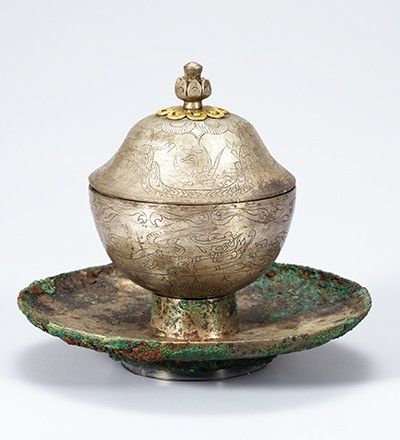
Artifacts recovered from the tomb were divided into objects placed inside and outside the wooden coffins of the king and queen. Items inside the coffins included both personal ornaments worn by the deceased and funerary objects placed for burial rites. Among the artifacts discovered within the queen’s coffin was an elaborate silver cup complete with lid and stand.
The queen died in November 526 and was later interred beside King Muryeong in February 529. The silver cup was discovered near her head. Whether it had been used during her lifetime or created specifically for burial remains unknown. Though believed to have been a vessel for liquid, its original contents have never been identified.
Scientific analysis conducted by the Gongju National Museum revealed that the cup, lid, and knob were composed of more than 99 weight percent silver. The lotus-shaped golden ornament attached to the lid contained 88.79 weight percent gold and 10.95 weight percent silver, equivalent to approximately 21.3-karat gold. The stand itself was made of bronze composed of 77.53 weight percent copper and 21.55 weight percent tin.
Art historian Ju Kyung-mi noted that the alloy composition of the stand closely resembles that of traditional Korean brassware, suggesting it may represent one of the earliest surviving examples of such metal craftsmanship. The vessel is particularly remarkable because gold, silver, and bronze were all combined within a single royal object.
Its decorative structure is equally intricate. Lotus motifs with eight petals appear beneath the lid’s knob and around the foot of the cup, dividing the decorative space into upper and lower sections. Three dragons, each with subtly different horns, circle around the body of the cup in the same direction.
The lid features four mountain-shaped forms resembling mythical peaks. Between them appear birds, antlered deer, trees, and flower buds. Ancient Chinese texts from the Wei dynasty mention sacred mountains resting atop dragons’ heads, referring to the legendary mountain islands believed to house immortals.
The imagery recalls the famous gilt-bronze incense burner excavated from the Baekje temple site at Neungsan-ri in Buyeo, which also combines a mountain-shaped lid with a dragon-shaped base. Both artifacts share a visual system associated with the world of immortals and celestial realms.
Fine engraved patterns also cover the upper surface of the stand. A lotus motif occupies the center, surrounded by saw-tooth borders. Between them appear densely packed figures including human-faced birds, dragons, birds, deer, lotus flowers, and trees. The incised lines are even finer than those decorating the cup and lid, making them difficult to observe with the naked eye.
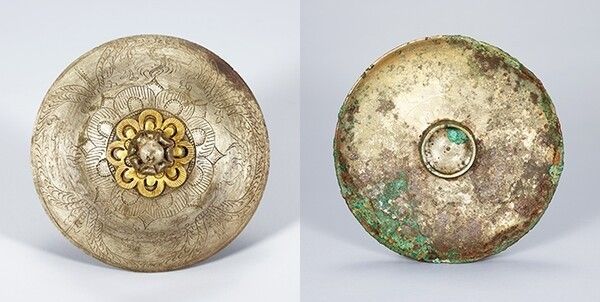
In terms of form, cups with lids and stands can be traced to the Southern Dynasties of China. Yet the manufacturing techniques used for the Tomb of King Muryeong’s silver cup differ significantly from Chinese examples. Chinese vessels were often cast as unified forms, while the Baekje cup was assembled piece by piece.
The cup body was cast separately before its foot was attached through soldering. The lid, knob, and lotus-shaped gold ornament were also individually crafted and then fixed together. The knob itself functioned structurally like a rivet, inserted through a hole in the lid and secured by flattening the end so it could not slip out.
Early scholarship once suggested that certain distinctive artifacts from the tomb may have been produced in China’s Southern Liang dynasty. However, as more artifacts from Baekje sites have been uncovered, research increasingly supports the view that the silver cup was produced within Baekje itself.
The silver cup from the Tomb of King Muryeong ultimately stands as far more than a funerary object. Its combination of gold, silver, and bronze, its imagery of dragons and sacred mountains, and its uniquely Baekje methods of production collectively reveal the sophistication of Baekje royal metalwork and funerary culture. It remains one of the clearest surviving examples of how Baekje absorbed foreign influences while transforming them into its own artistic language.
Reported by News Culture M.J._mj94070777@nc.press
Copyright ⓒ 뉴스컬처 무단 전재 및 재배포 금지


