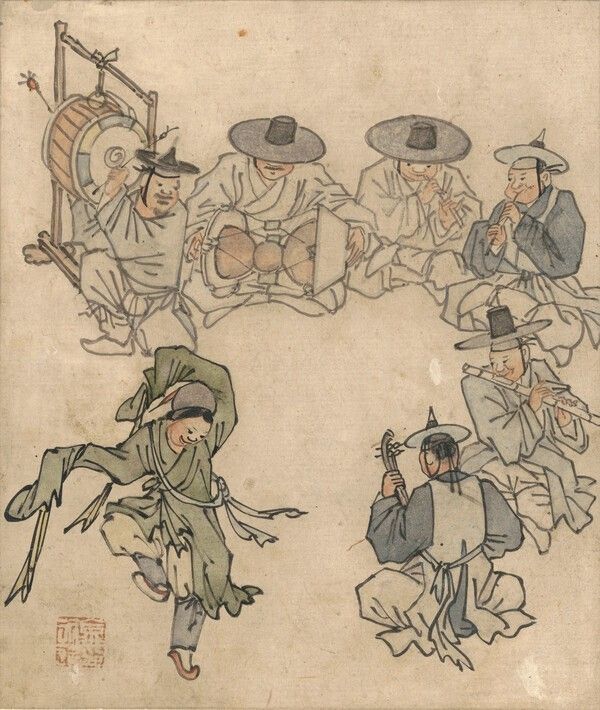
Kim Hong-do was never simply a skilled painter. He was the artist who captured the expressions, rhythms, and movement of an entire era more vividly than anyone else. Streets and marketplaces, mountain landscapes and leisurely gatherings, even the quiet dignity of an aged plum blossom all found their way into his brushwork.
The special exhibition “Danwon Kim Hong-do, Painting an Era”, newly opened at the calligraphy and painting gallery on the second floor of the National Museum of Korea, revisits the life and artistic world of late Joseon through Kim Hong-do’s eyes.
At the center of the exhibition stands his celebrated Danwon Genre Painting Album, designated as a Korean treasure. In these works, Kim Hong-do observed ordinary people with warmth and precision. The tension of a ssireum wrestling match, the lively energy of dancing children, and scenes where labor and play blend naturally together all come alive through concise brush lines and remarkably balanced compositions.
Kim Hong-do’s genre paintings continue to resonate not merely because they preserve old customs, but because the figures within them still feel alive. Their expressions are playful, their gestures natural, and their movements captured with extraordinary immediacy. His work reveals how sharply he observed human behavior. Kim Hong-do did not limit himself to royal courts or aristocratic culture. He elevated ordinary people and everyday life into subjects worthy of fine art.
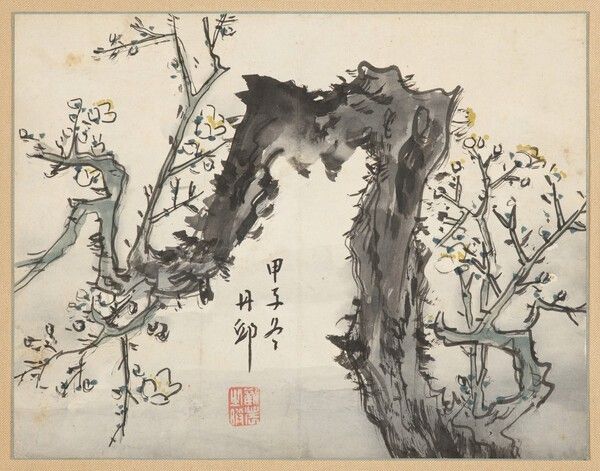
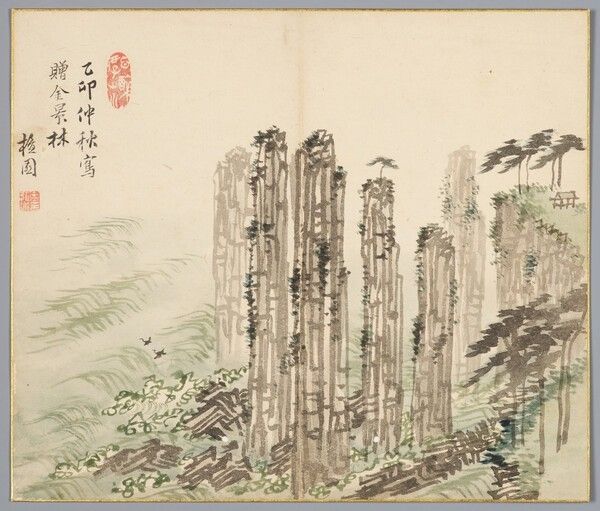
The exhibition also presents works from both the height of Kim Hong-do’s career and his later years. Chongseokjeong Landscape, painted at age fifty-one, appears alongside later works such as Gathering of Elder Statesmen and Old Plum Blossom, created around his sixtieth year.
Among them, Gathering of Elder Statesmen depicts a gathering of senior scholars at Manwoldae in Gaeseong. Landscape, architecture, figures, and brush technique merge seamlessly, revealing the artistic maturity Kim Hong-do achieved late in life. The exhibition broadens the public image of Kim Hong-do beyond genre painting, showing an artist equally capable of navigating landscapes, figure painting, and literati aesthetics.
Old Plum Blossom deepens the exhibition’s emotional atmosphere even further. The twisted branches and restrained brushwork of the aged plum tree reflect not decorative beauty, but the quiet dignity of something weathered by time. Unlike the lively confidence of his earlier paintings, the work reveals the gaze of an older artist seeking the essence of things rather than their outward vitality.
The exhibition also highlights the importance of Gang Se-hwang in Kim Hong-do’s artistic development. Gang Se-hwang was not only Kim Hong-do’s teacher, but also a lifelong artistic companion. Their relationship began as master and student before evolving into one of mutual artistic respect. The exhibition includes Gang Se-hwang’s self-portrait alongside Kim Hong-do’s Seowon Gathering Painting and Travel Genre Scenes, works that reveal how Kim Hong-do’s talent matured through exchanges with Joseon literati society.
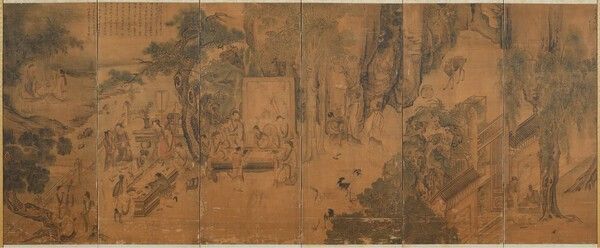
One of the exhibition’s most compelling aspects is the way Kim Hong-do’s influence expands into the broader visual culture of late Joseon. In Gallery Three, all three versions of Pyeongyang Governor’s Banquet, painted in Kim Hong-do’s stylistic tradition, are displayed together. Featuring more than 2,500 figures, these grand banquet scenes demonstrate the richness and complexity of late Joseon visual culture. Power, urban vitality, ceremony, and everyday life fill the screen simultaneously.
Alongside Kim Hong-do’s works, the gallery rotation introduces a wider spectrum of Joseon painting and calligraphy. Original palace decorative paintings once displayed at Gyotaejeon Hall in Gyeongbokgung Palace, the Munbangdo painting donated by Lee Kun-hee, and calligraphy works by notable masters including Yi Gwang-sa and Oh Se-chang are also featured. Particularly notable is the first public display of a handwritten letter by Yi Sun-sin written just four months before the Battle of Noryang.
Kim Hong-do served as one of the leading royal court painters during the reign of King Jeongjo and became the artist who most vividly depicted the vitality of late Joseon society. His paintings encompass royal dignity, literati elegance, commoners’ lives, and the spirit of nature itself. To encounter Kim Hong-do is not simply to admire the work of one painter, but to experience the emotional texture of late Joseon Korea.
The special exhibition “Danwon Kim Hong-do, Painting an Era” features 96 works across 50 pieces, including eight designated treasures. On June 2, Yu Hong-jun, director of the National Museum of Korea, will also deliver a special lecture titled “The Life and Art of Danwon Kim Hong-do.”
Reported by News Culture M.J._mj94070777@nc.press
Copyright ⓒ 뉴스컬처 무단 전재 및 재배포 금지


