For late Joseon Korea, opening its ports amid the violent tides of imperialism in the late 19th century was not simply a diplomatic shift. Traditional crafts and objects became tools of international representation, carrying the burden of a nation negotiating between inherited identity and rapid modernization.
The Seoul Museum of Craft Art is presenting the special exhibition “The Hybrid” through July 26 at its Exhibition Hall 1. The exhibition commemorates both the 140th anniversary of diplomatic relations between Korea and France and the 120th anniversary of the royal wedding of Emperor Sunjong and Empress Sunjeonghyo.

“The Hybrid” examines the cultural exchanges and artistic transformations that emerged after the 1886 Treaty of Friendship, Commerce and Navigation between Joseon and France. The exhibition title derives from an anecdote involving American scholar Percival Lowell, who reportedly received a Western-style hat woven from traditional Korean horsehair from King Gojong and described it as a “hybrid.” Now housed at the MARKK Museum, the hat symbolizes an era in which Eastern materials and Western forms intersected during Korea’s transition into modernity.

The exhibition unfolds across three sections. Part I, “Becoming Diplomatic Envoys,” focuses on objects that functioned not merely as luxury goods but as instruments of diplomacy during the opening-port period. A white porcelain jar with underglaze dragon motifs, believed to have been presented to French diplomat Victor Collin de Plancy, reflects royal authority and ceremonial prestige.
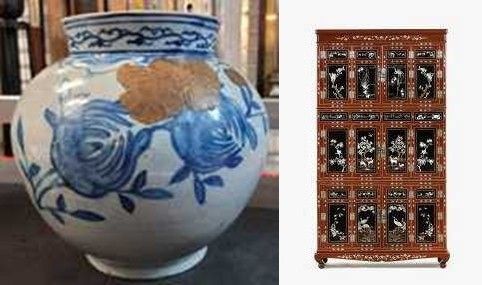
A three-tiered mother-of-pearl lacquer cabinet gifted by King Gojong to American educator Homer Hulbert reveals how Korean crafts adapted to Western domestic lifestyles while retaining traditional decorative techniques.
Other objects include a fan reportedly presented by Empress Myeongseong to the wife of missionary Horace Allen and a pure gold bracelet gifted to celebrate the marriage of the Underwood couple. Together, these works demonstrate how decorative arts became mediators of diplomacy during a turbulent era.
Among the exhibition’s highlights are a large hwagak chest adorned across its entire surface and a gourd-shaped cabinet decorated with Mount Fuji using Japanese maki-e techniques, both reflecting the increasingly personalized tastes of elite patrons.
Also returning to Korea after 126 years are the openwork blue-and-white porcelain peony-patterned flower stand, which won a silver medal at the 1900 Paris Exposition, and a citron-patterned porcelain jar still bearing a memo identifying it as an imperial household object.
Part II, “Facing the World,” explores how the Korean Empire used art and design to establish itself as an independent modern nation. Newly adopted imperial symbols such as the taegeuk, mugunghwa flowers, and plum blossoms appeared across decorative objects to visually reinforce state identity.
Western-style military uniforms worn by King Gojong, embellished with elaborate European gold embroidery, alongside ceremonial court uniforms worn by officials such as Min Cheol-hun and Park Gi-jun, reflect efforts to assert sovereignty within the international order.
At the same time, Korea pursued industrial modernization through craft production, inviting foreign technicians and establishing educational institutions dedicated to technical arts and manufacturing.

The final section, “East and West Converge,” presents works born through the interaction of different aesthetic systems and technologies. Craftsmen at the French national porcelain manufactory in Sèvres became fascinated with Korean cultural objects collected by Collin de Plancy and others, eventually developing experimental flambé glaze vase series inspired by Korean forms. Some pieces were even titled “Seoul,” “Busan,” and “Ulsan.”
Furniture combining traditional Joseon structures with Japanese cabinet frameworks, mother-of-pearl wardrobes depicting Mount Geumgang based on paintings by Lee Do-young, and Kim Jin-gap’s red lacquer mother-of-pearl cabinets demonstrate how Korean artisans expanded beyond craftsmanship into the realm of design and artistic authorship.

The exhibition is especially significant for reintroducing overseas Korean cultural heritage to domestic audiences. Of the 24 international artifacts included — 23 from France and one from Germany — 17 are being shown publicly in Korea for the first time.
Together, these objects reveal how Korean artisans and diplomats responded to unfamiliar cultures not through passive imitation, but through adaptation, negotiation, and reinvention across borders.
Reported by News Culture M.J._mj94070777@nc.press
Copyright ⓒ 뉴스컬처 무단 전재 및 재배포 금지


