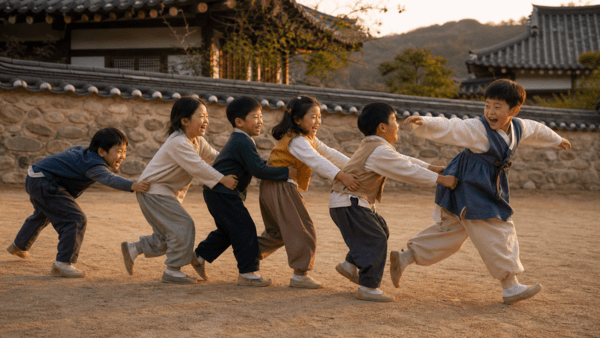
Kkorittagi, or tail-chasing, is a traditional Korean children’s game in which players form a single line by holding the waist of the person in front of them while attempting to protect—or capture—the last player in the line. The game was widely passed down across Korea, developing different names and variations depending on the region.
It was known by many names, including Kkorijapgi, Daksari, Jwinjusaekki Nori, Jokjebi Nori, Subakttagi, Hobakttagi, Dongattagi, Wild Goose Game, and Waist-Holding Game. Regional names such as Maejittaneun Nori, Cheongae Ttagi, Gyepo, Baekjogyu, and Kkongdaengi Japgi were also used.
The game generally developed into three major formats. One common version divided children into two opposing teams. Each team formed a long line by holding the waist of the player ahead. The leader of one team attempted to catch the last person in the opposing line, while the opposing leader guided the line to evade capture.
The game Subakttagi followed a similar structure. Before play began, children exchanged playful dialogue. One side would announce, “We came to pick watermelons,” while the other side delayed the game by insisting the fruit was not yet ripe. Once the “watermelon” was declared ready, the chase began. Attackers targeted the last player in the opposing line, while defenders twisted and moved together to keep the line from breaking apart.
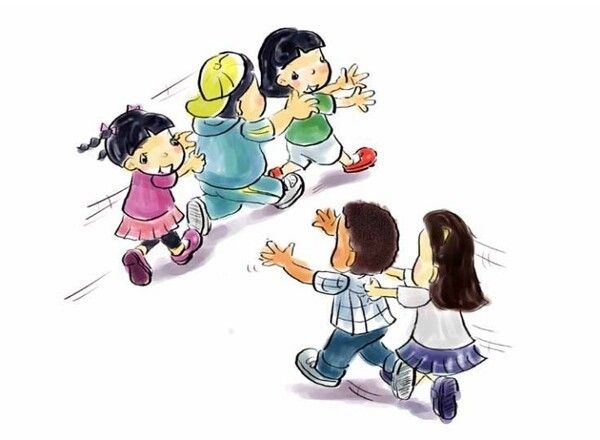
Another variation assigned one child as the tagger, often playing the role of a ghost or wildcat. The remaining children stood in a single line holding each other’s waists, while the front player took the role of the “mother.” As the tagger tried to capture the last child in line, the mother stretched out both arms to block the attack. If the tagger caught every child one by one from the back, the game ended in victory for the tagger. Jeju Island’s Wild Goose Game closely resembled this format.
There was also a version in which the leader of the line attempted to catch the final player in their own team’s line. Since every participant remained connected, movement required coordination and balance. The leader constantly shifted directions while the last player twisted and dodged to avoid being caught. Variations such as Daksari in Jeollanam-do and Jokjebi Nori in Chungcheongnam-do belonged to this tradition.
Tail-chasing also survived as a subsidiary game connected to Ganggangsullae, Korea’s traditional circle dance. In regions such as Jindo and Haenam, games like Jwinjusaekki Nori were played during communal festivities. When the lead singer shouted, “Catch the little mouse!” players linked together into a line while the front player spun rapidly in an attempt to catch the last child. Once captured, the child moved to the front of the line. In some areas, the leader was even carried on another player’s shoulders while songs were sung during the game.
Jeju Island’s Wild Goose Game was traditionally played on bright autumn nights during the eighth lunar month. Children lined up according to height while one child played the role of a ghost attempting to seize the last child in line. The “mother” at the front moved the line defensively to protect the others. If the ghost captured all the children, the round ended.
Similar traditions also survive within Wolwoli Cheongcheong folk games in Yeongdeok, North Gyeongsang Province, including variations such as Sanjittigi, Songajittegi, and Dongae Ttagi. Subakttagi in Icheon, Gyeonggi Province, is also categorized within the same family of children’s folk games.
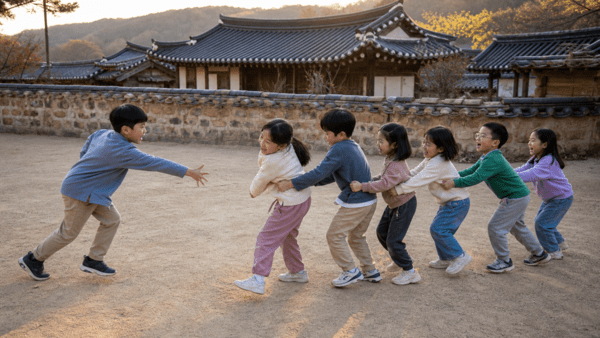
The beauty of tail-chasing lay in its simplicity. No tools were required. The moment children linked together into a line, the game could begin. The key was maintaining balance and preventing the line from breaking apart. The leader controlled direction and strategy, while the last player relied on quick reflexes to avoid capture.
More than a game of speed, tail-chasing cultivated cooperation and collective awareness. The leader carried responsibility for protecting the group, and in some regions, failure to protect the last player reflected directly on the leader. Built around excitement and competition, the game also taught children solidarity, coordination, and shared roles within a group.
Reported by News Culture M.J._mj94070777@nc.press
Copyright ⓒ 뉴스컬처 무단 전재 및 재배포 금지


