If forced to choose only one novel for a lifetime, this would be the one.
The Name of the Rose contains nearly everything a novel can aspire to be: mystery, philosophy, theology, history, and intellectual suspense woven into a single narrative structure.
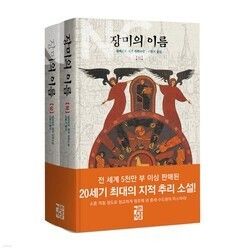
Published in 1980 by Italian semiotician and novelist Umberto Eco, the book operates simultaneously as a murder mystery and as a dense exploration of medieval European thought. Within the isolated walls of a monastery, a chain of deaths unfolds around forbidden texts, drawing readers into the act of reading itself.
The story begins in a Benedictine monastery in northern Italy during the 14th century. Shortly after Franciscan friar William of Baskerville and his novice Adso arrive, monks begin dying under increasingly disturbing circumstances. Each death echoes the imagery of biblical apocalypse.
William resembles a medieval version of Sherlock Holmes. He pursues truth through logic, observation, and experience, directly challenging an era that sought to explain all things through divine will alone. His investigation ultimately leads him into the monastery’s labyrinthine library, where forbidden books are hidden behind layers of secrecy.
At the center of the mystery lies more than murder. The true conflict concerns the suppression of laughter, the control of knowledge, and the fear surrounding books themselves. Central to this tension is the lost second volume of Aristotle’s Poetics, devoted to comedy.
The novel’s most striking idea is its treatment of laughter as a threat. Within the monastery, laughter is viewed as dangerous because it undermines authority and destabilizes absolute truth.
This is where the novel transcends historical fiction. Questions such as “Who owns knowledge?” and “Why does power fear knowledge?” become the true foundation of the narrative.
Some readers view the novel as an exploration of how institutions preserve authority through the control of knowledge. Though rooted in a medieval setting, the work continues to resonate in an era shaped by information control, censorship, and competing interpretations of truth.
Eco once remarked, half in jest, that he began the novel because he “wanted to poison a monk.” Behind the irony, however, was years of meticulous research into medieval theology, semiotics, and the architecture of knowledge itself.
He immersed himself in medieval manuscripts and philosophical texts while constructing the novel’s layered world. The library’s maze-like design becomes more than architecture—it symbolizes the structure of knowledge itself. The closer one moves toward truth, the more disorienting the world becomes.
Even William’s name carries meaning, referencing William of Ockham and the principle known as “Occam’s Razor,” the idea that the simplest explanation is often the closest to truth.
The novel was adapted into the 1986 film The Name of the Rose, starring Sean Connery as William. Connery brought gravity and accessibility to the role, translating Eco’s philosophical complexity into a more mainstream mystery format. Still, many readers note that the film necessarily reduced much of the original novel’s extensive intellectual discourse.
The title itself connects directly to the novel’s final line:
“The rose remains only in its name.”
The phrase reflects Eco’s worldview—that human beings ultimately grasp not truth itself, but interpretations and symbols. The rose may signify love, truth, faith, or memory, yet in the end, only the name survives.
This is not a novel that ends when the killer is revealed. In many ways, that is where it truly begins. Does objective truth exist? Who should control knowledge? Why is laughter feared by authority?
Eco offers no definitive answers. Instead, he leaves readers with questions that stretch far beyond the monastery walls and into the information age of the modern world.
That a detective novel can sustain such philosophical weight remains precisely why The Name of the Rose continues to endure decades after its publication.
Reported by News Culture M.J._mj94070777@nc.press
Copyright ⓒ 뉴스컬처 무단 전재 및 재배포 금지


