Gwanghallu Pavilion in Namwon, North Jeolla Province, has been elevated to National Treasure status, reflecting its outstanding architectural integrity and historical continuity within Joseon-era cultural landscapes.
Originally derived from Gwangtongru, a structure established by Prime Minister Hwang Hui during his exile, Gwanghallu developed into a representative government pavilion of the Honam region in the late Joseon period. The complex consists of the main pavilion, the auxiliary Yoseongak equipped with ondol heating, and Wolrang, a stepped structural addition designed to counterbalance rearward load displacement.
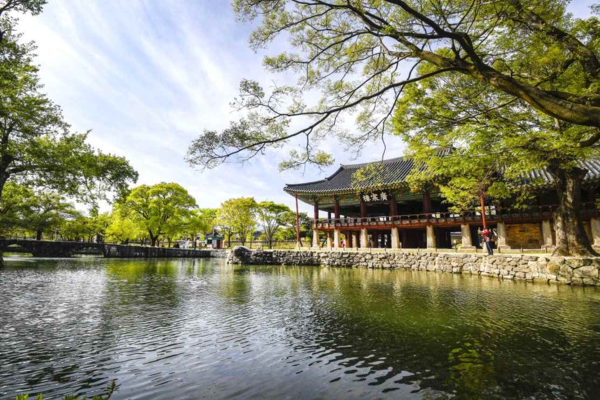
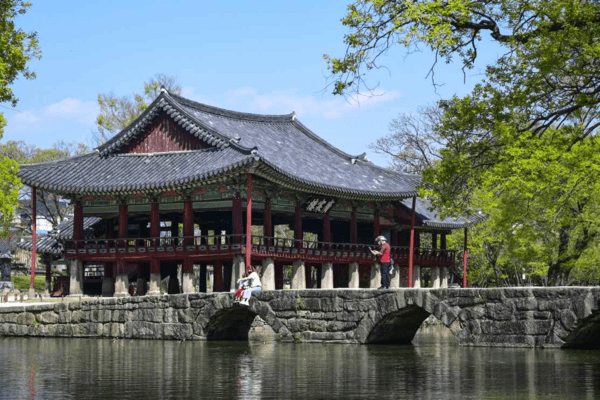
The pavilion is distinguished by its multi-layered beam framework, an advanced structural system that enables expansive interior space. Decorative elements, including carvings of dragons and turtles, exemplify the refined aesthetic vocabulary of Joseon-period timber architecture. The integration of structural stability and ornamental detail highlights the technical sophistication of 17th-century construction methods.
According to the Cultural Heritage Administration, the designation is grounded in both architectural and cultural-historical value. Since its reconstruction in 1626 following destruction during the Japanese invasions, the structure has maintained a high degree of authenticity. Detailed records, including ridge beam inscriptions, document successive repair processes, providing rare continuity in preservation history.
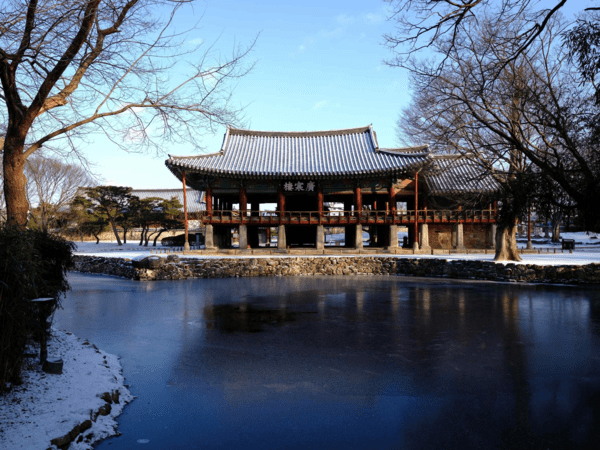
The site’s significance extends beyond architecture into the realm of literary and cultural representation. Gwanghallu, together with its surrounding landscape elements such as the artificial pond, islands, and Ojakgyo Bridge, forms the principal setting of the classical narrative Chunhyangjeon. This association situates the pavilion within a broader cultural framework that connects built space with literary imagination.
The surrounding garden complex, already designated as a scenic site, reinforces the pavilion’s spatial composition, illustrating the synthesis of architecture and landscape design characteristic of Joseon elite culture. The arrangement reflects a deliberate articulation of symbolic space rather than a purely functional layout.
With its elevation to National Treasure status, enhanced conservation measures are expected to follow. Systematic preservation strategies and continued administrative support will be implemented to maintain the structure’s material authenticity and ensure its transmission to future generations.
Reported by News Culture M.J._mj94070777@nc.press
Copyright ⓒ 뉴스컬처 무단 전재 및 재배포 금지


