Songs that echoed alongside the turning of the spinning wheel have endured as cultural records encapsulating the lived experiences of Korean women. The “spinning wheel song” emerged organically within the labor of textile production, forming a distinct genre of folk music that carries layers of daily emotion and memory. Over long hours of repetitive work, these songs alleviated physical fatigue, sustained mental focus, and functioned as channels through which shared experiences were passed within the community.
The spinning wheel song forms one axis of weaving songs alongside “thread-spinning songs” and “loom songs.” As the entire process of textile production unfolded as a continuous sequence, each stage developed its own musical counterpart. These songs played a critical role in maintaining the rhythm of labor. Because weaving required extended periods of sustained effort, singing became more than casual humming; it was a structural element that enabled continuity in work.
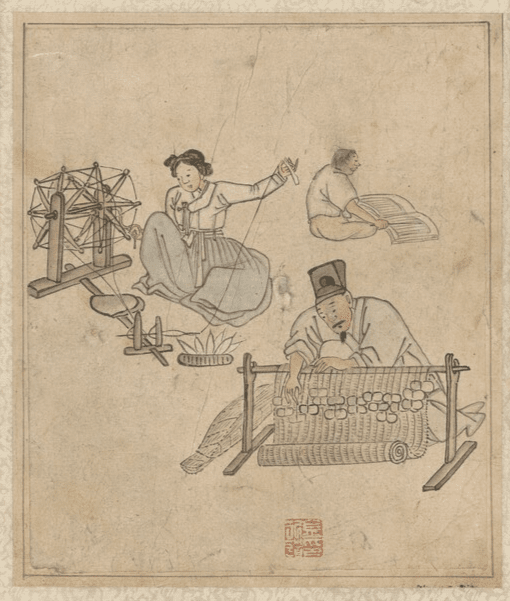
The solitary nature of spinning gave rise to distinct musical characteristics. Without the need for synchronized group participation, melodies stretched freely, unconstrained by rigid structure. This condition facilitated a through-composed form without sectional divisions, allowing lyrics to flow continuously without interruption.
Melodic elements remain restrained, placing emphasis on the lyrics. Verses extend organically, unraveling like thread itself. Rather than foregrounding melody, the songs prioritize storytelling, embedding personal experiences and emotional nuance with density and clarity.
At the core of these narratives lies the hardship of married life within patriarchal households. Feelings of isolation, emotional suppression, and separation from one’s family are deeply embedded in the lyrics. These elements transcend individual experience, offering insight into the broader social structure and the lived realities of women in historical Korea.
The distinctive “whirring” sound of the spinning wheel is often reproduced directly within the songs through onomatopoeia. This auditory imitation vividly captures the labor environment, demonstrating the tight integration between sound and action. The rotation of the wheel and the flow of song align, creating a seamless connection between physical rhythm and emotional cadence.
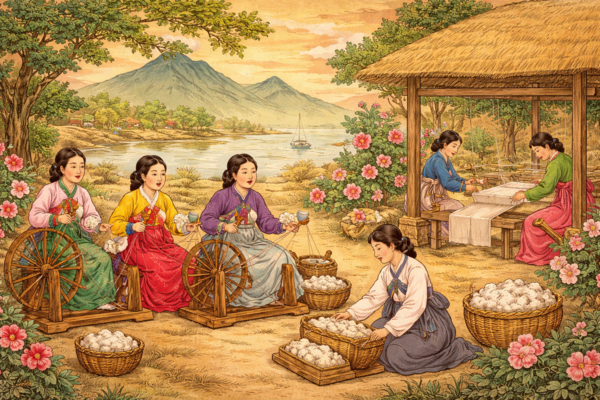
Within repetitive labor, the songs functioned as psychological support systems. They helped sustain concentration, ease monotony, and provide the mental resilience required to endure long hours of work. This can be understood as a cultural adaptation, a form of expression developed as humans responded to their environment.
The spinning wheel song exists both as a living tradition and as a performative art form. Regional folk traditions such as the southern “Mulle Taryeong” and the western “Anju Aewon-gok” evolved into structured performances led by professional singers, adopting call-and-response formats and achieving refined musical expression. This transformation illustrates how everyday songs have been reinterpreted on stage, gaining renewed vitality.
Such expansion highlights the adaptability of folk music. Originating in daily life, these songs have transcended their original context, sustaining relevance across different environments through reinterpretation.
Structurally, spinning wheel songs accommodate extended narratives. The solitary and prolonged nature of the work allowed lyrics to grow in length and complexity, evolving into narrative-driven forms. This characteristic distinguishes them from other folk genres and underscores their value as oral literature.
Historical awareness is also embedded within the lyrics. References to ancient weaving traditions or figures such as Mun Ik-jeom demonstrate how lived memory was transmitted through song. These elements represent an alternative mode of historical recording, distinct from written documentation.
Themes of love and longing appear repeatedly. The emotional weight of waiting for absent loved ones and enduring prolonged separation resonates throughout the songs. These expressions reflect not only individual sentiment but also shared emotional experiences across communities.
Regional variations introduce subtle differences in form and content. For instance, the “Mulle Taryeong” of Yeongam reflects local environmental and cultural contexts. Despite these variations, the songs maintain a cohesive emotional framework within the broader tradition of Korean folk music.
Weaving songs are interconnected across stages of labor. Songs for carding cotton, spinning thread, and weaving fabric form a continuous cultural sequence. This interconnectedness underscores that weaving was not a singular act but a complex, multi-stage process embedded in daily life.
Today, spinning and weaving have largely disappeared from everyday practice due to mechanized production. As traditional labor fades, opportunities to hear these songs in their original context have diminished. In this transformation, spinning wheel songs remain as invaluable cultural records that preserve the texture of past lives.
Despite this shift, their significance endures. The voices of women, often absent from written history, are preserved within these lyrics. As orally transmitted traditions, these songs function as an alternative historical archive, capturing lived experiences across generations.
Ultimately, the spinning wheel song stands at the intersection of labor and art. Born from repetitive motion and accumulated emotion, it has endured beyond the disappearance of the spinning wheel itself. What remains is not merely sound, but a resonance that continues to connect the past with the present.
Reported by News Culture M.J._mj94070777@nc.press
Copyright ⓒ 뉴스컬처 무단 전재 및 재배포 금지


