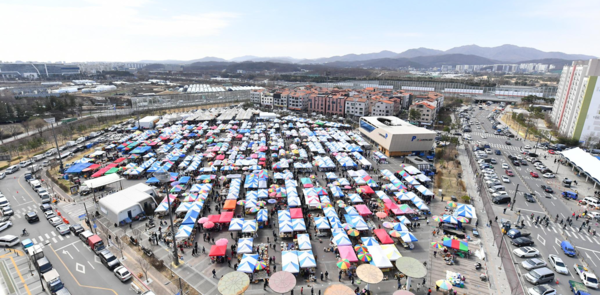
On market days, the area around Moran Station in Seongnam moves at a different rhythm. What is normally a parking lot transforms into a dense grid of stalls and crowds. Flowers, grains, herbs, fish, vegetables, and prepared foods stretch across the space, drawing visitors from across Seoul and southern Gyeonggi Province. Moran Folk Market still operates as a traditional periodic market, opening on dates ending in four and nine, with around 950 vendors across roughly 11,000 square meters.
The market did not emerge in isolation. It developed alongside the growth of Seongnam itself. After the Korean War, the city absorbed waves of displaced residents and relocated populations, forming a rapidly expanding urban settlement. In the absence of a stable commercial infrastructure, periodic markets became essential. Moran Market was established in 1962 under these conditions, initially as a small trading space before expanding significantly in the late 1960s.
The market’s structure reflects this layered history. Following the relocation of large populations from Seoul, the surrounding areas, including Sujin Bridge and Daewon Stream, became dense commercial zones. By the 1970s, the market had evolved into a major hub for daily necessities, agricultural goods, and regional trade.
Moran Market also inherited the legacy of Songpa Market, one of the major markets of late Joseon. After Songpa Market disappeared following administrative changes in 1963, its trading rhythm and customer base shifted to Seongnam. Even the market schedule, opening on the 4th and 9th, was carried over. The name “Moran” itself is tied to a refugee’s memory of Pyongyang, symbolizing longing and displacement.
By the 1980s, Moran had become one of the largest periodic markets in Korea, attracting traders from across the country. Its scale expanded further due to its proximity to the intercity bus terminal, enabling a wide distribution network. However, this growth also brought tension, as local authorities viewed the market as inconsistent with the city’s desired image.
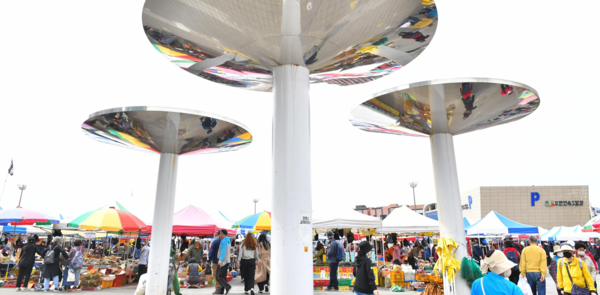
In 1990, the market relocated to its current site along the covered Daewon Stream. The area functions as a parking lot on regular days and transforms into a marketplace on trading days. This dual-use structure underscores Moran Market’s continuing role as a living, adaptive space rather than a preserved relic.
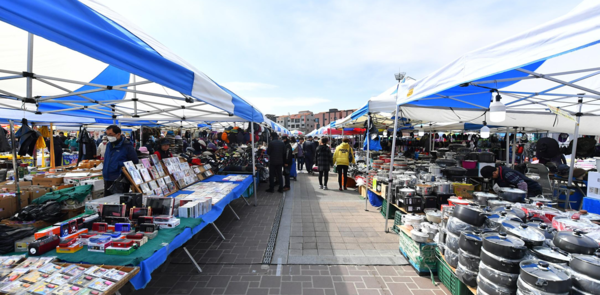
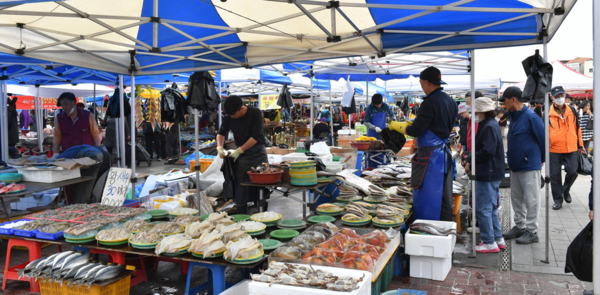
The market is divided into 13 specialized sections, including flowers, grains, herbs, clothing, fish, vegetables, and prepared food. Among these, the chili pepper section is particularly influential, historically shaping price trends across the Seoul metropolitan area. The diversity of goods reinforces the market’s reputation as a place where “everything can be found.”
Food culture forms another core dimension. From kalguksu to pumpkin porridge, the market’s food section reflects everyday consumption patterns. Vendors and visitors share the same space, creating a fluid environment where commerce and daily life intersect.
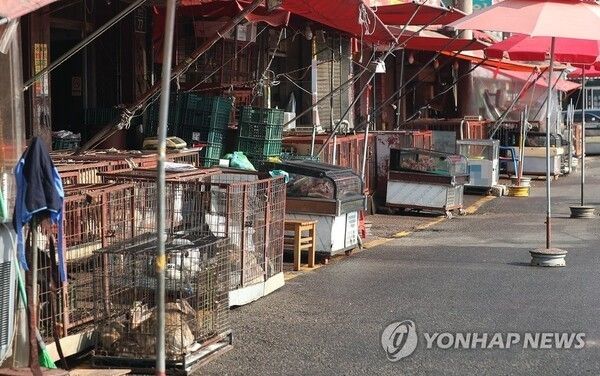
At the same time, Moran Market has been at the center of social debate. In the early 2000s, it accounted for a significant portion of the country’s dog meat distribution, drawing criticism from international animal rights organizations. These controversies have influenced both public perception and policy, leading to gradual shifts in market practices.
Today, Moran Market stands as more than a commercial hub. It is a condensed record of urban migration, economic adaptation, and cultural continuity. From a refugee-built marketplace to one of Korea’s largest periodic markets, its evolution reflects the broader transformation of modern Korean society.
Reported by News Culture M.J._mj94070777@nc.press
Copyright ⓒ 뉴스컬처 무단 전재 및 재배포 금지


