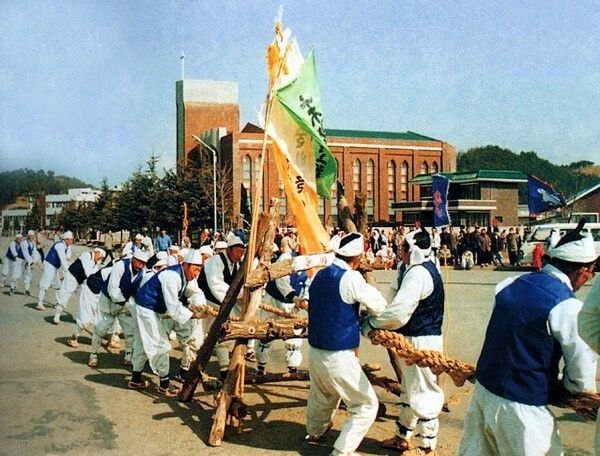
In Samcheok, Gangwon Province, the full moon of the first lunar month brings forth a massive tug-of-war unlike any other. Designated as Gangwon-do Intangible Cultural Heritage No. 2 in 1976, the Samcheok Gijul Tug-of-War reflects both the region’s linguistic identity and its layered belief system. The term “gi,” meaning crab in local dialect, originates from the rope’s structure, where smaller strands resemble crab legs, believed to ward off evil spirits.
The origins of the ritual are not unified but instead branch into four widely circulated interpretations. One traces back to the tenure of Heo Mok during the reign of King Hyeonjong, when a ritual for a good harvest followed the completion of a reservoir embankment. Another links it to seasonal wind-divination practices during the full moon, where coastal victory foretold maritime success and inland victory predicted agricultural prosperity. Additional explanations connect the event to communal labor such as fortress repairs, or to exorcistic practices aimed at suppressing malevolent spirits in areas associated with executions.
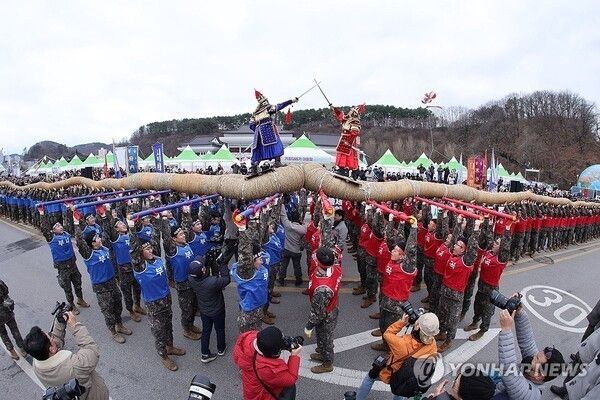
The event unfolds progressively. Children begin with smaller “sokdak” ropes within villages. Adolescents follow with mid-sized ropes during early lunar days. By the full moon night, the entire town converges for the “big rope,” a structure extending roughly 200 meters in length. Each stage expands participation, transforming a local pastime into a collective ritual.
The main event divides participants into two symbolic factions: the eastern “Bunae,” representing coastal and feminine elements, and the western “Malgok,” associated with inland and masculine qualities. Victory is not exclusive. Whether sea or land prevails, the outcome is understood as prosperity for the entire community.
Rope-making itself is a communal ritual. Each village contributes segments that are later assembled into the main rope at the central square. Straw forms the base, reinforced with kudzu vines to prevent breakage. The twisting process involves repeated bundling and tightening, accompanied by music and chant known as “Sulbitong songs,” turning production into performance.
On the day of the full moon, the scale intensifies. Villagers parade through the town carrying their respective ropes, joined by flags, traditional bands, and costumed performers. The final assembly connects the rope’s head and body using a large wooden pin, completing a structure that can rise up to two meters at its peak.
The tug-of-war begins under moonlight and torchlight, often lasting from midnight until dawn. There are no restrictions on participation. Signals are relayed through gestures by designated leaders positioned along the rope. Movements of the rope indicate commands, whether to pull, hold, or reposition. Even physical tactics, such as digging into sand or adding weight to garments, become part of the struggle.
Yet the event is not merely a contest. It is a prolonged act of endurance, where neither speed nor domination defines success. The losing side withdraws quietly, while the winning side celebrates, reinforcing the ritual’s communal rather than competitive nature.
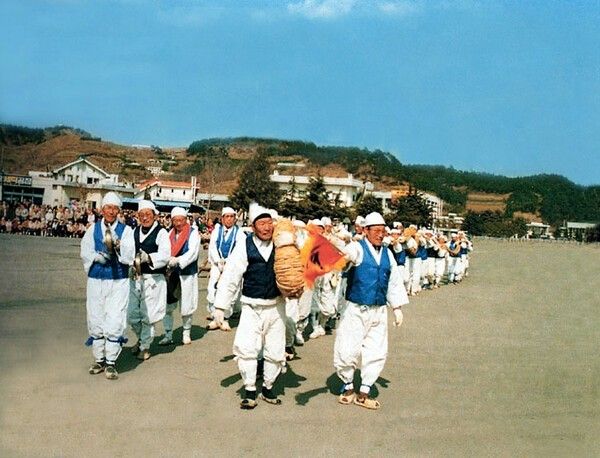
Ritual elements are inseparable from the event. Agricultural rites such as Seonnongje are performed in early spring, followed by processions through the town. Some villages conduct shrine rituals before the tug-of-war, and the rope itself may be preserved at sacred sites throughout the year. The boundary between ceremony and play dissolves into a single, unified practice.
Interrupted during the Japanese colonial period in 1936, the tradition was revived in 1973 with the establishment of a local folk committee. Since then, it has been sustained through festivals and cultural preservation efforts, adapting its location while maintaining its core structure.
Samcheok Gijul Tug-of-War cannot be reduced to a single event. It encompasses rope-making, music, procession, ritual, and communal celebration. Set against coastal terrain of sand and gravel, it embodies the interplay of geography, belief, and social structure.
Ultimately, the ritual transcends the notion of competition. It is a full-bodied communal act, where opposing forces meet not to divide, but to affirm collective prosperity.
Reported by News Culture M.J._mj94070777@nc.press
Copyright ⓒ 뉴스컬처 무단 전재 및 재배포 금지


