A special exhibition at the Gyeongju National Museum is drawing renewed scholarly attention to Korea’s ancient past, centering on two stone fragments discovered 83 years apart that have now been identified as parts of a single monument.
The exhibition, titled “Reunion After 83 Years: Stone Fragments from Wolsong,” traces the journey of the fragments found in 1937 and 2020. The first piece, unearthed west of Wolsong, was long overlooked due to the absence of identifiable markings beyond a single character. The discovery of a second fragment during a 2020 excavation of the Wolsong moat, however, fundamentally changed the interpretation.
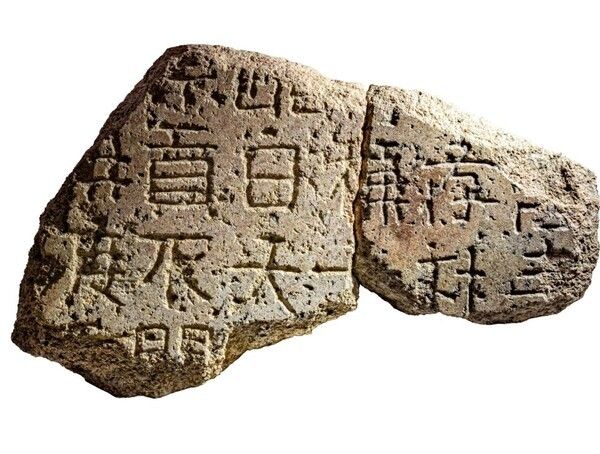
While the fragments initially appeared unrelated, high-resolution 3D scanning revealed that their fractured surfaces aligned precisely. More significantly, partial inscriptions on each piece combined to form the character “稱,” symbolizing the reconnection of a once fragmented historical record.
The exhibition has become a focal point of academic debate, particularly over the calligraphic style engraved on the stone. Unlike typical Silla steles, which are rendered in the orderly regular script (kaishu), the Wolsong fragments display characteristics of clerical script (lishu), a distinction that carries significant historical implications.
Comparative analysis further complicates the issue. The Chungju Goguryeo Stele, designated National Treasure No. 205, exemplifies Goguryeo’s use of clerical script with bold, angular strokes, echoing the stylistic force of the Gwanggaeto Stele. The presence of similar script elements in the Wolsong fragments has led some scholars to suggest a possible connection to Goguryeo influence in the 5th century.
Counterarguments remain equally compelling. Transitional inscriptions such as the Danyang Silla Jeokseong Stele (National Treasure No. 198) exhibit a shift from clerical to regular script, while the Pohang Naengsuri Silla Stele (National Treasure No. 264) retains vestiges of clerical form within a primarily regular script framework. Similarly, the Uljin Bongpyeong-ri Silla Stele (National Treasure No. 242) demonstrates lingering clerical characteristics despite its classification in regular script.
These examples illustrate that Silla inscriptions gradually developed an independent calligraphic identity while absorbing external influences, making it difficult to attribute the Wolsong fragments to a single origin based solely on script. The fact that the stone was quarried from granite in Gyeongju’s Namsan region, however, lends weight to arguments supporting Silla production.
Questions surrounding the fragments remain unresolved. Although the inscription is believed to contain 16 characters, neither its exact date nor its producer has been definitively established. The finely processed surface suggests techniques associated with Unified Silla, while the script points to a much earlier period, complicating chronological classification.
Rather than presenting definitive conclusions, the exhibition invites visitors into the investigative process. Through 3D scan data and comparative materials with the Gwanggaeto Stele, audiences are encouraged to engage directly with the unresolved questions of early Korean history.
Kim Hyun-hee, head curator, described the exhibition as “a space to share unanswered historical questions with the public.” The reunited fragments, separated for over eight decades, now stand as both artifact and inquiry, prompting a renewed search for the truths embedded within their stone surface. The exhibition runs through August 17.
Reported by News Culture M.J._mj94070777@nc.press
Copyright ⓒ 뉴스컬처 무단 전재 및 재배포 금지


