The series Life with the Kings begins with the idea of revisiting spaces embedded in everyday life yet often overlooked, drawing inspiration from the film "The King's Warden." It seeks to reframe these sites not as distant relics, but as places still accessible today.
Geonwolleung is the royal tomb of King Taejo of Joseon, located within the Donggureung complex. Constructed in 1408, it is the first royal tomb of the Joseon dynasty and the starting point of what would later become a cluster of nine royal tombs. The entire Donggureung complex, designated Historic Site No. 193, holds this collective significance.
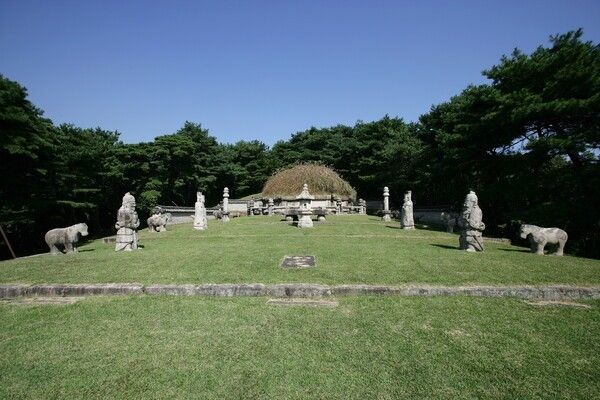
King Taejo passed away on May 24, 1408, at the age of 74. Selecting the burial site for the founder of a new dynasty was a matter of immense political and symbolic weight. King Taejong ordered officials and geomancers to survey lands within roughly 100 ri of Hanyang. The Geomam area was recommended as an auspicious site, with official Ha Ryun endorsing the location. Construction, overseen by Park Jacheong, reportedly mobilized around 6,000 workers, underscoring the importance placed on royal tomb construction in early Joseon.
The location of Geonwolleung later became the nucleus for additional royal tombs, reflecting its acceptance as a geomantically favorable site. Positioned centrally to the north, with subsequent tombs extending east and west, Donggureung evolved into the largest royal tomb complex of Joseon. It was inscribed as a UNESCO World Heritage Site in 2009.
◇ Between Goryeo Legacy and Joseon System
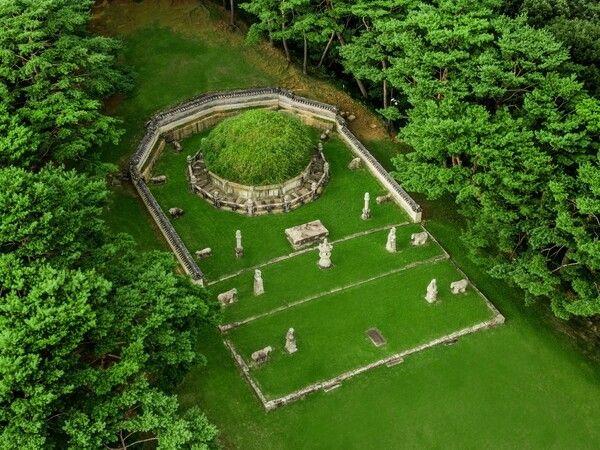
Geonwolleung represents the transitional phase between Goryeo and Joseon funerary traditions. It was modeled after the tomb of King Gongmin (Hyeonjeongneung) of Goryeo, while incorporating emerging Joseon stylistic elements. These include the installation of curved retaining walls around the mound, restructured stone placements, and refined lamp structures.
The stone carvings are particularly notable. The retaining stones feature reliefs of the twelve zodiac guardians and cloud motifs, while additional carvings reflect lingering Buddhist symbolism, such as sacred ritual objects. This indicates that Buddhist elements still coexisted within early Joseon royal funerary practices, prior to the full codification of Confucian rites in texts like "Gukjo Oryeui."
One of the most distinctive features of Geonwolleung is its burial mound. Unlike other Joseon royal tombs, which are covered with grass, Geonwolleung is uniquely covered with silver grass. According to historical records, this reflects King Taejo’s will to use reeds from Hamheung. It is the only such case among Joseon royal tombs, carrying both symbolic and political implications tied to the relationship between Taejo and Taejong.
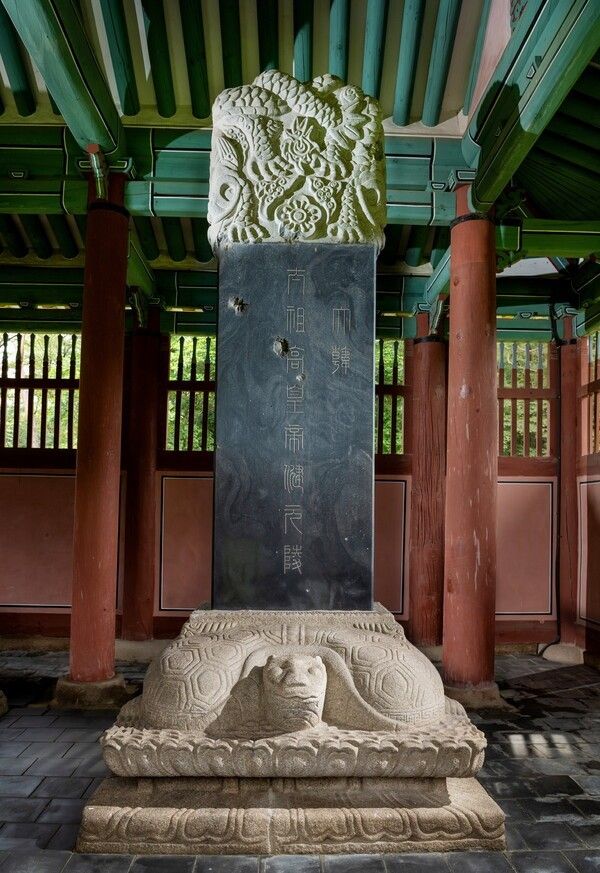
Geonwolleung’s significance extends beyond the burial mound. The Jeongjagak ritual hall, built alongside the tomb in 1408, represents the archetype of Joseon royal shrine architecture. It was designated a Treasure in 2011. The tomb stele (Sindobi) of King Taejo is also recognized for its sculptural and symbolic significance.
Records also mention a temple (wonchal) associated with the tomb, though its physical traces have not been clearly identified. This further illustrates that early Joseon funerary practices cannot be fully explained by Confucian norms alone, as elements of Buddhist tradition and Goryeo heritage persisted.
◇ From Taejo’s Geonwolleung to Heonjong’s Gyeongneung
Geonwolleung is not merely a single tomb but the origin point of the broader Donggureung complex. The site encompasses nine royal tombs, including those of King Munjong, King Seonjo, King Yeongjo, and King Heonjong, among others. It is the largest concentration of Joseon royal tombs in one location.
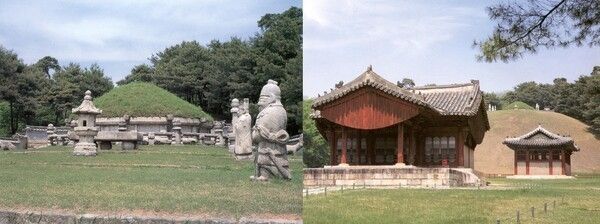
Geonwolleung stands not only as the resting place of a king but as a condensed record of Joseon’s formative era. Its silver grass mound, stone carvings, ritual architecture, and central role within Donggureung collectively reflect the political order, artistic transition, and cultural continuity from Goryeo to Joseon.
To examine Geonwolleung is, in effect, to retrace the very beginning of the Joseon dynasty.
Reported by News Culture M.J._mj94070777@nc.press
Copyright ⓒ 뉴스컬처 무단 전재 및 재배포 금지


