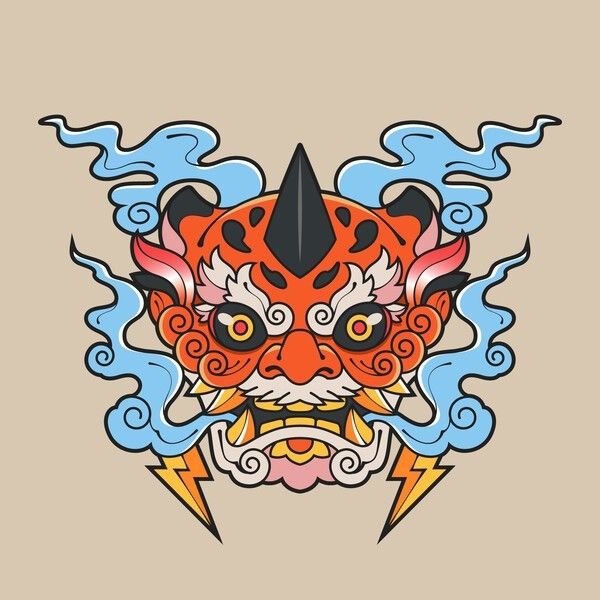
“Why does the dokkaebi have horns and carry a club?”
The familiar image of the horned dokkaebi wielding a magical club appears deeply rooted in Korean cultural memory. Yet, when traced historically, its origin proves far more complex and difficult to define. While the dokkaebi is widely recognized as a uniquely Korean folkloric being, neither its form nor its linguistic origin can be reduced to a single source. In particular, the term “Dokgakgwi (獨脚鬼),” meaning a one-legged spirit, has long stood at the center of debates surrounding its archetype.
The earliest recorded reference to the dokkaebi appears in Samguk Yusa, specifically in the tale of “Dohwa-nyeo and Bihyeong-rang.” In this narrative, the dokkaebi does not resemble the monstrous figure recognized today. Instead, it functions as a being that interacts with humans and serves practical purposes. Bihyeong-rang is said to gather dokkaebi at night to play, and under royal command, they construct a bridge overnight. This depiction suggests that early conceptions of the dokkaebi emphasized collective labor and functionality rather than physical form.
Notably, the story offers almost no description of the dokkaebi’s appearance. There is no mention of horns, clubs, or a single leg. Instead, the dokkaebi exists as an entity outside human society, yet one that can be summoned and controlled when needed. This indicates that early interpretations focused more on role and behavior than on fixed visual characteristics.
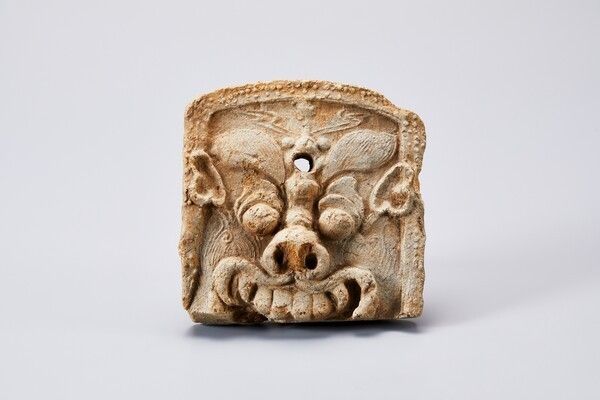
Over time, however, the image of the dokkaebi became increasingly concrete. In late Joseon texts such as Hak-san Han-eon and Oju Yeonmun Jangjeon Sango, the dokkaebi is described as a figure wearing a bamboo hat and straw raincoat, running through drizzle. These accounts portray it as a one-legged being with a foul odor, capable of causing illness.
Here, the term “Dokgakgwi” emerges prominently. Literally translating to “one-legged ghost,” it became a key textual reference supporting the image of the one-legged dokkaebi. Repeated citations of this term gradually solidified the idea as a defining characteristic of the creature.
Folk tales reinforce similar imagery. In wrestling stories, the dokkaebi often appears as a one-legged opponent. Though seemingly disadvantaged, it possesses overwhelming strength, and defeating it requires specific rules or techniques. These narratives simultaneously emphasize playfulness and structure while reinforcing the one-legged motif.
As literary records and oral traditions intersected, the image of the one-legged dokkaebi gained traction. However, a critical question remains: does this image represent the original form of the dokkaebi? Some scholars argue that the concept of “Dokgakgwi” suggests a connection to Chinese mythological creatures.
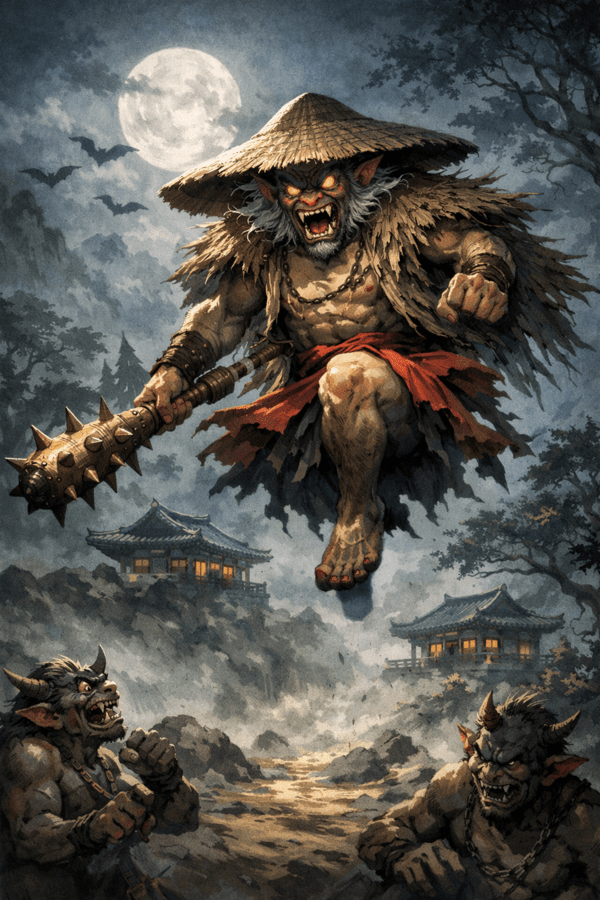
In Chinese texts such as Baopuzi and Strange Tales from a Chinese Studio, one-legged spirits and mountain entities appear frequently. The mountain spirit known as “Shanxiao (山魈)” is also described as a one-legged being. Based on these parallels, some interpretations suggest that the dokkaebi may share origins with broader East Asian nature-spirit traditions.
Japanese scholar Yoda Chihoko expanded this perspective, linking the dokkaebi to the Dokgakgwi lineage and connecting Chinese tree-spirit beliefs with Korean mountain worship traditions. In this framework, the dokkaebi is seen as a being governing disease and disaster within agrarian societies, with its one-legged form functioning symbolically.
However, this interpretation faces substantial criticism. The central issue lies in whether “Dokgakgwi” explains the origin of the dokkaebi or merely serves as a later textual representation. Early Joseon records such as Seokbosangjeol already contain the native term “Dotgabi,” suggesting that the concept of the dokkaebi predates its Sino-Korean transcription.
If so, “Dokgakgwi” may not define the origin but rather reflect a linguistic adaptation. Over time, the literal meaning of the Chinese characters may have influenced how people visualized the dokkaebi, emphasizing the one-legged trait even if it was not originally inherent.
This phenomenon highlights how language can reshape cultural imagery. Literal interpretations of written terms, combined with later imagination, can introduce attributes that were not initially present. The one-legged dokkaebi may be a product of this process.
A broader examination of Korean folklore reveals that the dokkaebi is defined less by fixed appearance and more by behavior and function. It plays tricks on humans, grants or takes away wealth, and often tests human character. Its form remains fluid, shifting depending on context.
From this perspective, the one-legged attribute appears less as an essential trait and more as a feature emphasized during a particular historical phase. The repeated depiction of one-legged dokkaebi in late Joseon texts reflects a period when oral traditions were being documented and reinterpreted. In this process, certain elements were amplified or reconstructed.
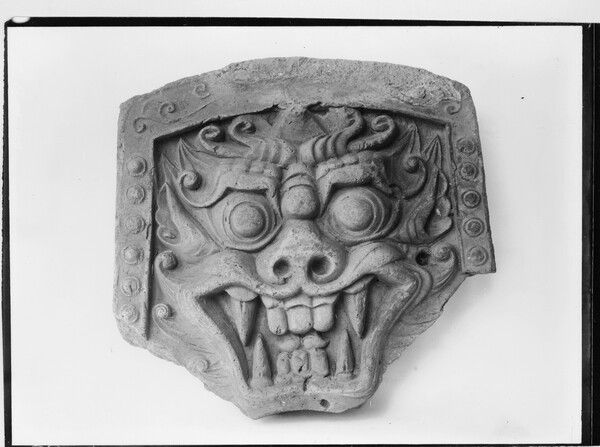
Ultimately, the form of the dokkaebi is best understood not as a singular origin but as the result of layered cultural influences. Indigenous Korean animistic beliefs, Chinese mythological concepts, Joseon-era textual interpretations, and folk imagination all contributed to shaping its modern image.
The debate over the one-legged dokkaebi serves as a compelling case study in how cultural symbols evolve. What appears to be an ancient and fixed tradition often reveals, upon closer examination, a history of reinterpretation and transformation.
The dokkaebi, as we recognize it today, is less a preserved original than a composite shaped by successive layers of meaning. The one-legged figure is simply one of those layers.
Reported by News Culture M.J._mj94070777@nc.press
Copyright ⓒ 뉴스컬처 무단 전재 및 재배포 금지


