Standing before the Gyeongcheonsa Ten-Story Stone Pagoda, the eye is drawn upward almost instinctively. Rather than revealing itself at once, the structure unfolds gradually. Intricate carvings embedded in stone, layered with time, create the impression of a compressed historical narrative rather than a single monument.
Most Goryeo stone pagodas followed the restrained proportions and compositional discipline inherited from Unified Silla. This pagoda, however, breaks from that convention. Its cross-shaped base introduces spatial variation, creating a rhythmic visual flow that interacts with the tapering vertical structure above.
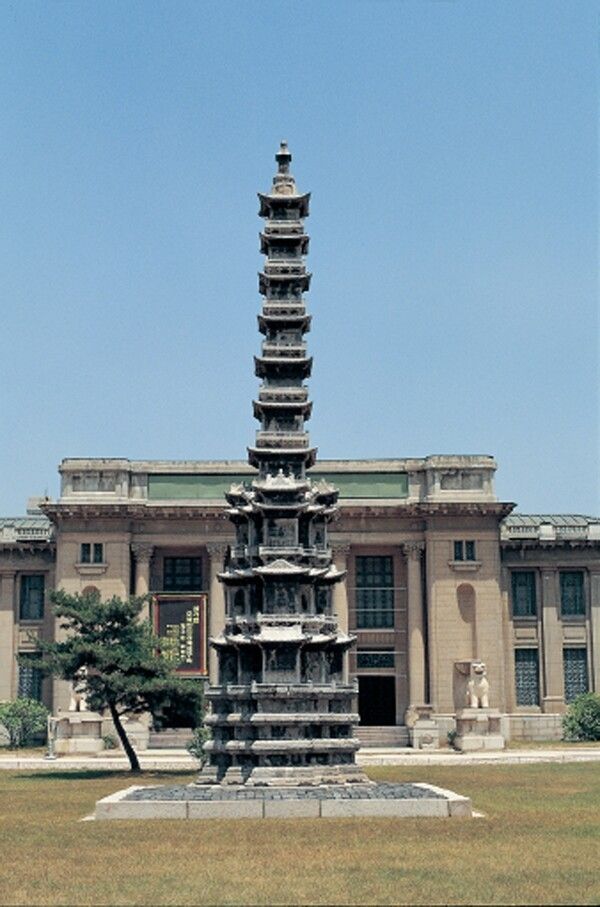
The relationship between the base and the pagoda body balances structural clarity with ornamental density. The three-tiered base anchors the structure, while its surfaces are filled with carvings that diffuse visual weight. These are not merely decorative. Figures of Buddhas, bodhisattvas, celestial beings, and dragons collectively articulate a layered Buddhist worldview.
Moving upward, the architectural logic shifts. The lower three stories retain the base’s planar system, but higher levels gradually reduce in scale, reinforcing a sense of ascent. From the fourth story, the plan transitions into a square format, stabilizing the composition while introducing variation. This reflects a deliberate expansion of architectural language.
Balustrades beneath each roofline function symbolically rather than structurally, marking boundaries within the composition. The bracket systems carved beneath the eaves replicate wooden construction in stone, illustrating a hybrid architectural approach. The roof design further emphasizes this, with detailed tile grooves and hip-and-gable forms that convincingly evoke timber architecture.
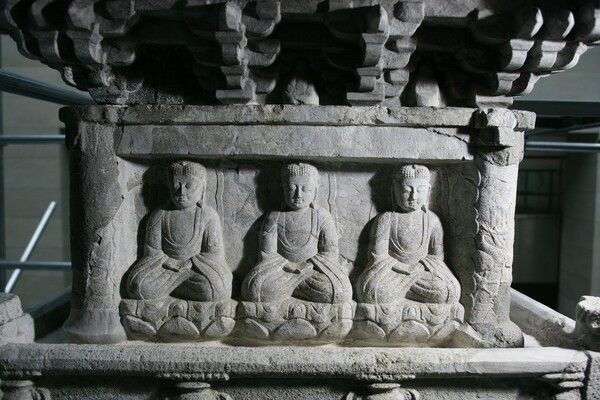
The density of carving remains one of its most defining characteristics. Despite its visual richness, the composition maintains internal balance. Each figure operates independently yet integrates seamlessly into the whole.
An inscription on the first-story body stone records “Jijeong 8,” identifying the year 1348 during King Chungmok’s reign. Even amid political instability, this confirms the continuity of Buddhist patronage and architectural production in late Goryeo.
This period coincided with strong Yuan influence, reflected in the pagoda’s multi-bracket systems and elaborate ornamentation. The structure thus embodies a tangible record of cross-cultural exchange.
Its later history adds another layer of meaning. Originally located in Kaepung, the pagoda was removed to Japan during the colonial era before being returned and reconstructed in Korea. This trajectory positions it as a key example of cultural restitution.
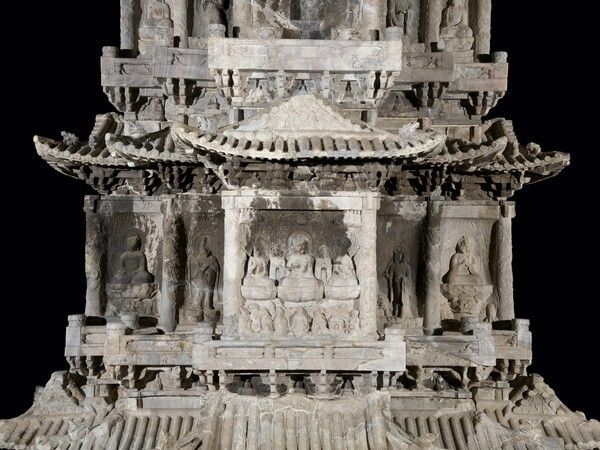
Although no longer in its original setting, the pagoda continues to generate new interpretations within its current context. Placed within a palace environment, it prompts reflection on the intersections of royal authority, Buddhism, and heritage preservation.
Comparable examples appear in early Joseon stone pagodas, yet few match its scale or refinement. This reinforces its role as a reference point in the evolution of Korean stone pagoda design.
Aesthetically, the work achieves a precise balance between stability and upward tension. The broad base grounds the structure, while the narrowing upper tiers guide the viewer’s perception vertically.
Beyond its formal qualities, the pagoda retains its religious function as a symbolic axis of Buddhist belief. The carved imagery transforms doctrine into visible form.
Today, it stands not only as a relic of Goryeo artistry, but as a layered cultural artifact shaped by exchange, displacement, and recovery. Observing it becomes an act of reading history through form.
Reported by News Culture M.J._mj94070777@nc.press
Copyright ⓒ 뉴스컬처 무단 전재 및 재배포 금지


