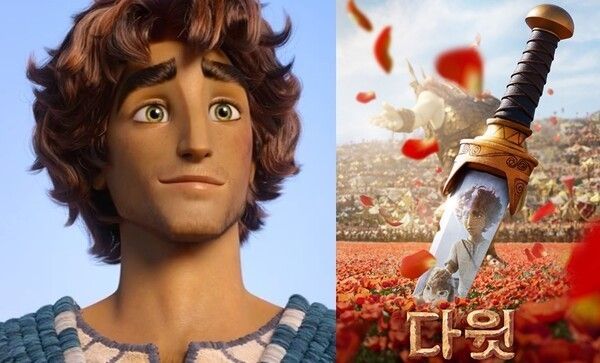
“Even if arrows fly, by night or by day, I will not be afraid.”
Perfection does not exist, nor do flawless heroes. David builds its narrative on that premise, tracing how faith becomes a mechanism to confront fear and internal limitation. The film centers on David, the second king of the Kingdom of Israel, and the formative moments that define his ascent.

A shepherd by origin, David is told by the prophet Samuel that he is destined for kingship. Before the meaning of that prophecy settles, he is drawn into war. On a battlefield held in tension, he faces Goliath alone. A single stone secures victory, but the aftermath shifts the conflict inward and upward. Elevated to hero status, he becomes a target of King Saul’s suspicion, forcing him into a second phase of confrontation, one defined less by combat and more by destiny.
The film positions David’s transformation not as spectacle, but as a gradual negotiation between fear, belief, and responsibility.
Following the performance of The King of Kings, the genre has gained renewed commercial traction. David extends that momentum, surpassing its predecessor in North America and establishing a new opening benchmark for religious animation.

The King of Kings previously demonstrated that faith-based narratives could translate into broad audience engagement, combining theological subject matter with accessible storytelling. Its box office performance confirmed the viability of the genre beyond niche markets.
David advances this trajectory with a more focused character study. Produced in the United States, the film moves from intimate beginnings to large-scale confrontation, anchoring its structure in emotional continuity rather than episodic spectacle. Its $22 million opening weekend underscores both market expansion and audience receptivity.

Technically, the film leans on controlled visual composition and a measured score to sustain tone. The emphasis remains on interior conflict: the tension between vulnerability and conviction. This approach allows the narrative to operate simultaneously as religious text adaptation and universal coming-of-age framework.

The central image remains structurally simple: an unarmed boy facing an overwhelming force. Yet its symbolic density is high. The act of throwing a single stone functions less as action and more as thesis, a distilled expression of belief under pressure.
“Are you ready to face a great adventure?” The question posed by Samuel operates as both narrative trigger and thematic anchor. As the film progresses, it reframes that question from prophecy into choice.
David ultimately refrains from excess. Instead, it relies on clarity of structure and thematic consistency, positioning faith not as abstraction, but as a disciplined response to fear.
Reported by News Culture M.J._mj94070777@nc.press
Copyright ⓒ 뉴스컬처 무단 전재 및 재배포 금지


