The traditional performance play “Gwangdae” draws from “Sochundae Yuhee,” a modern paid production staged at Hyomnyulsa in 1902, and reshapes it for a contemporary audience. Hyomnyulsa is widely regarded as the origin of the National Jeongdong Theater. At the time, it brought together Namsadang nori, mudong nori, mask dance, tightrope walking, and early forms of changgeuk, marking a defining moment in Korean performance history. By weaving traditional dance, vocal performance, pungmul, and beona into a single stage language, the work revives the dynamic spirit of historic theaters with renewed immediacy.
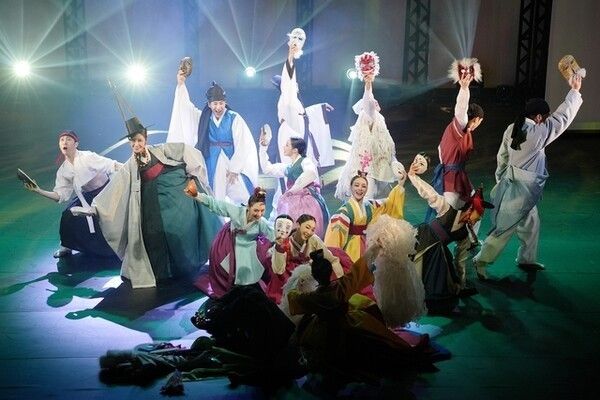
The production’s trajectory is equally striking. It began with four showcase performances in November 2024 under the title “Sochundae Yuhee,” before expanding into a 30-run season last year as “Gwangdae.” The work has since toured internationally, including the Osaka-Kansai Expo in Japan, alongside domestic stops in Daegu, Donghae, Jindo, Daejeon, and Jinju. Building on this momentum, the production will scale up to 50 performances this year, positioning itself as a flagship repertoire of the National Jeongdong Theater Company.
The narrative is set in motion by an unexpected blackout during rehearsal. As the company and its artistic director Soonbaek prepare a reconstructed staging of the 1902 Hyomnyulsa performance, “2026 Sochundae Yuhee,” a sudden power outage plunges the theater into chaos. What follows is not a simple interruption but a rupture in time. A century-old past and its “gwangdae” seep into the present, while a mysterious child appears before the disoriented Soonbaek. The stage breaks free from the framework of historical reconstruction and evolves into a surreal space where past and present collide.
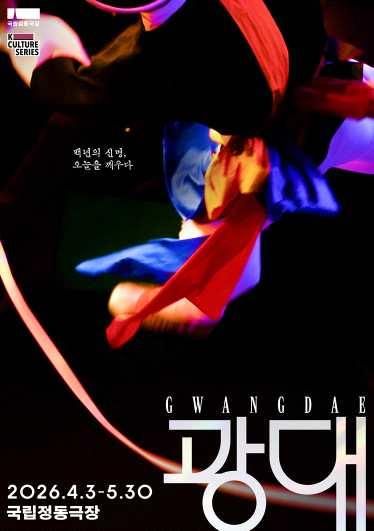
The cast lineup reinforces the production’s depth. The role of artistic director Soonbaek is triple-cast with Lee Sang-hwa, Park In-hye, and Kang Hyun-young. Lee Sang-hwa, known for her wit and technical finesse in the role, is expected to deliver a more layered performance. Park In-hye, a creator and vocalist who engages audiences through pansori-based works such as “Over the Tteechang: Munjeon Bonpuri” and “Paper Flower Field: Duhalmang Bonpuri,” adds artistic breadth. Kang Hyun-young, a newly joined member of the company, brings fresh energy to the stage.
The role of the child is shared by Go Chae-hee, Choi Yi-jeong, and Seo Yi-eun. Go Chae-hee gained recognition as a TOP5 finalist on KBS’s traditional music talent program “Akdong.” Seo Yi-eun, a rising talent, won first place in the elementary lower division of the pansori category at the 25th Park Dong-jin Master Singer Competition. Choi Yi-jeong received top honors in the elementary division at the 42nd National Traditional Music Competition, marking her as another promising performer.
“Gwangdae” is positioned as a traditional performance designed for the era of 30 million K-tourism visitors. Its intent to engage both domestic and international audiences is clear. The National Jeongdong Theater aims to share the emotional depth of traditional arts while expanding the reach of foundational performance culture. “Gwangdae” ultimately presents a stage where the original form of tradition and its contemporary relevance coexist with precision and vitality.
Reported by News Culture M.J._mj94070777@nc.press
Copyright ⓒ 뉴스컬처 무단 전재 및 재배포 금지


