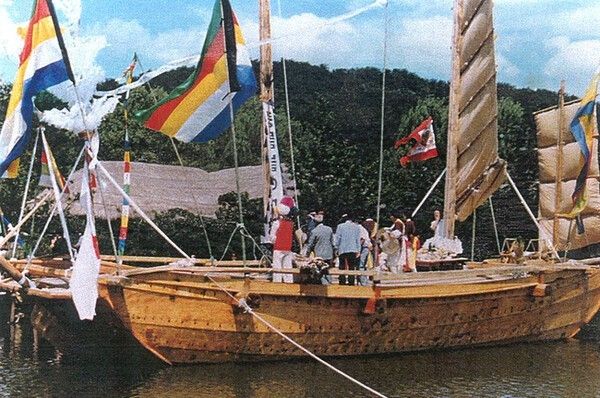
A boat is a living technology shaped by the rivers and seas of the land. Joseonjang refers to the artisan who builds hansen, Korea’s traditional wooden boats. According to heritage records and exhibition materials, modern hansen generally refers to vessels that moved between rivers and seas around the Japanese colonial period. Georutbae, narutbae, yageoribae, and dangduri form part of that lineage. Today, hwangpo sailboats, pleasure boats, motor vessels, and maesaengi fishing boats are often cited.
The craft of a Joseonjang goes beyond carpentry. Large boats were typically built by two to three people, while smaller ones required one or two, taking from a week to a month depending on the type. Villagers often joined the process. The work demanded structural insight, mastery of timber, and practical knowledge of how vessels withstand currents and weight. Boatbuilding was closely tied to livelihood, transport, and fishing within the community.
A defining feature of traditional Korean boats is the flat bottom. Designed to navigate shallow upstream waters, the structure allowed boats to move along rivers or rest directly on sandbanks. In the case of yageoribae, a single mast enabled travel across both sea and river. Hansen was not shaped by aesthetics first, but by adaptation to terrain, tides, and waterways.
Joseonjang cannot be reduced to simply “boat builder.” Hansen represents an accumulation of indigenous shipbuilding knowledge, and Joseonjang is the figure who carries and transmits that knowledge through practice. The flat-bottom structure evolved as a direct response to Korea’s fast currents, shifting depths, and tidal coasts.
Today, Seoul’s Joseonjang remains without a holder. Designated as a Seoul Intangible Heritage item on September 30, 1992, it has been vacant since the passing of its recognized master, Park Jeong-ok, on October 6, 1994. The city has acknowledged it as a long-vacant category.
This absence is more than the loss of one artisan. Traditional boatbuilding cannot be fully restored from blueprints alone. Knowledge such as reading wood grain, assembling structure, and understanding how boats endure real waters is transmitted through people. That is why Joseonjang must be revived.
Reported by News Culture M.J._mj94070777@nc.press
Copyright ⓒ 뉴스컬처 무단 전재 및 재배포 금지


