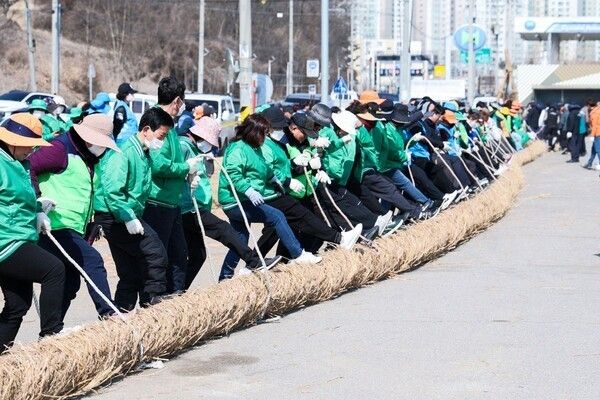
Every spring, Gijisi-ri in Songak-eup, Dangjin, Chungcheongnam-do, gathers to create a massive rope and pull it together. This tug-of-war, passed down for over 500 years, is a communal ritual wishing for peace and a good harvest.
According to local legend, the area’s terrain resembles a woman weaving cloth. Just as woven fabric is stretched and beaten in finishing, those motions evolved into a communal game of tug-of-war. Another account says the village shape resembled a centipede, and pulling a large rope modeled after it marked the origin of the tradition.
During the Joseon Dynasty, records tell of tidal waves and epidemics that struck the region. Villagers responded by holding rituals and tug-of-war ceremonies to ward off disaster and pray for peace. Over time, the event became a ritual embodying communal well-being and prosperity.
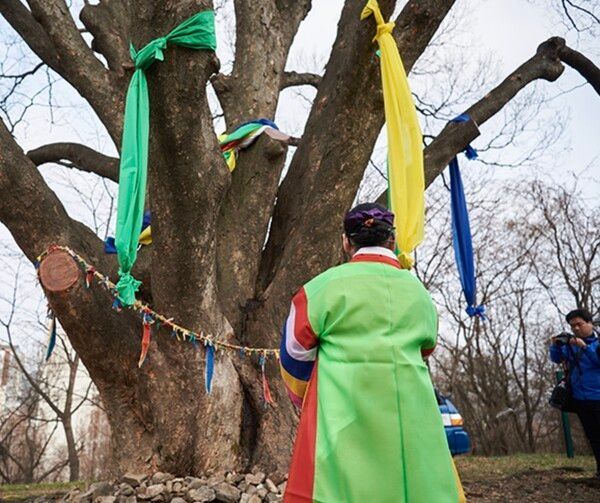
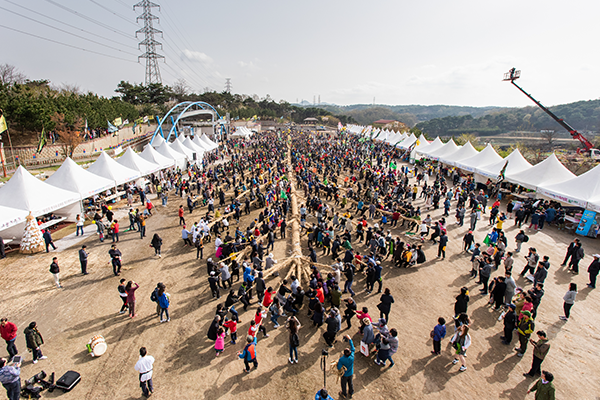
The event begins with a ritual at Guksu Peak. After prayers for peace and a good harvest, the village divides into two groups to make separate ropes. The upstream side forms the male rope, while the downstream side forms the female rope. The completed ropes are moved to an open field, where the tug-of-war takes place. The movement of the rope is often likened to a dragon twisting its body.
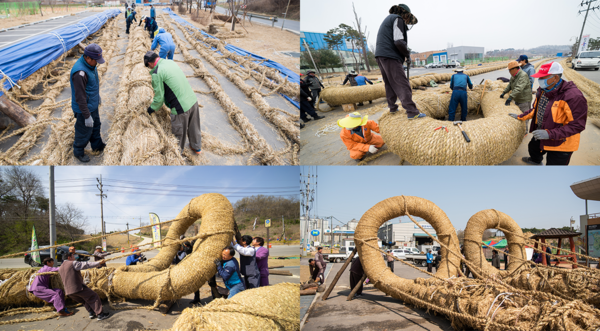
The scale of the rope itself is extraordinary. Measuring about 200 meters in length and 1 meter in diameter, it is made by weaving thousands of bundles of rice straw. It is so thick that even when people stand on it, their feet do not touch the ground. In Dangjin, around 20 people have been working daily since February, using some 6,000 bundles of straw to produce the ropes for this year’s event, including the head ropes, side ropes, and smaller strands used as handles.
Once the tug-of-war begins, villagers and visitors join together regardless of age, status, or origin. While there is a winning side, the essence lies in the collective act of pulling together. The sense of unity formed through this process is considered the core of the event.
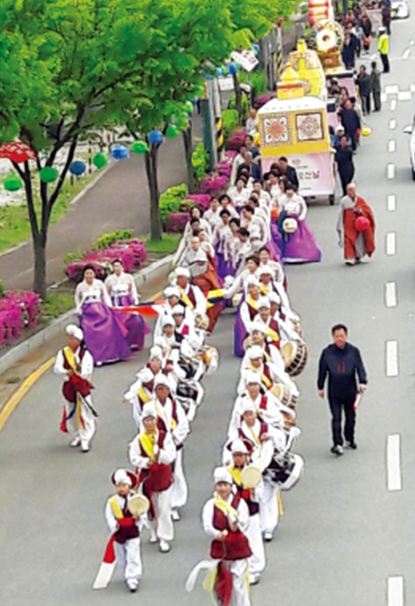
The event also features traditional Dangjin farming music. Based on dure nongak, it belongs to the Utdari pungmul style, characterized by percussion instruments such as kkwaenggwari, jing, buk, and janggu, along with the rhythmic pattern known as “chilchae.” Its shifting tempo and structured rhythm guide both the flow of the tug-of-war and the atmosphere of the site.
After the tug-of-war, a custom of cutting and sharing pieces of the rope continues. People take them home or boil them, believing they bring health and good fortune. This reflects how the tradition blends daily life with belief.
Originating as a folk tradition, Gijisi Tug-of-War was later designated as a National Intangible Cultural Heritage and, in 2015, was inscribed on UNESCO’s Representative List of the Intangible Cultural Heritage of Humanity alongside similar traditions from other countries. Its value lies in its role as a communal ritual for peace and prosperity.
This year’s festival will be held from April 9 to 12 around the Gijisi Tug-of-War Museum, featuring rituals, an opening ceremony, performances, international tug-of-war demonstrations, traditional games, hands-on programs, and various competitions. Gu Eun-mo, head of the preservation society, said, “The rope-making process is progressing as planned through cooperation and support, and we hope many people will experience the appeal of Gijisi Tug-of-War through the festival.”
Reported by News Culture M.J._mj94070777@nc.press
Copyright ⓒ 뉴스컬처 무단 전재 및 재배포 금지


